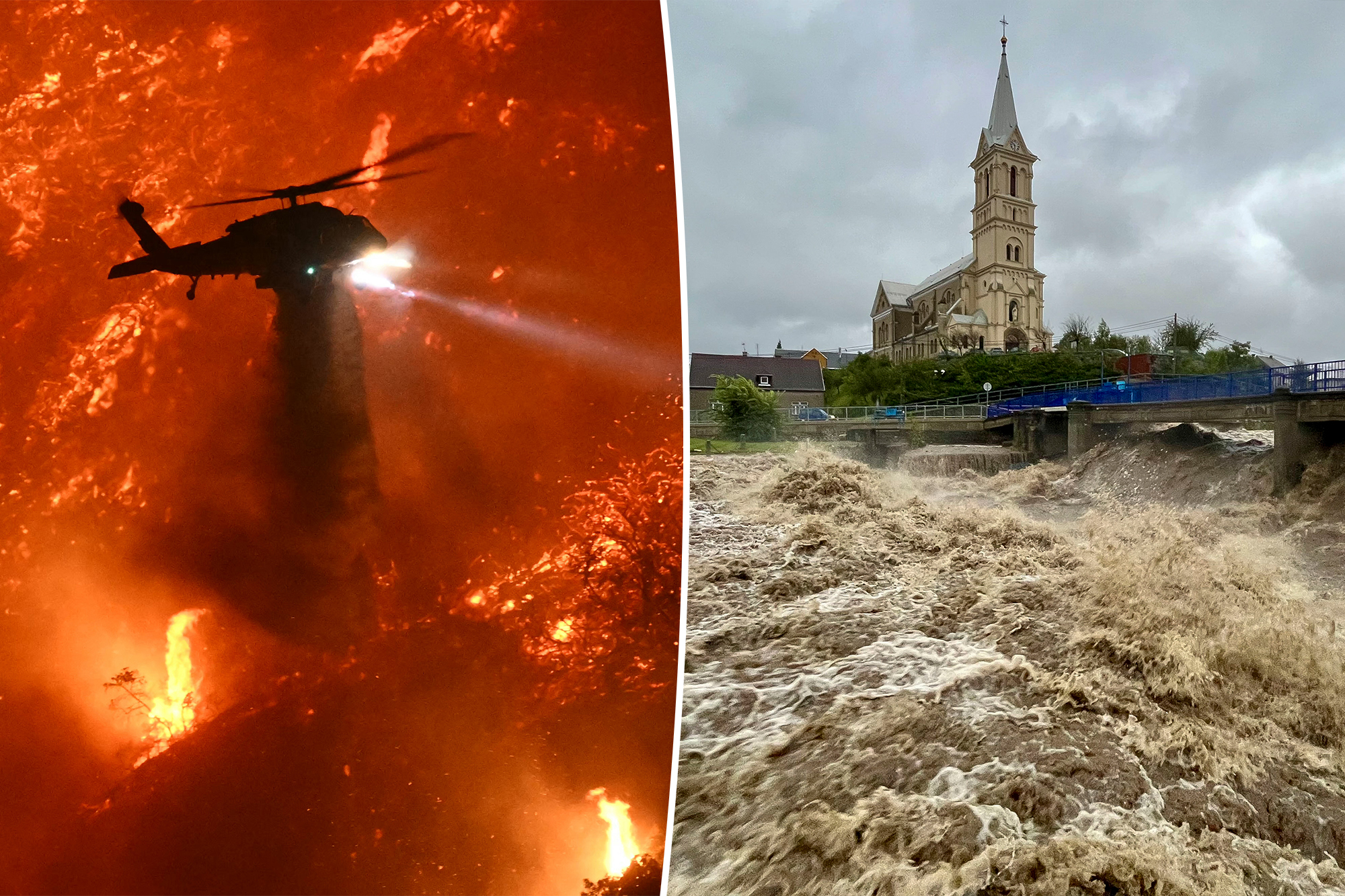
A torrent of water flows along the river Bela during heavy rain on September 14, 2024 in Mikulovice, Czech Republic. Getty Images This forecast does not look good.
Archaeologists might need to locate Noah’s lost ark sooner than we think.
By 2085, over a third of all land animals’ habitats could be adversely impacted by extreme weather events such as fires and floods, should temperatures continue to surge worldwide, per an alarming study in the journal Nature Ecology and Evolution.
If we don’t reverse course, this “Day After Tomorrow”-esque confluence of events could potentially expedite extinctions.
“I think climate change, and in particular extreme events, are still really being underestimated when it comes to conservation planning,” declared head author Stefanie Heinicke, a postdoctoral researcher at the Potsdam Institute for Climate Impact Research (PIK), Phys.org reported. “It’s not just going to be a gradual shift of temperature over many years.”
Heinicke was part of a team of 18 international researchers who set out to gauge climate changes affect on global biodiversity.
To determine its impact, these apocalyptic meteorologists used climate impact projections and species habitat data to predict “changes in exposure to droughts, heatwaves, river floods and wildfires” for ecosystems around the world.
These forecasts spanned a staggering “33,936 terrestrial vertebrate species and 794 ecoregions.”
The scientists found that if the warming continues at this rate, by 2050, 74% of current animal habitats on land will be exposed to heat waves, 16% to wildfire, 8% to droughts and 3% to river floods.
This Biblical phenomenon will effect essential biospheres in the Amazon basin, Africa and Southeast Asia.
And that’s just the tip of the iceberg. According to these models, “36% of the area within species’ ranges are projected to be exposed” to the aforementioned perfect storm in less than 60 years.
This method was groundbreaking in that it highlighted which weather events were the most harmful to wildlife with scientists finding that fires ranked more dangerous than droughts in this regard.
We don’t have too look to models to see how devastating the effects can be.
In 2019/2020, a heatwave in Australia killed more than 72,000 flying foxes while an estimated 17 million vertebrates perished in wildfires across South America’s Pantanal — the largest wetland in the world.
The damage is amplified when multiple extreme events follow each other, like the scenario in the study. Following the 2019–2020 Australian blazes, there were 27–40% greater declines in fauna and flora species in regions that had just experienced drought than in areas that had not.
Thankfully, scientists claim we can avoid this ecological armageddon by reducing our emissions to net zero. In fact, should the warming trend reverse in the latter part of the century, just 9% of the aforementioned habits would experience a confluence of said weather events by 2085, according to these projections.
However, more research is needed to narrow down the precise toll these weather events will have on wildlife.
“These findings highlight the need for further research into species’ sensitivity and adaptive capacity to extreme events, and for conservation strategies that address the impacts of multiple extreme events,” the authors wrote.