play Live Sign upShow navigation menuplay Live Click here to searchsearchSign upNews|MilitaryJapan builds up its ‘southern shield’ as faith in US security cover faltersJapan is pushing the legal limit of ‘defence’ as it faces its ‘most severe and complex security environment’ since 1945.
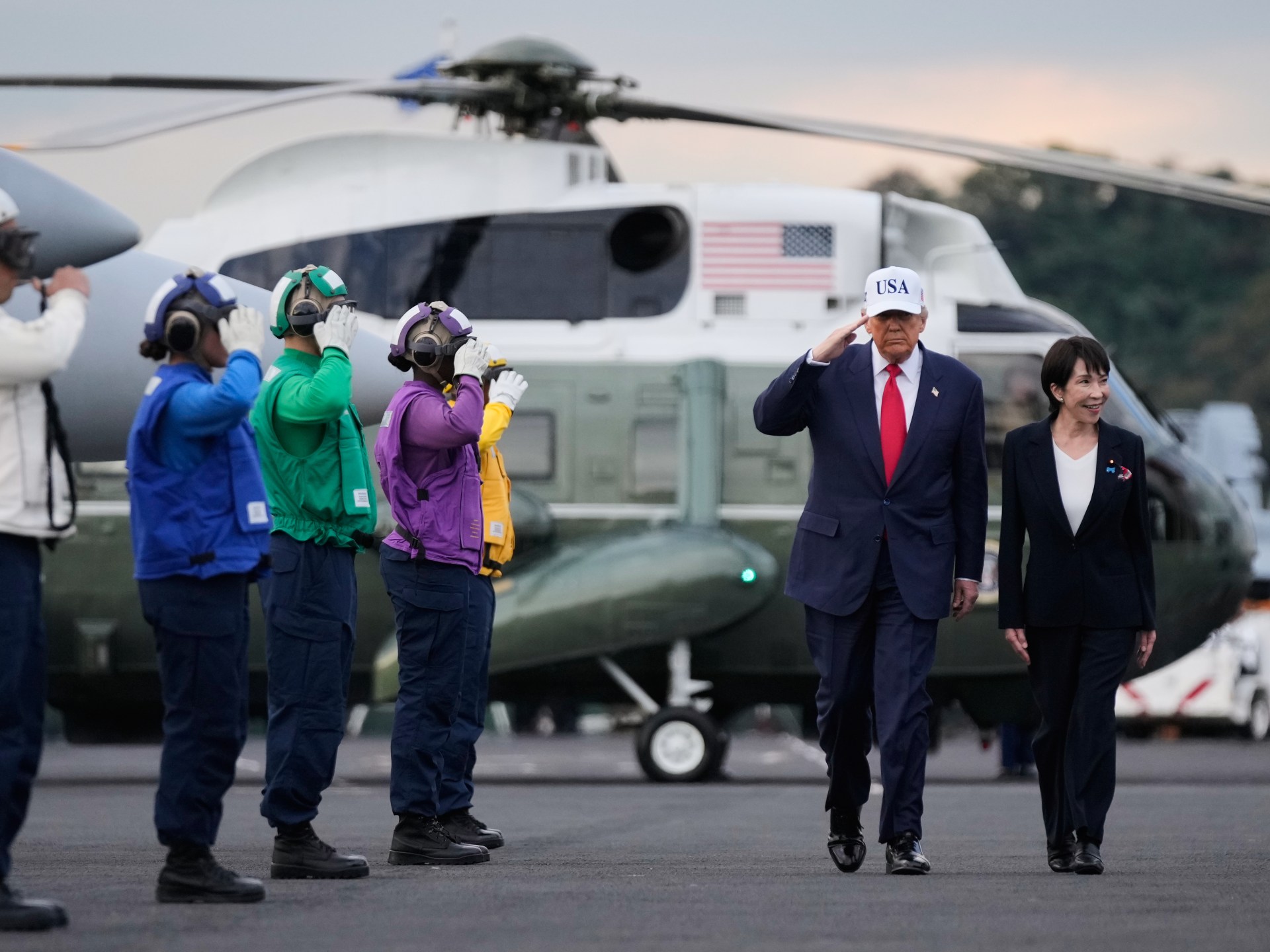
xwhatsapp-strokecopylinkgoogleAdd Al Jazeera on GoogleinfoUnited States President Donald Trump and Japanese Prime Minister Sanae Takaichi walk on the USS George Washington, an aircraft carrier docked at a US naval base, before speaking to members of the military in Yokosuka, south of Tokyo, on October 28, 2025 [Mark Schiefelbein/AP]By Erin HalePublished On 24 Apr 202624 Apr 2026Taipei, Taiwan — Japan’s southern island of Kyushu is known for its volcanic landscape and tonkatsu ramen, but the popular tourist destination is ground zero for one of the greatest shifts in Japan’s defence strategy since 1947, when it formally renounced the use of war to settle international disputes.
In late March, Japan deployed long-range missiles to Kumamoto Prefecture on the island’s southwest coast. Unlike previous defence installations, these missiles could hit China, reflecting the fact that Beijing has ranked as Japan’s top national security threat above North Korea and Russia since 2019.
Defence Minister Shinjiro Koizumi told reporters at the time that “Japan faces the most severe and complex security environment in the post-war era” and the country must strengthen its “deterrence and responsiveness”.
Known as the “southern shield,” the new front in Japan’s defence strategy has seen the Japan Self-Defense Forces (JSDF), as the country’s military is formally known, deploy a range of weapons platforms as well as electronic warfare and air assets in southern Japan and its southwest outlying islands.
“The balance is changing. The defence posture has completely shifted towards the southwest, so the north is much less prioritised,” Suzuki Kazuto, director of the Institute of Geoeconomics, an independent think tank in Tokyo, said.
Much of Japan’s growing defence budget, which hit a record $58bn for the fiscal year 2026, has been allocated towards this build-up, he said. The strategy focuses heavily on the Nansei or Ryukyu Islands, which run from Kyushu to within 100km (62 miles) of Taiwan.
These islands form a natural barrier dividing the East China Sea from the Philippine Sea, and are a critical part of the United States-led “First Island Chain” maritime defence strategy, which aims to keep Chinese forces out of the Pacific.
While the “First Island Chain” strategy has its roots in the Cold War, Tokyo is worried about increased Chinese military activity in the Asia Pacific, including the East China Sea and the Taiwan Strait.
The “southern shield” aims to create “anti-access or area-denial layers along the First Island Chain, complicating potential Chinese operations near Taiwan or in the East China Sea,” said Jonathan Ping, a political economist whose work focuses on statecraft at Australia’s Bond University.
It also incorporates a major shift in Japan’s defence policy towards acquiring “counterstrike capability” that would allow the JSDF to hit back if attacked, stretching the legal definition of what constitutes “self-defence”. These kinds of contradictions define the modern JSDF, which is a military in all but name and ranks alongside South Korea and France in the 2026 Global Firepower Index.
The JSDF emerged from Japan’s post-war police, at a time when Japan was reckoning with the Imperial Army’s brutal wartime atrocities during the US occupation, according to Soyoung Kim, an assistant professor who researches Japan’s post-war security policy at Nagoya University.
JSDF members are legally classified as “special national government employees,” and until the end of the Cold War, focused largely on humanitarian and disaster relief. Their role began to change after the Gulf War, when Japanese politicians felt humiliated by their inability to offer military support to the US-led coalition, Kim said.
In the decades since, public attitudes about the role of the JSDF have begun to shift, Kim said, amid Japan’s ongoing territorial dispute with China over the Senkaku or Diaoyu Islands. The Japanese public also regularly receives alerts each time North Korea test-fires a missile, as a reminder that Pyongyang still poses a major threat to Japan.
“There is increasingly greater acceptance or perhaps resignation to greater mission capability of the SDF,” Kim told Al Jazeera.
Over the past decade, the Japanese government has slowly moved the needle on what the JSDF can legally do, starting with a 2014 constitutional ruling that found Japan could participate in the “collective self-defence” of its allies.
“Japan has largely avoided formal amendments, choosing instead to ‘reinterpret’ the text. This makes Japan unique not just for its pacifism, but for the ‘legal gymnastics’ required to maintain a modern military under a constitution that explicitly forbids one,” said Taniguchi Tomohiko, who served as a special adviser to the cabinet of Prime Minister Shinzo Abe.
In 2022, Japan’s national security strategy was expanded to include “counterstrike capabilities,” which means it can hit back if attacked. As part of this strategy, Japan is due to acquire 400 US-made Tomahawk missiles, which can be launched from submarines and naval vessels.
Tokyo will release the next phase of its national security strategy later this year, covering 2026 to 2030. The document is expected to incorporate lessons from Ukraine and Iran about drones and supply chain chokepoints, according to Suzuki at the Institute of Geoeconomics. In its latest legal backflip, Japan separately approved the export of lethal weapons this month as it moves to build up a domestic drone industry.
While some of these changes are a response to the rise of neighbouring China, they also reflect growing concern in Tokyo about its longtime ally, the US, and its ability or willingness to defend its allies, say analysts.
Japan has historically fallen under the protection of Washington’s nuclear umbrella, but China’s rapid military and nuclear expansion has “reduced the credibility of the US extended deterrence,” according to Kei Koga, an expert in East Asian security and the US-Japan alliance, at Nanyang Technological University in Singapore.
“Japan wants to play a more kind of active role to compensate for the relative gains of China,” he said, which includes a second-strike nuclear capability – the ability to retaliate after a nuclear attack. China’s close ties to Russia and North Korea have raised the stakes further, he said.
Japanese politicians are also worried about the long-running question of whether a conflict will break out over Taiwan, a self-ruled democracy of 23 million people. China claims Taiwan as a province and has pledged to annex it by peace or by force.
US military assessments state it will likely be capable of doing so by next year. Japanese Prime Minister Sanae Takaichi said in December that a Taiwan conflict could prove to be a “survival-threatening situation” for Japan, which hosts multiple US military bases.
Some of Japan’s outlying islands also lie closer to Taiwan than the Japanese mainland. And under US President Donald Trump, many of the longstanding assumptions about the US commitment to defend allies like Japan are changing.
Whether Trump would intervene to help Taiwan is even less certain. Washington does not formally recognise Taipei, although it has pledged to help Taiwan defend itself under the 1979 Taiwan Relations Act. Known as “strategic ambiguity,” the policy stops short of committing US forces, but it has long been seen as a credible enough threat to deter China from moving on the much smaller island.
Trump’s shift towards an “America First” policy and combative relationship with longtime allies in Europe has worried Japan. A 2025 survey by Japan’s Asahi Shimbun indicated that 77 percent of respondents doubt that the US would protect Japan in a military crisis.
“Everything is focused on the American interest and American defence, so defending other countries is not the priority,” Suzuki told Al Jazeera.
Growing US scepticism in Japan has pushed Tokyo to shore up alliances with other US allies like the Philippines and Australia, while also dimming some of the public criticism about Japan’s military build-up.
“For many years, the opposition assumed that the United States would come and rescue Japan, and therefore we don’t need to have more than self-defence,” Suzuki said. “Increasingly, people are realising this assumption is too optimistic, and we need to have at least the minimum capability to have deterrence and counterstrike capability.”