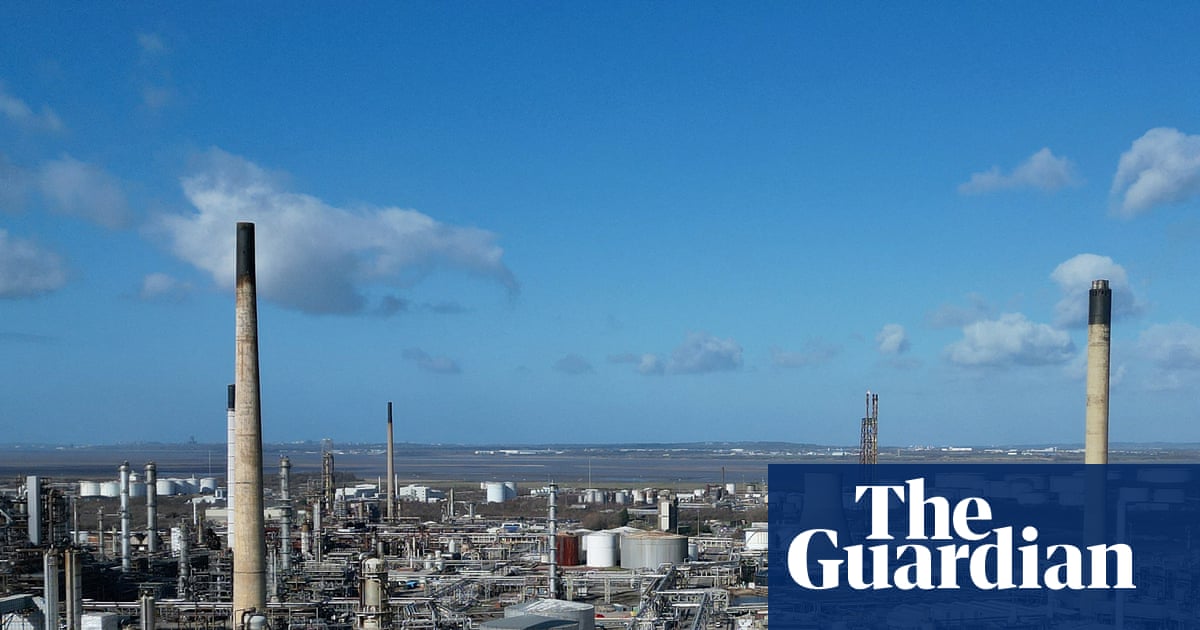
Essar bought the Stanlow refinery in Cheshire in 2011. Photograph: Paul Ellis/AFP/Getty ImagesView image in fullscreenEssar bought the Stanlow refinery in Cheshire in 2011. Photograph: Paul Ellis/AFP/Getty ImagesRevealed: UK oil refinery owner moved Russian loans to offshore subsidiary where sanctions did not applyMPs call for investigation into Essar Energy, owner of Stanlow refinery, which shifted loans from ‘Putin’s piggy bank’ VTB to Mauritius
Days after the first wave of Russian tanks surged over the border into Ukraine in March 2022, dockers at a port in northern England took a stand.
Appalled by Vladimir Putin’s brutality, workers at Ellesmere Port in Cheshire vowed never to unload any Russian oil destined for the nearby Stanlow refinery, a major hub for UK fuel supplies.
As the spotlight fell on Essar, the Indian-owned conglomerate that is Stanlow’s parent company, it also acted fast, ceasing all imports of Russian fuel.
But analysis of the Essar group’s company accounts by the Guardian and SourceMaterial, an investigative journalism organisation, raises questions about whether the flow of money was staunched as swiftly as the flow of oil.
In the months after the invasion, Essar entered into complex offshore arrangements that appear to have enabled the group to keep dealing with a Russian bank under sanctions from the west.
Essar shifted billions of dollars in loans, provided by the Kremlin-controlled lender VTB, from Cyprus to a subsidiary in the tax haven of Mauritius, where sanctions did not apply.
The Cyprus and Mauritius entities that took part in the transfer included subsidiaries of Essar’s UK arm, Essar Energy.
Essar said that UK sanctions law did not apply to the transaction and that it complied with all applicable sanctions law after taking advice from a leading law firm. But the restructuring “raises red flags in relation to possible [sanctions] circumvention”, according to a leading expert.
Authorities in Cyprus, whose government approved the transfer, are examining whether Essar has done anything that would “constitute a violation of EU sanctions regulations”.
Now experts and MPs say British authorities should consider following suit.
View image in fullscreenVladimir Putin with Narendra Modi at the Kremlin in Moscow in July 2024. Photograph: Sergei Bobylyov/Sputnik/Kremlin pool/EPAEven as much of the world turned its back on Russia after its 2022 assault on Ukraine, India maintained cordial ties.
In July 2024, Putin presented India’s prime minister, Narendra Modi, with Russia’s highest honour, the Order of St Andrew the Apostle.
The two nations’ friendship had been forged partly by blockbuster energy deals, including with Essar, owned by the billionaire Ruia brothers.
In 2014, the year Putin’s forces seized Crimea from Ukraine, Essar group borrowed $1bn (£740bn) from the state-owned lender VTB.
Then, in 2017, the Russian state oil company, Rosneft, invested $13bn in the group’s refineries business, Essar Oil, a pivotal player in India’s growing thirst for oil and gas.
Essar’s financial relationships extended westwards, too.
In 2010, seeking greater access to global investors, the group had listed Essar Energy on the London Stock Exchange. A year later, it bought Stanlow, the Cheshire refinery that fuels one in six British vehicles and nine airports, for $1.3bn.
But even before the coronavirus pandemic choked off demand for Stanlow’s fuel, Essar Energy began posting heavy losses.
As Essar sought stability, it tapped Russian credit lines again. By 2020, its debt to VTB had risen to €2.35bn (£2bn).
The loans were housed in two Cypriot companies, with UK-based Essar Energy as guarantor, according to Companies House filings.
But before long, as geopolitical tension brought Essar’s Russian and British ties into conflict, the loans transformed from a lifeline to a logistical and reputational headache.
View image in fullscreenPutin speaking at the 16th VTB Investment Forum, named Russia Calling!, in Moscow, in December 2025. Photograph: Sergei Ilnitsky/EPAPutin’s February 2022 attack on Ukraine changed everything. Russia became a pariah state, and VTB and its chief, Andrey Kostin, were targeted by international sanctions.
Essar’s UK arm was just one of many British companies with Russian business interests to be ensnared by the conflict.
Typically, UK businesses with financial obligations to companies under sanctions seek a permit from the UK’s Office for Financial Sanctions Implementation (OFSI) to honour their debts while the relationship is unwound.
Shortly after sanctions came into force, Essar duly reported in its accounts in April 2022 that “payments to VTB loans can only be made after having obtained a special licence from the UK government”.
When approached by the Guardian, Essar said the note had reflected broader sanctions advice on what would be required to make certain payments, not any expectation that it would require OFSI’s approval. It added that UK sanctions law did not apply to the relevant transaction.
In the end, Essar never sought the OFSI’s blessing. Instead, it sought and received approval from the government of Cyprus to move the loans more than 4,000 miles to Mauritius, in the Indian Ocean, where Russian sanctions did not apply.
The resulting loan termination agreement was signed by two subsidiaries of Essar’s UK arm, Essar Energy Limited, authorised as “obligors’ agents” to act on its behalf.
Leading sanctions experts said the transfer should be investigated by the UK authorities.
The arrangement was “unusual”, said Michael Ruck, a sanctions expert and partner at the law firm K&L Gates. He said the restructuring “raises red flags in relation to potential sanctions circumvention”.
Another sanctions lawyer, who asked not to be named, said the fact that Essar Energy Limited’s subsidiaries signed the agreement on its behalf could expose it to liability.
Liam Byrne, who chairs the business select committee, which is looking into the efficacy of sanctions, called on the UK authorities to review the transaction.
He said: “VTB is not just another bank. It is an arm of the Russian state helping finance a war of aggression against Ukraine. That is why it is sanctioned. And that is why any UK business should not go anywhere near it, directly or indirectly.
“So the next steps for government are very simple. Investigate. Now.”
Essar directed questions to its lawyers, who said it had taken “responsible and proactive steps, on the basis of expert legal advice, to ensure full compliance with the UK, EU and any other applicable sanctions”.
Arrangements surrounding the loan transfers had been “expressly approved by the Cypriot authorities” following advice from a leading law firm, and any suggestions of “red flags” or circumvention were “without foundation”, the lawyers said.
The island-hop to Mauritius appears to have done little to distance Essar from VTB, nicknamed “Putin’s piggy bank”. Essar may even have deepened its dependency on Russian loans following the Mauritius move, corporate filings suggest.
Following the move, Essar appears to have “enhanced” its VTB borrowing by $1.2bn, according to accounts for its main UK subsidiary.
The group’s lawyers said that the “enhancement” reflected accrued interest rather than new borrowing, adding that any suggestion that Essar deepened ties with VTB was “false” and that the company was repaying the loans in a “sanctions-compliant manner”.
But two forensic accountants from leading UK firms who reviewed Essar’s latest accounts identified new rouble exposure equivalent to at least $1bn that they believed could not be explained by accrued interest.
“Essar’s accounts as filed don’t make sense unless there was new borrowing from Russia,” said Rachel Sexton, an independent forensic accountant.
In the year after the move, Essar’s Cyprus subsidiary paid $39m to the Mauritius company. After this partial payment, the Cypriot company still owed its Mauritian counterpart half a billion dollars as of March 2024.
Lawyers for Essar said that a $39m payment was made in accordance with an “intercompany liability” and that none of the funds were used by the Mauritius subsidiary for payments to VTB, directly or indirectly. There was “no breach of the permission granted by the Cypriot authorities”, they said.
A spokesperson for the Cypriot government said: “The approval did not authorise any loan repayments to VTB, whether directly or indirectly, including via third-country jurisdictions such as Mauritius. On the contrary, the approval was explicitly conditional upon no funds being made available, directly or indirectly, to VTB.”
View image in fullscreenThe north Mauritian coast. Photograph: travelib/AlamyMeanwhile, Essar has built a presence on the ground in Russia. In 2023 it set up a new company in Moscow with offices in the Moscow Federation Tower, a boat-shaped skyscraper that is also home to the headquarters of VTB Capital.
Essar’s lawyers said that the only purpose of the Moscow subsidiary, owned via Hong Kong, was to manage the VTB loans as the group wound it down.
One Moscow employee does not appear to have understood this. In an online interview published in March 2024, he said that one of his duties was to “identify investment opportunities”.
Essar’s continuing relationship with VTB is now a worry for the government of Cyprus, which has long been a haven for Russian money, but joined the rest of the EU in imposing sanctions on the Kremlin and its allies.
Authorities in Cyprus, whose government approved the transfer of $3bn in loans to Mauritius, are examining whether Essar’s transactions with VTB following the move “constitute a violation of EU sanctions regulations”, a spokesperson for the country’s finance ministry said.
Essar said it was unaware of any inquiry and that the group’s Cypriot lawyers had confirmed that there had been no breach of Cypriot or EU sanctions regulations.
The group’s manoeuvres also appear to have caused disquiet in Mauritius.
After transferring its Russian loans to the tax haven, Essar in September 2022 asked authorities there to approve a restructuring to “delink” its Mauritian business from the UK.
It took three years for Mauritius to approve the changes.
Essar’s lawyers said that the “delinking” was part of a wider company reorganisation that was unrelated to any sanctions issues. Asked about the delay, they blamed Mauritian authorities, citing administrative reasons.
But a Mauritian government spokesperson said the hold-up had been caused by Essar’s failure to supply evidence about the nature of its ties to Russia.
Essar had not handed over key documents, including evidence relating to “creation of security [loan by Russian bank]” and provided a shareholder structure that “doesn’t match with names of shareholders as per letter of incumbency”, they said.
The UK government should now apply the same critical eye applied by the authorities in Cyprus and Mauritius, said Lloyd Hatton, an MP and member of a cross-parliamentary group examining corruption.
The relationship, he said, was “very alarming. The authorities must now investigate Essar and their potential dealings with this Russian bank.”