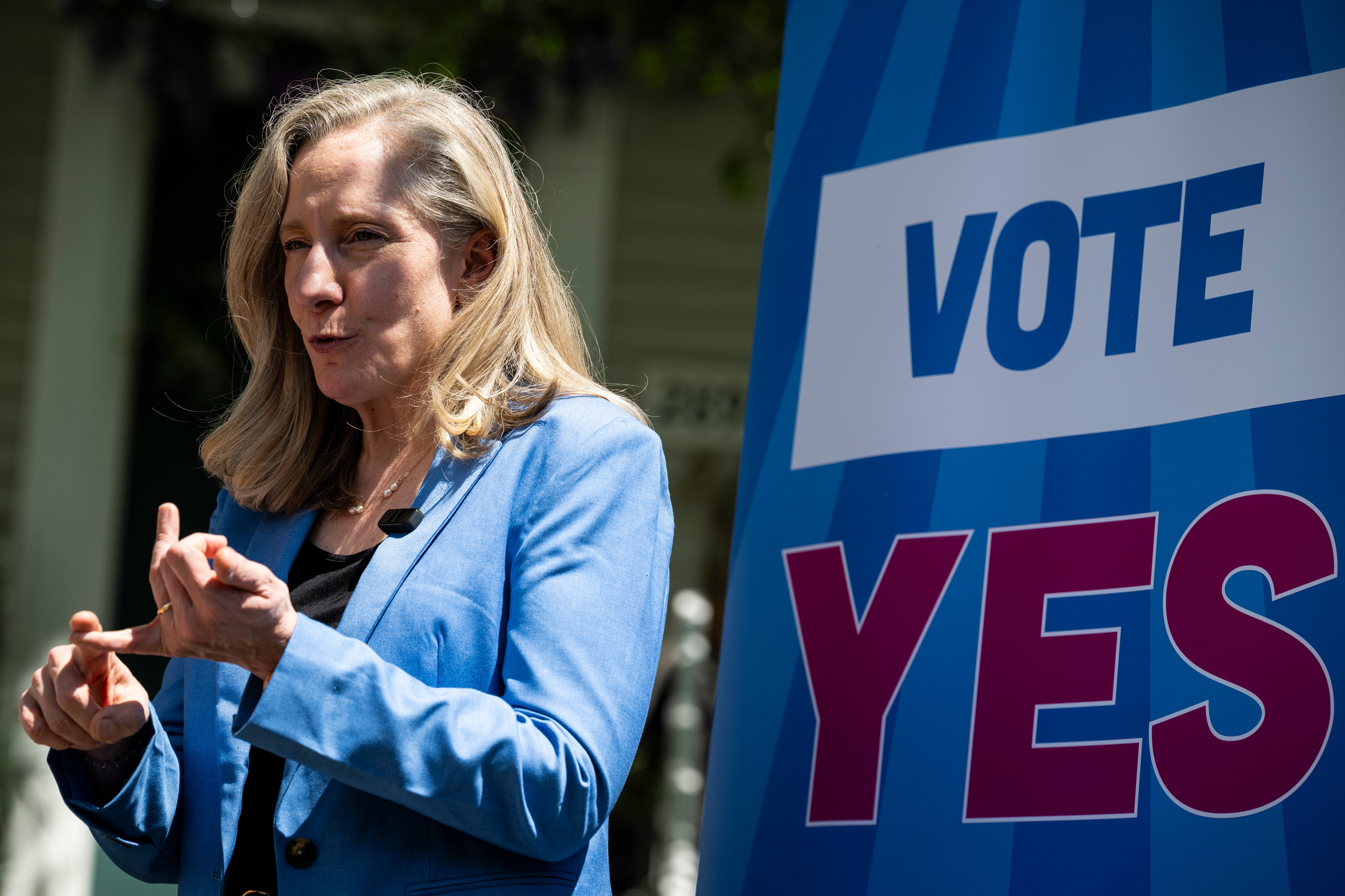
Abigail Spanberger, governor of Virginia, speaks during a "Virginians For Fair Elections" canvassing event in Woodbridge, Virginia, US, on Saturday, April 18, 2026. Bloomberg via Getty Images During the national debates of 1788, the great Virginian James Madison worried that mere “parchment barriers,” or constitutions, wouldn’t be enough to stop an “overbearing majority” from seeking power and stripping minorities of their voice and rights.
What he envisioned, in other words, was someone like Abigail Spanberger.
Virginia’s current governor recently signed a bill making her state the 18th to join the National Popular Vote Interstate Compact, a scheme to circumvent the Constitution and award all electoral votes to the presidential ticket with the highest national vote total — rather than to the candidate who won the state’s election.
Democrats spend a lot of their time accusing Republicans of denying minorities a vote.
Virginia Democrats, already pushing the most radical gerrymandering in US history, now propose handing the votes of all Virginians to other states with dissimilar, sometimes conflicting, interests.
How would Virginians feel if their electors ignored their votes to follow states that legalized the illegal immigrant vote or didn’t require voter ID?
Because nationalizing elections means nationalizing the corruption and voting problems of other states.
One of the most fruitless tasks in contemporary politics is championing countermajoritarian institutions.
It’s not a surprise that the Electoral College, which tempers some of the excesses of democracy, isn’t popular — especially among Democrats who’d like to silence massive swaths of the country.
How many people understand that, despite its elevated place in our vernacular and thinking, a “popular vote” isn’t a real thing?
Winning the overall vote is like tallying the most hits rather than winning the most games in a World Series.
Even that analogy exaggerates its significance, because the presidential “popular vote” represents the gross totals of a contest that isn’t being played.
Presidential tickets, after all, focus on appealing to voters in 51 separate elections.
If presidential candidates concentrated on big, untapped reserves of voters in major states, the “popular vote” would look very different — and not in a healthy way.
The current congressional map in Virginia has four GOP-controlled seats. Social Good Fund for Dave's Redistricting Forty states, for example, have smaller populations than Los Angeles County.
A “democracy”-loving left-winger majoritarian must therefore believe that Los Angeles voters should have a bigger say than those 40 states.
Too many Americans have been programmed to believe that voting is not only the pinnacle of civic duty, but also of power.
Otherwise, they will argue, the country is experiencing “minority rule.”
But no one with even a passing knowledge of US history believes that’s what the framers envisioned.
Democrats have also convinced half the country that the Electoral College’s undercutting of the popular vote is an antiquated quirk of the Constitution.
The Electoral College compels national candidates to moderate their views, create coalitions and appeal to voters in disparate areas who have disparate interests and needs.
In this way, a diffused election generates stability.
The proposed Virginia congressional map has just one competitive district for Republicans. Social Good Fund for Dave's Redistricting Anyway, we are inching closer to a true constitutional crisis.
The member states of the compact don’t have to send their votes to the “popular vote” winner until the coalition reaches an Electoral College majority of 270.
How would the Supreme Court rule if the member states stole an election?
The Constitution explicitly rejects the notion of direct popular vote for the president.
The Founders debated numerous other processes, mechanisms and ideas for electing a president, and landed on this compromise.
States have leeway in how they run their own elections.
By creating a de facto direct democracy, the compact threatens not only to compel state electors to cast votes against candidates that voters have chosen, but also to deny the country the ability to run a presidential election using the constitutional design of the framers.
Moreover, there’s already a prescription in place to change the process: It’s called a constitutional amendment.
It’s difficult to pass one? Yeah, and that’s deliberate as well.
We are heading into third-world direct democracy territory, with threats against the legislative filibuster — seemingly on its last legs — and the Electoral College.
A significant number of progressive groups also want to pack the Supreme Court and lament the undemocratic nature of two-seat Senate representation.
Any elected official who signs this compact is literally abandoning his or her constitutional duty.
Then again, in the end, the Constitution is only as good as the people.
And that doesn’t bode well for its survival these days.
David Harsanyi is a senior writer at the Washington Examiner. X: @davidharsanyi