Video NTSB timeline raises more questions in deadly LaGuardia crash New NTSB details are fueling questions after an Air Canada jet struck a fire truck at LaGuardia, with aviation expert Mike Coffield pointing to a chain of failures and curfew pressure.
A new federal report reveals that multiple layers of safety failed in the seconds before a deadly runway collision last month at New York’s LaGuardia Airport, including air traffic control decisions, communication breakdowns and technology limitations.
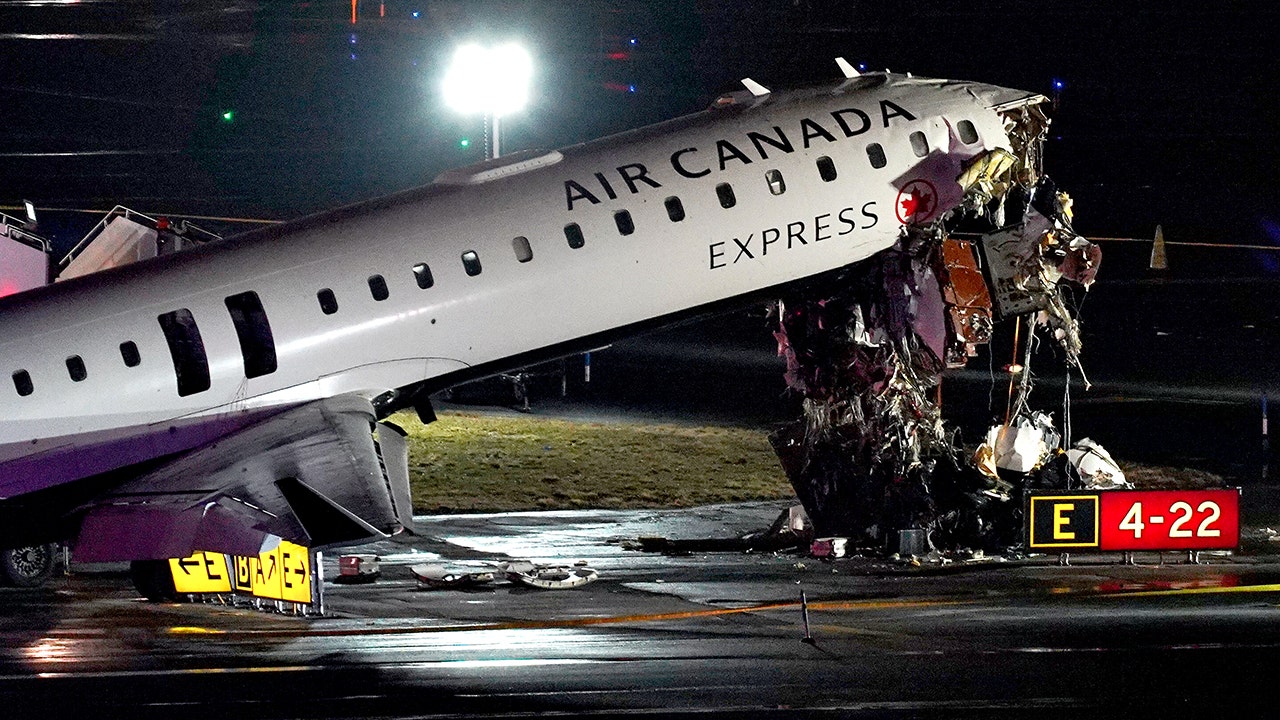
On March 22, at about 11:37 p.m., Jazz Aviation Flight 646, operating as Air Canada Flight 8646, collided with an airport rescue vehicle while landing at LaGuardia Airport in New York City, killing both pilots and injuring dozens of others, according to the report.
The National Transportation Safety Board’s (NTSB) preliminary report released Thursday found that an air traffic control tower’s local controller, referred to in the report as the "LC," cleared an airport rescue vehicle to cross an active runway even as a regional jet was on very short final approach.
At the time, the plane was about a quarter-mile from the runway and roughly 130 feet above the ground as it descended toward landing.
PLANE CRASHES SPARK RENEWED FEAR OF FLYING: 10 CAUSES OF AVIATION DISASTERS
An Air Canada jet sits on the runway at LaGuardia Airport in New York, March 23, after colliding with a Port Authority aircraft rescue and firefighting vehicle following landing. (Ryan Murphy/AP)
Seconds later, the controller instructed the vehicle to stop, but the warning came too late as the aircraft touched down and continued down the runway.
Investigators pointed to confusion over radio communications that may have delayed the truck crew’s response.
"The turret operator in Truck 1 recalled hearing the words ‘stop stop stop’ (on the tower frequency) radio, but he did not know who that transmission was intended for," the report read. "He subsequently heard ‘Truck 1 stop stop stop’ and realized it was for them and subsequently noticed that they had entered the runway."
DELTA PLANE ABORTS TAKEOFF IN MEXICO CITY AFTER PLANE NEARLY LANDS ON TOP OF AIRCRAFT
"He further recalled that as they turned left, he saw the airplane’s lights on the runway," the report added.
There were two controllers on duty at the time of the crash, consistent with normal staffing levels, and both were experienced and qualified for their positions.
But the tower was handling multiple issues simultaneously, including an aircraft that had performed two rejected takeoffs and a separate ground emergency near a terminal.
As the situation unfolded, the "LC" took over transmitting instructions on both ground and tower frequencies.
The report also highlights significant limitations in the airport’s safety systems.
AMERICAN AIRLINES PLANE THAT CAUGHT FIRE HAD ENGINE PARTS INSTALLED INCORRECTLY, NTSB FINDS
The view from the LaGuardia Airport control tower shows Runway 4, Taxiway D, and the crash site where a regional jet collided with an airport rescue vehicle, as displayed alongside ASDE-X monitoring screens. (National Transportation and Safety Board Report)
The airport’s surface detection system, known as ASDE-X, is designed to track aircraft and ground vehicles and alert controllers to potential runway conflicts.
"Multiple ground vehicles, none of which were equipped with transponders, were intermittently detected as radar targets," the report read. "At the time of the accident, ASDE-X displayed only two radar targets on taxiway D (near taxiway BB), rather than all seven of the response vehicles as distinct targets at their respective locations."
"A review of the ASDE-X system data by the FAA determined that the system did not generate an aural or visual alert on the ASDE-X displays in the LGA ATC tower to warn controllers of the potential runway conflict," the report noted.
The NTSB also found that another layer of protection failed to prevent the crash.
TRUMP SAYS REAGAN NATIONAL AIRPORT CRASH COULD HAVE BEEN PREVENTED: 'CLEAR NIGHT'
An Air Canada Express plane with a severed cockpit rests on a runway next to a damaged Port Authority fire truck at LaGuardia Airport in New York, after the two collided. (Seth Wenig/AP)
Runway entrance lights, known as RELs, are designed to warn vehicles not to cross when an aircraft is approaching.
"A review of airport surveillance video recordings revealed that the RELs illuminated for the arrival of the accident airplane, as Truck 1 and company were stationary in the vicinity of the taxiway AA and taxiway D intersection," the report read, noting the trucks were located about 300 feet away from runway 4. "The RELs on taxiway D remained illuminated until about the time Truck 1 reached the (near) edge of runway, when they extinguished, about 3 seconds prior to the collision."
The report does not indicate whether the truck crew saw or reacted to the warning lights.
Taken together, investigators suggest the crash was not caused by a single error, but by a breakdown across multiple safeguards — including human decision-making, communication clarity and technological support systems.
The collision killed both pilots aboard the aircraft and injured dozens of passengers and emergency responders.
REAGAN NATIONAL AIRPORT HAS BOTHERED LAWMAKERS FOR YEARS, BUT QUICK ACCESS TO POWER HAS STALLED CHANGE
Travelers look for rides after an Air Canada Express plane collided with a fire truck on the tarmac, closing LaGuardia Airport in New York City. (Spencer Platt/Getty Images)
The report describes a chaotic but ultimately orderly evacuation following the crash.
"The aft flight attendant reported getting in the aft jump seat for landing and described the flight as normal until he felt an impact and jar," the report read. "He did not know what had happened and attempted to call the pilots and received no response. He reported the conditions were dark, but passengers deplaned orderly through all exits."
Investigators said the debris field stretched roughly 300 feet long and 150 feet wide, and was documented using drone imaging, GPS mapping and laser scanning technology.
CLICK HERE TO DOWNLOAD THE FOX NEWS APP
The preliminary investigation also found that the most severe damage was concentrated in the front of the aircraft, with the cockpit and forward cabin sustaining significant structural destruction.
The report found that while the forward section was heavily crushed, the passenger cabin remained largely intact, with most seats still secured and only minor damage reported throughout much of the aircraft.
The NTSB said the information in the report is preliminary and subject to change.
Greg Wehner is a breaking news reporter for Fox News Digital.
Story tips and ideas can be sent to Greg.Wehner@Fox.com and on Twitter @GregWehner.
The hottest stories ripped from the headlines, from crime to courts, legal and scandal.
By entering your email and clicking the Subscribe button, you agree to the Fox News Privacy Policy and Terms of Use, and agree to receive content and promotional communications from Fox News. You understand that you can opt-out at any time.
You've successfully subscribed to this newsletter!