France and the UK are leading efforts to establish a multinational mission to safeguard shipping through the Strait of Hormuz. Questions remain about the scope of the operation and whether it can bring lasting stability.
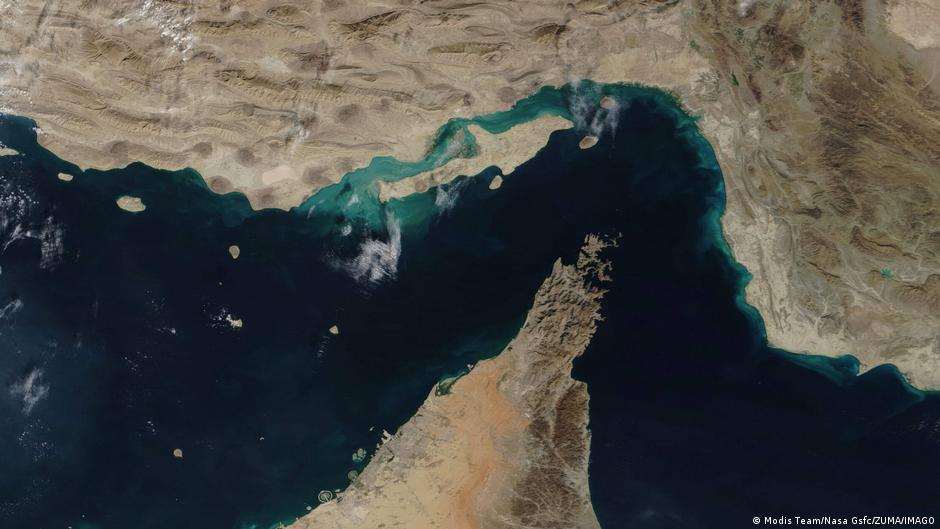
https://p.dw.com/p/5Ci6DThe US-Israeli war on Iran, which was launched on February 28, has wreaked havoc on global shippingImage: Modis Team/Nasa Gsfc/ZUMA/IMAGOAdvertisementEuropean powers are moving to establish a multinational naval mission to secure shipping in the Strait of Hormuz after fighting in the Iran war disrupted traffic through one of the world’s most critical trade routes.
At talks in London this week, military planners from 30 countries met to discuss how such an operation could work in practice and how commercial vessels could be protected.
At the heart of proposals by United Kingdom and France is a "strictly defensive" multinational naval operation — focused on protecting commercial vessels from attacks rather than targeting positions on land. The mission, the two countries say, would be deployed only after a negotiated end to hostilities between the United States and Iran.
According to Jürgen Ehle, a retired German rear admiral and former senior military adviser to the EU, such a mission would involve responding to attacks rather than engaging offensively. In practical terms, that means defending vessels targeted by missiles, drones or fast attack craft, rather than striking Iranian military infrastructure or troops on land.
Experts told DW the operation would likely require frigates or destroyers equipped with air defense systems, as well as mine-hunting drones — including unmanned systems — to detect and neutralize naval mines.
The European Three (E3) — consisting of Germany, France and the UK — are expected to shoulder much of the military burden. Germany has indicated it would be prepared to contribute mine clearance vessels and maritime reconnaissance, pending parliamentary approval. Chancellor Friedrich Merz emphasized the need for a clear legal mandate before any deployment.
France already has significant navel assets in the region, including eight warships, an aircraft carrier and two amphibious assault ships. President Emmanuel Macron said forces currently stationed in the eastern Mediterranean and Red Sea — including the aircraft carrier Charles de Gaulle — could be partially redirected to support the mission.
The UK’s contribution has yet to be specified. Prime Minister Keir Starmer said more than a dozen countries have expressed an interest in contributing assets but has not expressly stated what London would provide. While the UK has advanced destroyers; however, their "readiness and availability remain unclear," Bence Nemeth, a senior lecturer in defense studies at King’s College London, told DW.
Deploying naval assets to the Gulf could stretch European capabilities at a time of heightened tensions closer to home. Nemeth warns that Europe needs to balance threats from Russia, particularly in the Baltic Sea and North Atlantic. "Europeans first need their naval assets to keep themselves safe," Nemeth said, adding that "they can’t rely on the US as much as before."
Operational risks in the Gulf remain significant. Ehle noted that "air defense capabilities do not ensure 100% security," particularly against large-scale drone attacks.
Writing for the Royal United Services Institute (RUSI), David B. Roberts highlighted a "layered" threat environment, ranging from "slow, low-altitude loitering munitions at the lower end to fast-moving anti-ship missiles and contact mines at the higher [end.]"
Analysts broadly agree that naval deployments alone cannot secure the Strait of Hormuz. "Only a diplomatic settlement — one in which Iran makes a sovereign political decision to stand down — holds out the prospect of halting attacks entirely," Roberts said.
France and the UK are seeking to broaden the coalition beyond Europe, engaging countries such as India — which supplies around 10% of the world’s seafarers — and South Korea. The aim is to increase diplomatic leverage and the eventual resumption of commercial shipping.
Nemeth adds that "countries have different reasons for participating in these negotiations," the most common, he says, "are freedom of navigation, international law and energy security."
"These states do not want to normalize a situation in which a power can use force and geography to control a crucial maritime choke point," he said. "This would create a dangerous precedent for global trade."
As Europe works to build a coalition, countries including India, Pakistan and China are also pursuing bilateral arrangements with Tehran to maintain shipping flows, though volumes "remain marginal," Roberts wrote.
For now, Europe is preparing a limited defensive naval mission while pushing for a political solution. Whether enough countries will support this approach remains unclear.