Analysts say the war in Iran has temporarily delayed an escalation in smoldering tensions between Ethiopia and Eritrea. But renewed armed conflict cannot be ruled out.
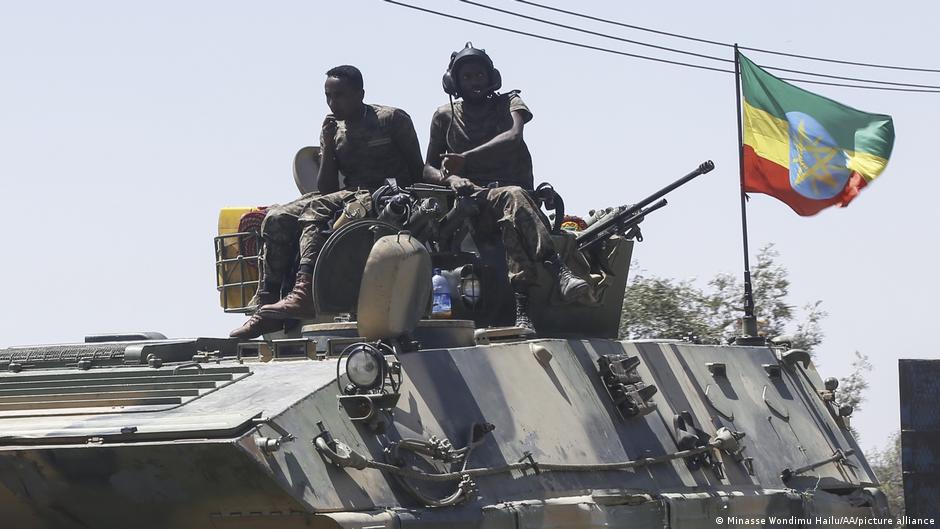
https://p.dw.com/p/5CfRBEthiopia's civil war ended in 2022, but tensions remain between the central government, Tigrayan regional forces, and neighboring Eritrea Image: Minasse Wondimu Hailu/AA/picture alliance AdvertisementThe political situation in the Horn of Africa continues to be dominated by tensions between Ethiopia and Eritrea. Ethiopia's Prime Minister Abiy Ahmed leaves little doubt about this: During a television appearance earlier this week, he emphasized that it is "not feasible at any time" to continue viewing Ethiopia as a landlocked country.
The country lost its access to the Red Sea when Eritrea gained independence in 1993 after decades of war. Initially, an agreement allowed Ethiopia to import goods duty-free through the port of Assab.
But a renewed border conflict in the late 1990s ended this arrangement. Today, a large portion of Ethiopia's trade passes through Djibouti — a costly undertaking for the landlocked nation.
Abiy Ahmed wants to reduce this dependence, according to political analyst Abduraham Sayed.
"The reason he is pushing for this right now is not because there is no access to the Red Sea or to ports near Ethiopia," he tells DW. While access is already possible via neighboring Djibouti and Somalia, Abiy Ahmed wants direct, Ethiopian control, which coastal states are resisting, Sayed says.
The 2018 peace agreement between Ethiopia and Eritrea would have offered a good opportunity. On this basis, Sayed says, Ethiopia could have secured easy access to the sea with some guarantees for sustainability and security.
The peace efforts earned Abiy the Nobel Peace Prize in 2019 — now the signs point once again toward confrontation with the neighboring country.
Sayed suspects Ethiopia's push for access to the sea "is heavily driven by external interests outside the Horn of Africa region, and that the Ethiopian government is merely implementing these interests as part of its own agenda. Otherwise, access would have been secured back then."
He is referring to Ethiopia's geostrategic partners, primarily the United Arab Emirates.
But the UAE is under pressure: "Due to the conflicts in the Persian Gulf, the UAE will sooner or later be forced to reduce their presence and involvement in the Horn of Africa to focus on the problems in their own country."
This means Ethiopia can expect less support in the event of a potential war against Eritrea.
Prime Minister Abiy has been demanding separate access to a seaport for Ethiopia since 2023.
His rhetoric on the matter has intensified over the years, says Guido Lanfranchi, a researcher at the Dutch Institute of International Relations, Clingendael.
Earlier this year, several news agencies reported Ethiopian government soldiers and fighters from Tigray were stationed along the region's thousand-kilometer border with Eritrea.
Yet the situation has not broken out into war so far.
Tensions between Ethiopia and Eritrea have been escalating for over a year and have remained at a fairly high level, says Lanfranchi.
"Now it seems as though the danger has passed and war has been averted — which is due, among other things, to problems such as fuel shortages in the region linked to the crisis in Iran," he tells DW.
"However, this does not mean that the international community should reduce its focus on this crisis, as the underlying causes of the rivalry between the two parties still exist," says Lanfranchi.
According to Lanfranchi's colleague Amanuel Dessaglen Gedebo, Eritrea itself has never had much interest in a direct conflict, given its weaker economic and military position.
Instead, there have been indirect maneuvers such as strengthening ties with the Tigray People's Liberation Front (TPLF) and providing some support to armed groups like the Amhara ethnic militia Fano. Eritrea has also strengthened its ties with Ethiopia's regional adversaries, particularly Egypt.
War in oil producing regions has caused transportation and food prices in Ethiopia to rise. It has made an already fragile economic situation worse, and a new military operation currently unfeasible.
However, the current "pause" is only a postponement, Amanuel tells DW.
According to analysts, the central conflict in Ethiopia is the ongoing fragile situation in Tigray. This persists even though the two-year civil war in the northern Ethiopian region was officially settled with an agreement in November 2022.
Since then, Tigray has been governed by an interim administration appointed by Addis Ababa, whose mandate was extended for another year in April — despite criticism from the TPLF.
In response, the TPLF recently announced the reinstatement of a regional parliament. An election for this body was one of the triggers for the Tigray war in 2020.
Observers fear armed conflict between the Ethiopian government and regional forces could flare up again.
Gerrit Kurtz of the German Institute for International and Security Affairs (SWP) tells DW that while external and geopolitical factors have exacerbated the conflict in Ethiopia, the multi-ethnic state cannot be reduced to the interests of partners.
Kurtz says it would be an escalation if Tigray were to establish a rival government. He adds that while war is not inevitable, it is a matter of both sides maneuvering for dominance.
While the TPLF may view Eritrea as a partner, the extent of that support in the event of a war with Ethiopia remains uncertain, according to Kurtz.
Upcoming parliamentary elections on June 1 in Ethiopia are important for Abiy Ahmed's ruling Prosperity Party (PP) to secure legitimacy.
According to analyst Lanfranchi, the PP inherited the political dominance and economic network of its predecessor, the Ethiopian People's Revolutionary Democratic Front (EPRDF) — which governed Ethiopia for several decades after overthrowing the Derg regime in 1991.
The opposition has little chance in the elections, Lanfranchi says: "From Abiy's perspective, it makes little sense to postpone the elections ahead of a military operation."
Rather, his priority is to win the elections first.
Why can't Ethiopia and Eritrea be friends?To view this video please enable JavaScript, and consider upgrading to a web browser that supports HTML5 video