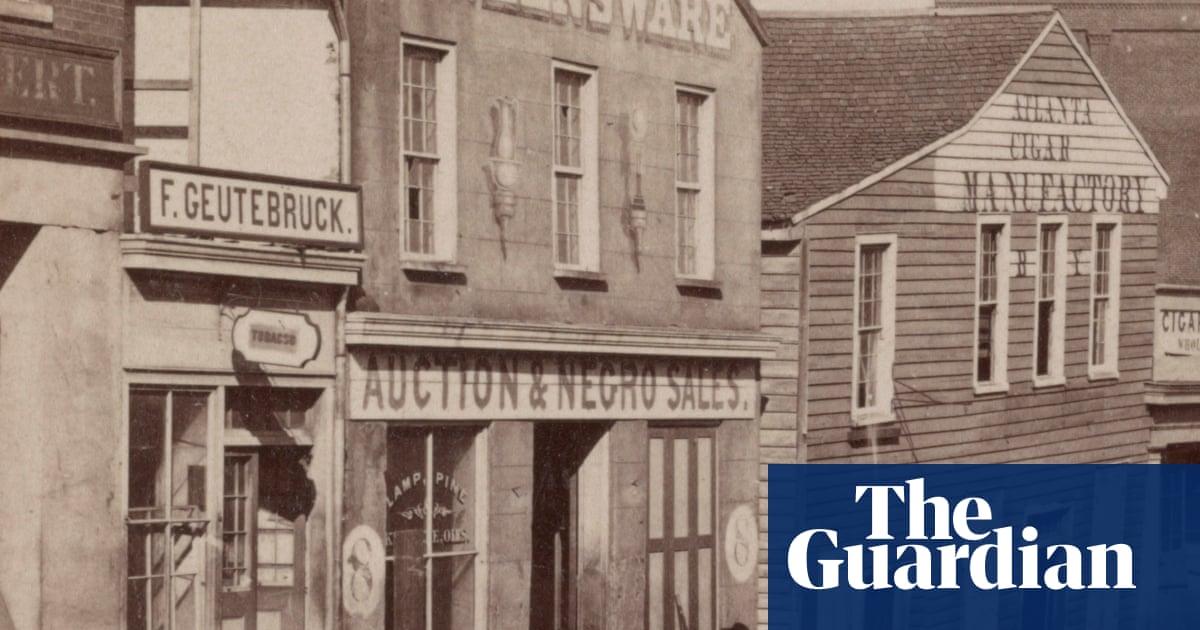
An 'Auction & Negro Sales' building in Atlanta in the early 1860s. Photograph: George N Barnard/Library of CongressView image in fullscreenAn 'Auction & Negro Sales' building in Atlanta in the early 1860s. Photograph: George N Barnard/Library of CongressTaskforce releases landmark report on lasting impact of slavery in Fulton countyReport examines how the effects of slavery and Jim Crow at the county level continue to harm Black Georgia residents
A Georgia taskforce has released a landmark report that details the lasting impact of slavery and its afterlives in Fulton county.
The report, spanning more than 600 pages, is based on original research by the Fulton county reparations taskforce and a review of primary source documents. It is the first-of-its-kind in the nation, according to county leaders and researchers. Rather than examining the impact of slavery and racism at the federal or state level, the harm report investigated the role of the county government.
Policies and decisions made at the county level contributed to long-term harm for Black residents, the researchers found.
Before the civil war, enslaved Black people were counted as property. They generated significant tax revenue for the county – revenue from which they were prevented from benefiting. As enslaved people, they received no wages for their labor, though their work enriched others.
After the civil war, Black men made up a disproportionate percentage of forced workers in the convict leasing and chain gang systems, though Black women and children were also arrested under discriminatory laws. The county leased the people it arrested to private contractors and forced them “into unpaid labor for county and state projects, effectively extending slavery under another name”, the report concludes. Those workers “physically built Fulton County’s roads, bridges, and sanitation networks”.
The injustices continued through the Jim Crow era, with Black communities being forcibly displaced through eminent domain, racial terror in the form of dozens of documented lynchings in Fulton county and Black property owners being taxed at higher rates than white people. In 1933, during the Great Depression, the Fulton county board of assessors lowered the value of white-owned city and town property by 63%, but continued to levy Black residents at a higher rate and did not grant tax relief to Black residents. Through the final years of the Great Depression, the report found, Black-owned city and town property “carries a tax burden three to four times higher than that of whites”.
The cumulative effect of these decisions continue to impact Black residents today.
The taskforce unveiled its findings at a panel last week, which was held on the 162nd anniversary of the Compensated Emancipation Act. That act, signed into law eight months before the Emancipation Proclamation, was the first federal legislation to free a significant number of enslaved people.
In an attempt to quantify the financial impact of the county’s discrimination against Black residents, researchers created two theorems, the Dual Lens Hidden Disparities Theorem and the Extraction-Accumulation Harm Theorem, to translate the harms – stolen labor and lost wages – into dollar amounts. In just one decade, from 1854 to 1864, that labor translates to about $903bn, according to the report.
“These figures demonstrate the enormous scale of economic loss inflicted on Black people and the parallel enrichment of White enslavers and public institutions,” the report reads. “Comparing the value of unpaid wages to the ad valorem taxes collected by the state and county reveals a striking imbalance … While the State of Georgia collected $149,316 in taxes and Fulton County collected $74,544, enslavers were exempted from paying $8,955,093.88 in wages between 1854 and 1864 to the very people whose labor generated their wealth. Enslavers retained those profits in full as wealth that fuelled private accumulation. As a compromise, they simultaneously paid taxes on the value of Blacks’ bodies that served as seed money for building the county’s public infrastructure.”
While some of the names of peopleaffected by these systems – those of the people who were enslaved, for instance – may never be known, researchers were able to track the impact of the various harms through individual stories.
Black residents began settling in Macedonia Park, also known as Bagley Park, after the civil war. Eventually, their community flourished, with Black people owning and operating grocery stores, restaurants, barbershops and other vital stores. William Bagley, who settled there with his wife in 1912 after fleeing racist violence in another Georgia county, eventually owned several lots of land in the area.
Then, in the 1930s, the Fulton county board of commissioners, working with the Ku Klux Klan, decided to dismantle the community. The report says that Klan members marched in full robes in order to clear Black residents from the area. What was then known as Bagley Park is now Buckhead and owned by the city of Atlanta. In 2025, that land was worth $60m, the report estimated.
Bagley’s granddaughter, Elon Butts Osby, attended the panel discussion and is a member of the taskforce. Land taken from her family would be worth an estimated $15m today.
Though the harm report is now available, county leaders have still decided on reparations. The Fulton county reparations taskforce, which is extended through at least 2027, is to develop formal recommendations – from direct cash payments to community investments or policy changes – which will be voted on by the Fulton county board of commissioners.