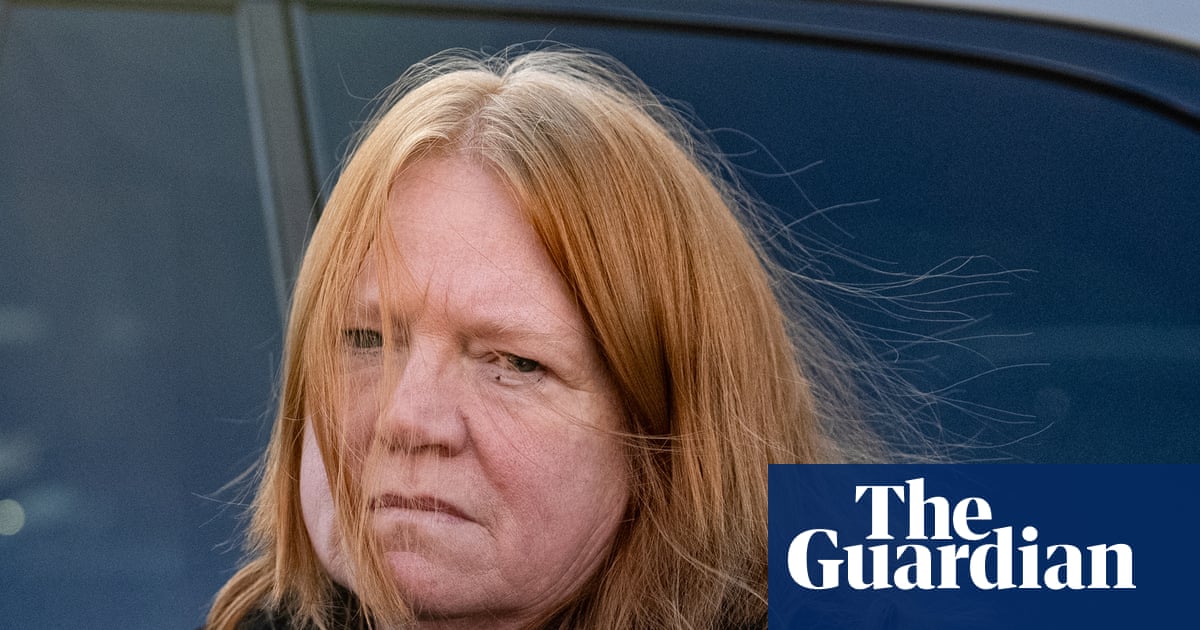
Asa Ellerup, the estranged wife of Rex Heuermann, arrives at the Suffolk county court for a scheduled court appearance in connection with the Gilgo Beach serial killings, in Riverhead, New York on 8 April 2026. Photograph: David Dee Delgado/AFP/Getty ImagesView image in fullscreenAsa Ellerup, the estranged wife of Rex Heuermann, arrives at the Suffolk county court for a scheduled court appearance in connection with the Gilgo Beach serial killings, in Riverhead, New York on 8 April 2026. Photograph: David Dee Delgado/AFP/Getty ImagesNew documentary reveals ‘kill room’ rituals of Gilgo Beach serial killerEpisode four of Peacock’s Gilgo Beach Serial Killer: House of Secrets features interviews with Rex Heuermann’s ex-wife
The meticulous rituals of the Long Island serial killer, Rex Heuermann, have been revealed in a Peacock documentary released on Thursday.
The confessed killer of eight women relays via a therapist that he maintained a four-day ritual of preparation, building trust with his victims, murdering them in a basement “kill room”, a day of “playtime” with their bodies, and then using a stopwatch to perfect dumping them on a beach 20 miles from his home. He’d use the fourth day to deal with any unforeseen complications.
The grisly revelations are made in episode four of the documentary, Gilgo Beach Serial Killer: House of Secrets, which collected wide-ranging interviews with Heuermann’s ex-wife, Asa Ellerup, daughter Victoria and a son.
Heuermann has admitted to killing Melissa Barthelemy, 24, Megan Waterman, 22, and Amber Lynn Costello, 27, Maureen Brainard-Barnes, 25, Jessica Taylor, 20, Sandra Costilla, 28, Valerie Mack, 24, and Karen Vergata, 34.
Heuermann, who confessed to the murders in court earlier this month and will be sentenced to multiple life prison terms later this year, is heard on the phone from his prison cell during a therapy session in which he attempts to help his family come to terms with his actions.
Alison Winter, a therapist, discloses that Heuermann describes to her that by the time he killed his eighth and last known victim, Costello in 2010, his practice had become so routine that he was able to dispose of her remains in just 37 seconds.
“He would hit the timer, dump the body, get back in the truck and hit the timer again,” Winter explains. “Clearly, he enjoyed killing and it became a sickness for him. It became an outlet. It became an obsession.”
Winter, Heuermann and the family members waived their rights to patient privacy to speak to the documentary makers.
Heuermann’s family confession to the grotesque killings, dating from 1993 to 2010, came soon before he changed his plea to guilty and told a court he’d killed each of his victims by strangulation before disposing of the bodies. At least one victim was killed in the marital bed and three were dismembered.
The documentary reveals details of how Heuermann refined his killing methods – from adolescent thoughts to a spur-of-the-moment murder of Costilla inside the family car in 1993.
Seven others were highly calculated, conducted in the family home in Massapequa Park. The confession to his family was a condition Heuermann set before entering a plea agreement, which had been in the works for a year before it was made public.
Asked if her husband’s confession helps her to understand Heuermann’s actions, Ellerup says: “Yes and no. Clarity comes from much more than just him saying something. But now that I know, it’s easier for me to move forward.”
Heuermann was asked if offering his family a confession to the murders is something he needed to do and he said: “It was something I needed to do face-to-face, and to be honest with each other. It needed to be done. Person-to-person, heart-to-heart. I went in, just as an open book.”
To participate in this extraordinary blend of murder and therapy-confession, the family was reportedly paid more than $1m, triggering a lawsuit from Benjamin Torres, Mack’s son, targeting “monies they were given to exploit the slaughter of plaintiff and to publicly attenuate defendant Rex Heuermann’s atrociousness via media exploitation”.
The couple’s daughter, Victoria Heuermann, reveals that Mack, victims Vergata, and Taylor were all “murdered, mutilated and dismembered” in the basement of the family home, where her mother now sleeps at night.
“I’m here because I do feel spiritual,” Ellerup explains. “I am trying to say, spiritually in my own way, that I am really sorry for what these victims went through.”
It is also revealed that Heuermann killed his victims on a second encounter, after paying them for sex on the first. On each occasion of killing, the rest of his family were away. Heuermann’s four-day ritual, Winter explains, was a “four-day high ... a four-day adrenaline rush and then he would meet his family.”
But the killings abruptly stopped, the family say, after the body of Shannan Gilbert was discovered near Gilgo Beach in 2010, leading to the discovery of Heuermann’s four “Gilgo Beach” victims.
Heuermann told the therapist he stopped because he was no longer receiving the same gratification.
“I think he was very concerned about getting caught, and I think he knew he would get caught,” Winter says.
The last episode of the documentary series may go down as one of the most chilling of its kind, revealing a murderous need for power and control often associated with serial killers and that they act out when that is threatened. Winter says Heuermann asked her if she had “ever sat with a serial killer before” and if she knew what it’s like to want to kill – “to play God”.
Heuermann’s sentencing is slated to happen on 17 June.