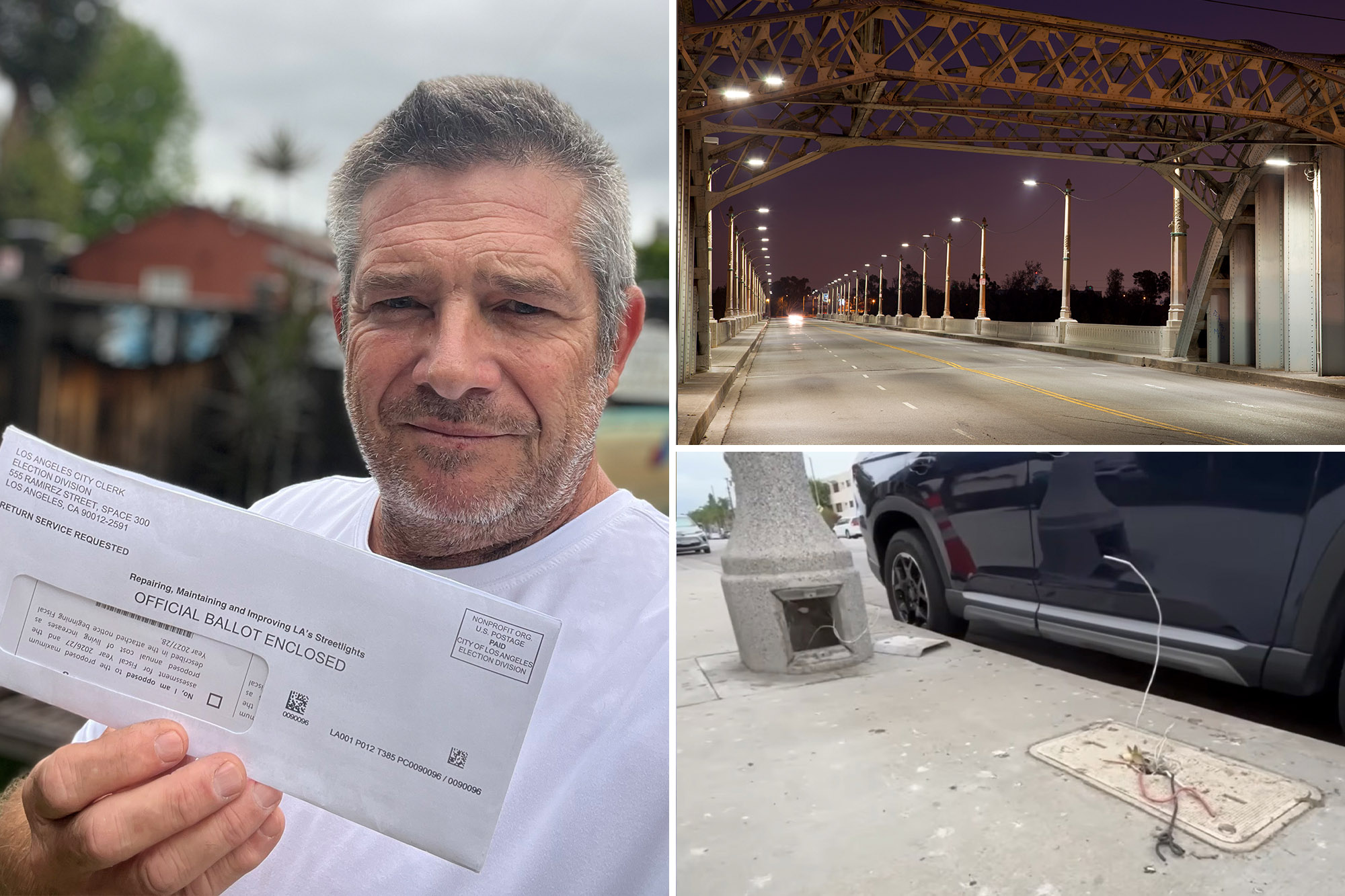
Los Angeles homeowners would be slugged hundreds of dollars to fix city streetlights in their neighborhood, under a new council plan.
Ballots have started popping up in the mailboxes of Angelenos who benefit from streetlights illuminating their property — asking them to sign off on an initiative to fork over hundreds of dollars in property fees each year to replace 200,000 streetlights across the city.
The plan, aimed at repairing streetlights continuously damaged by vandals and copper thieves, would increase the current budget from $45 million to $125 million — wire theft is currently costing LA more than $20 million a year. The ballot is expected to be sent to 600,000 property owners.
The Democrat-dominated LA City Council voted overwhelmingly in favor of the measure last month — with only one “no” vote — arguing more money is needed to cover permanent fixes to lighting infrastructure while copper-wire bandits have run rampant pillaging streetlights.
Los Angeles Mayor Karen Bass has voiced strong support for the initiative. “As long as voters support the street lighting assessment, we’ll be able to replace all 200,000 lights across the city,” she said. Calling the repairs “something long overdue.”
The initiative comes from the same LA City Council that spent $300 million on hotel rooms for homeless people — only to see 40% of those people return to the streets.
Woodland Hills resident Richie Varga was shocked to see the “bonehead ballot” sitting in his mailbox on Monday.
“When I opened it up I said, is this a joke?” he told The California Post of the proposed $200-plus fee he’s now starting down. “It’s legit.”
The ballot, pushed out by LA City Council, asks residents if they’re in favor of or opposed to paying the amount — which for Varga would equal $205.91 more per year for his two-bedroom duplex.
“Vote no — it’s a hard no with a middle finger, a hell no,” he said. “Who’s going to vote yes?”
“Properties are considered to receive a special benefit from the lighting if the portion of roadway and sidewalk adjacent to the property is receiving significant illumination from the lighting,” the bureau said, claiming the fee is “not a tax” but rather “a levy or charge for a special benefit.”
The amount Angelenos would pay varies based on factors like their property type and lot size, but estimates show many single-family homeowners would pay roughly $120 to $175 per year.
Apartment buildings with hundreds of units would have to pay a maximum of about $4,700 per year, while commercial properties would need to fork over as much as $8,200, according to review of various addresses.
Monica Rodriguez — the lone city councilmember to vote against the plan to charge property owners — told The Post that “it’s unreasonable to ask them to shoulder yet another cost.”
“You can’t ask people to pay more when you haven’t even done the work to rein in the expenses you’ve already passed on to them,” she said. “Before moving forward with any fee increase, the city should present a clear, up-to-date plan for maintaining and protecting this infrastructure.”
Residents in the Pacific Palisades who lost everything, and can’t even live in their homes would also be on the hook for the extra hundreds of dollars if passed.
Jessica Rogers, president of the Pacific Palisades Residents Association, called the proposal “yet another sign the City of Los Angeles is failing its residents.”
“Instead of addressing the root causes of these failures, the city continues to rely on short-term fixes and Band-Aid solutions,” she told The Post. “We’re not going to improve infrastructure if the default answer is always to raise taxes.”
The ballots sent to property owners — which must be returned by June 2 — will be weighted to favor property owners with higher proposed fees.
Varga, who also owns “a few modest rental properties,” said he would need to pass the cost of any new fees for those units on to his renters.
“I try to be cool, but people’s rents are gonna get raised by other landlords,” he said.
The push comes as copper-wire theft has remained a scourge across Los Angeles as the value of the metal creeps upward.
Most of the stolen wire turns up found in scrap markets as thieves try to sell it for profit. Some heartless crooks have even stooped to stealing copper wire from Little League fields.
The crime spree has left neighborhoods in Los Angeles are without power and have had thieves strike repeatedly.
Mayor Karen Bass believes solar-powered streetlights will make it harder for thieves to swoop in and plunge neighborhoods into the dark.
Varga says people who work hard are now being asked to clean up the city’s crime mess. “A third of LA’s City Council are democratic socialists of America. They don’t care about crime.” he said.
California Post News: Facebook, Instagram, TikTok, X, YouTube, WhatsApp, LinkedInCalifornia Post Sports Facebook, Instagram, TikTok, YouTube, XCalifornia Post Opinion California Post Newsletters: Sign up here!California Post App: Download here!Home delivery: Sign up here!Page Six Hollywood: Sign up here!