During a visit to four African countries, Pope Leo XIV called for peace, unity and dialogue. He criticized war, corruption and inequality, urging leaders to put people first.
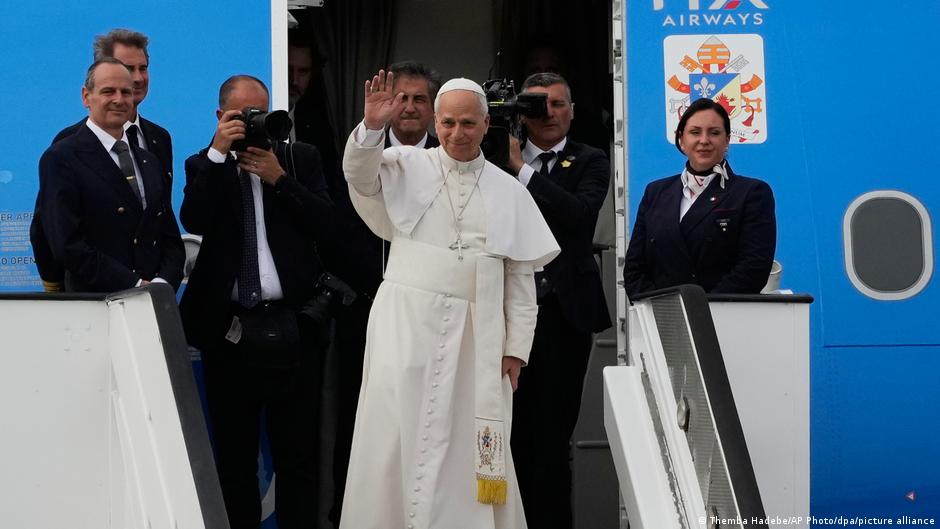
https://p.dw.com/p/5Cgm5Pope Leo XIV returns to Rome on Thursday after wrapping up an ambitious four-nation Africa tourImage: Themba Hadebe/AP Photo/dpa/picture allianceAdvertisementPope Leo XIV's first trip to Africa was intended to set an example and send a clear message of peace to the world. That was the message from church circles at the start of the pontiff's journey to four African countries.
On Thursday, after ten days on the continent, Leo began his return journey to Vatican City.
In many of the places the pope visited, he was greeted with great joy by his followers. In Cameroon's largest city, Douala, he celebrated Mass at the Japoma Stadium.
Franck Fokou, a political scientist based in Cameroon, said he was pleased that the pope did not shy away from the difficult issues of governance in the country.
"We understood the Holy Father's appeal as a reminder to the government to respect human rights. He pointed out that we must not use violence to harass the population, but must remember that violence must serve peace," he told DW.
Cameroon is ruled by 93-year-old Paul Biya, now in his eighth term. Rights groups like Amnesty International have expressed concern about the state of human rights in the country under Biya's rule.
For years, a violent conflict has been smoldering between separatists in the English-speaking Northwest and Southwest regions, and the French-speaking central government in the capital, Yaounde.
For the duration of the pope's visit to Cameroon, the separatists had declared a ceasefire lasting several days.
In his sermon, the pope directed strong words at the warring parties, which were met with applause.
"The warlords act as if they do not know that a single moment is enough to destroy; but that often a whole lifetime is not enough to rebuild," he told his audience.
Peace is a recurring theme that particularly drives civil society organizations, and one that Sophie Estelle Gouleu, president of the Policemen's Wives Association in Cameroon, considers a roadmap for the future.
"The Holy Father said: The world has had enough of wars. Women, young people, and civil society play a decisive role in maintaining social cohesion," she noted.
Can Pope Leo move President Trump on the Iran war?To view this video please enable JavaScript, and consider upgrading to a web browser that supports HTML5 video
Daniel Bilong, a Cameroonian priest, said the Church's messages resonated with him.
"The pope's visit means a lot to us in Cameroon, not only for Catholics, but also for people of other faiths," he said.
"The encounters with Muslims, in particular, were very promising," he told DW. "Our world cannot exist without dialogue, and for interfaith dialogue, it is very important that Christians and Muslims in Africa are able to engage in conversation."
Leo also recalled the visits of his predecessors.
"John Paul II, messenger of hope; Benedict XVI, who emphasized the importance of justice and the moral responsibility of those in power," he said, before drawing a connection to the present.
"We can therefore ask ourselves: Where do we stand? What remains to be done?"
The pope, however, began his four-country tour in Algeria, a predominantly Muslim country. He visited the Great Mosque of Algiers, the third-largest mosque in the world, and called for mutual respect between Muslims and Christians.
In Cameroon, as in Algeria, the pope sought to promote dialogue between different communities and social cohesion, according to Fredson Guilengue, a political scientist at the Rosa Luxemburg Foundation in Johannesburg.
"The pope's visit to the African continent aims to consolidate the Catholic Church's presence on the continent," Guilengue told DW, noting that 20% of the world's 1.4 billion Catholics live on the African continent. "This number is growing.”
In Angola and Equatorial Guinea, Guilengue sees a "certain similarity" between Leo's words and those chosen by his predecessor, Pope Francis, during his 2019 visit to Mozambique.
"The focus here is on the attempt to promote peace and reconciliation," said the Mozambican scholar.
Above all, however, it is about condemning exploitation and corruption by the elite. The country is marked by demonstrations and strikes against Prime Minister Joao Lourenco.
Half of the approximately 38 million inhabitants are considered poor, even though Angola is rich in natural resources such as oil and diamonds.
Guilengue recalls that Pope Francis had already made the point in Mozambique: peace and stability are impossible in a country where only a few people enjoy the nation's wealth.
"In Angola, too, there is widespread corruption and inequality, as well as wealth concentrated in the hands of a small minority," he said.
Pope Leo condemns use of religion to justify Iran warTo view this video please enable JavaScript, and consider upgrading to a web browser that supports HTML5 video
According to Guilengue, Pope Leo does not merely seek to promote unity.
"He also positions the Catholic Church as a moral voice against injustice and divisions in society, not only in Africa but among Catholics worldwide," he said — and sees a clear distinction from his predecessors: namely, his openness toward world leaders and heads of state.
This was also evident in Equatorial Guinea at the conclusion of the pope's visit to the continent.
The pope admonished the Teodoro Obiang Nguema — Africa's longest-serving head of state — saying the situation in the country had not changed in recent decades.
Obiang Nguema has been at the helm of the country since 1979; it has a population of just 1.7 million, 75% of whom are Catholic.
"The gap between a small minority — 1% of the population — and the overwhelming majority has widened dramatically," the pope said, criticizing the elite that profits from the country's oil wealth.
Guilengue emphasized the importance of a clear stance by the head of the Catholic Church on the need for stability, especially in Africa.
"We will only have a better picture in the near future of what people in Africa can expect from this pope, but at the moment he seems to be a very political pope," he said.
St. Peter's Basilica set to shine for 400th anniversaryTo view this video please enable JavaScript, and consider upgrading to a web browser that supports HTML5 video
Henri Fotso in Cameroon and Braima Darame in Angola contributed reporting.
This article has been adapted from German.