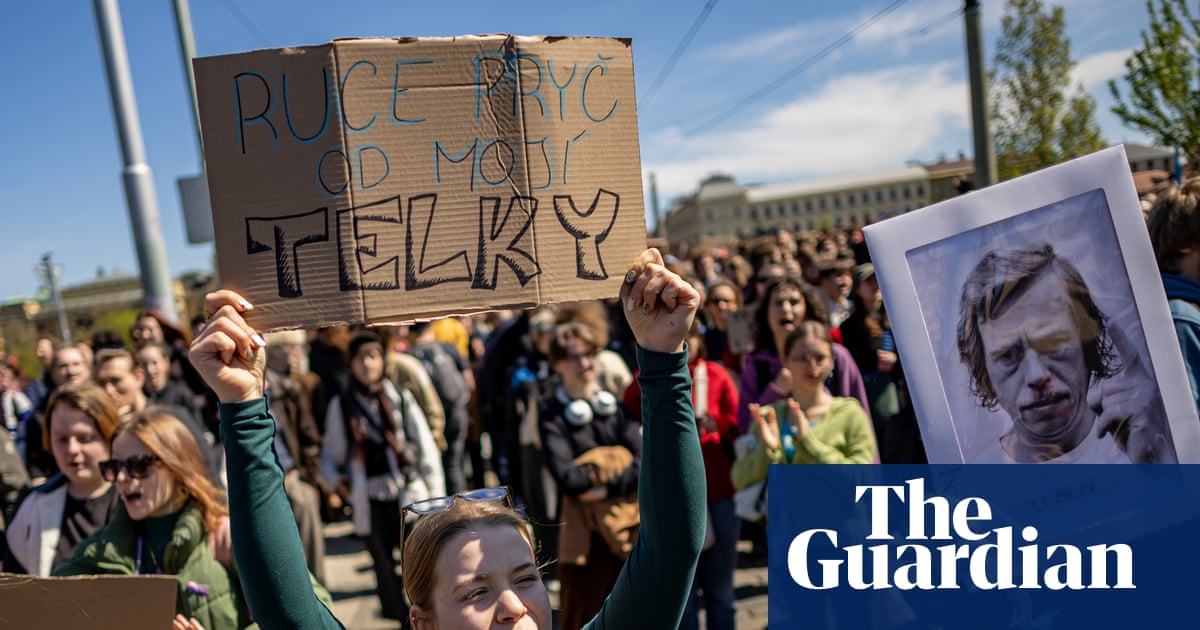
A woman holds a placard reading ‘Hands off my TV’ during a protest against the cuts in Prague. Photograph: Martin Divíšek/EPAView image in fullscreenA woman holds a placard reading ‘Hands off my TV’ during a protest against the cuts in Prague. Photograph: Martin Divíšek/EPACzech journalists threaten to strike over plan to scrap licence feesGovernment aims to move TV and radio funding under state control, which critics say undermines independence
Journalists at the Czech Republic’s public broadcasters have said they are prepared to go on strike unless the government of the billionaire prime minister, Andrej Babiš, backs down on its plan to scrap licence fees and move funding under state control.
In what the journalists see as a threat to their independence, the government wants to replace the current system, in which households pay fees directly to public service media, with direct funding from the state budget. “Licence fees are cancelled,” the culture minister, Oto Klempíř, declared last week.
Babiš’s populist Ano (Yes) party pledged to end licence fees before last October’s parliamentary election, which it won. But the move is deeply controversial. On Wednesday, thousands of university students gathered at Prague’s Jan Palach Square and marched through the capital chanting: “We won’t let you take the media.”
Pavla Kubálková, of the Czech Television strike committee, said: “Adoption of the bill would introduce direct political influence over Czech Television by changing a funding model that has functioned for decades. We see this as a direct threat to its independence.”
The proposal would cut about £48m from public service media funding in 2027. Czech Television would lose just under a third of its budget compared with 2026, while Czech Radio would lose about a fifth.
View image in fullscreenAndrej Babiš campaigned on a pledge to scrap licence fees. Photograph: Martin Divíšek/EPAJan Herget, of the Czech Radio strike committee, told the Guardian: “State financing puts a tool into the hands of politicians that can be used to undermine the independence and editorial autonomy of Czech Radio and Czech Television.”
He noted that radio licence fees were last set in 2005 at about £1.60, rising only slightly in 2025 to roughly £1.85. “The new proposal would effectively revert funding to 2005 levels, pushing it back by around 20 years,” he said. “It’s like expecting an average household with two children today to live on the same income it had in 2005.”
Wednesday’s student protest was joined by opposition figures including Zdeněk Hřib, the leader of the Pirate party, who has previously called on Klempíř to resign as culture minister.
“The situation is serious. Attempts to take control of the media through funding and government-controlled council members are far beyond acceptable limits,” he wrote on X.
View image in fullscreenThe Czech TV licence fee currently stands at about £5.30 a month. Photograph: Martin Divíšek/EPAJan Motal, a media commentator, said the proposed law “shifts funding under state control without explaining how independence will be protected”. “It is a half-formed reform being pushed through in a climate where political interference is a real concern,” Motal said.
He said successive governments had failed to reform Czech Television and Czech Radio. “Both the legislative and economic frameworks are essentially the same as they were 26 years ago. These institutions should have undergone reform long ago to secure their independence.”
Concerns about political pressure are shared by prominent figures within the media. Václav Moravec, a well-known journalist who worked at Czech Television for 21 years, recently left the broadcaster, saying live on air that it could no longer guarantee independence.
He told the Guardian that alongside external political pressure such as the proposed law, the broadcaster’s autonomy had been undermined internally, and he argued that resistance must also come from within the institution.
Moravec drew parallels with broader global trends. “Internal pressure and political pressure are working side by side. Political actors like Nigel Farage or Donald Trump argue that public media is no longer needed because we already have private media and a pluralistic information environment through social media and private news outlets.”
He argued that public opinion may further complicate the situation. “Research shows that 68% of the Czech public does not see a difference between licence fees and state budget funding,” Moravec said. “That makes it much easier for someone like Andrej Babiš to push for state control.”
Czech Radio has already reduced staffing in its international broadcasting division by a quarter after the foreign ministry cut funding to Radio Prague International. The foreign minister, Petr Macinka, now plans to end support for international broadcasting altogether next year, despite the service being mandated by law.
The Vienna-based International Press Institute said it feared that the bill, which still requires approval from the government and parliament, was intended to “weaken the broadcasters’ financial and editorial independence and compromise their ability to fulfil their public service remit”.