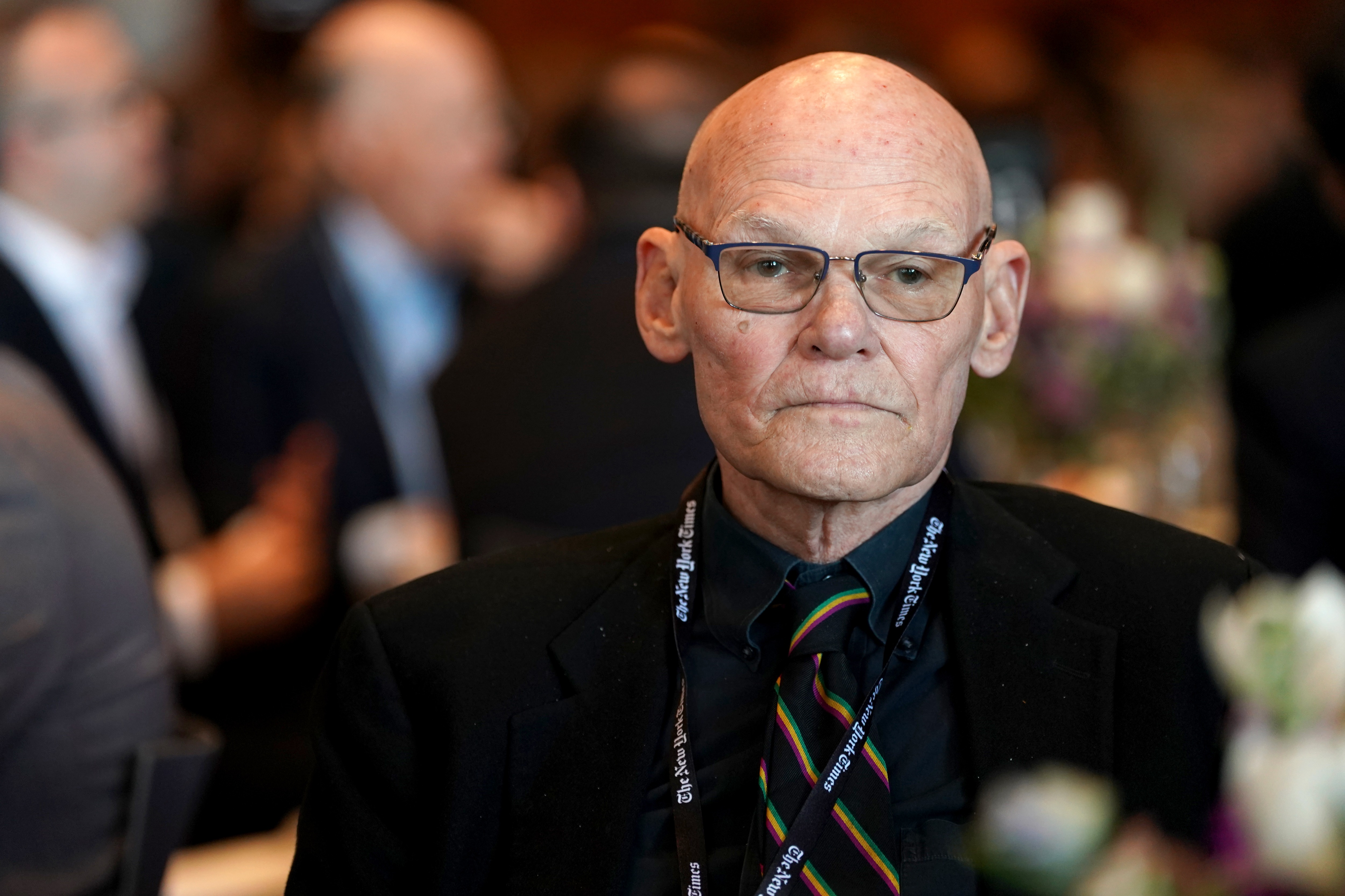
James Carville attends The New York Times DealBook Summit 2025 at Jazz at Lincoln Center on December 03, 2025 in New York City. Getty Images for The New York Times Conservative: Democrats Embrace Extremism It seem moderate Democrats no longer exist: “Famed political strategist James Carville recently advised his party “they should try to abolish American politics” if they win the presidency and Congress in 2028, marvels National Review’s Charles C.W. Cooke. Carville said: “On day one, they should make Puerto Rico and D.C. a state, and they should expand the Supreme Court to 13,” remaking all three branches of government to ram through Dems’ policy agenda. Damningly, notes Cooke, “Carville followed up his proposition with the counsel ‘don’t run on it, don’t talk about it, just do it.’ ” Beware: “That Carville has gone down this road” suggests that “if the Democrats give in to their worst instincts the next time they enjoy uniform power, all manner of supposedly respectable figures are likely to go along.”
“All that now matters” for President Trump “is that the U.S. prevails” in its war with Iran and that “the Islamic Republic ceases to be a menace to America and its interests,” argues The Wall Street Journal’s William McGurn. With the “mullahs on their heels,” Washington mustn’t “squander these gains” and allow them to retrench. The prospect of defeating Iran “rankles American establishments,” which all agree “they can’t stand” Trump and “want him to fail more than they want America to succeed.” In the “twisted logic of the Hate Trump chorus,” the “liberation of millions of people” wouldn’t be worth it if it means “Trump getting credit for bringing down a murderous regime.”
City Comptroller Mark Levine plans “to direct $4 billion of the city’s roughly $320 billion in pension assets to affordable housing development,” scowls City Journal’s Allison Schrager, but this “initiative constitutes poor risk management” and a lack of focus, as Levine “is tasked with investing pension funds prudently to ensure that benefits are paid,” not with “subsidizing housing for New Yorkers at below-market returns.” A 2019 state law has already “devastated the value of affordable housing,” and “market-rate investors shy away from affordable housing because the returns are so low.” With new pension perks poised to blow a “bigger hole in pension funds,” which are already “underfunded,” New York’s retirement systems “don’t have a dime to spare.”
Sen. Elizabeth Warren’s wealth tax promises that if you “tax the rich just a little bit more,” the country “can afford everything” — universal child care, free community college, paid family leave, etc., but “the math alone raises serious doubts,” scoffs Jeff Evans at The Hill. For starters, it’d be “an unrepeatable one-time liquidation,” not a steady long-term revenue source. Worse, it would “redirect resources away from productive investment into political allocation,” weakening the “engine that creates prosperity.” Redistribution just can’t “substitute for growth.” Besides, “the American dream has never been about government delivering prosperity” but allowing “individuals to create it. That system depends on incentives that reward work, risk-taking, and investment — forces that expand the economic pie rather than divide it.”
In “An Inconvenient Truth,” which turns 20 next month, Al Gore “argued that human-driven climate change was an urgent, civilization-threatening crisis,” recalls Roger Pielke, Jr. at The Honest Broker. But the film wasn’t truly about science; it was a “call to arms,” a “sermon — complete with a moral arc.” And “the climate science community” embraced it, adopting a version of Michael Barkun’s “New Apocalypticism” — “a secular variant of religious millenarianism” complete with “believers and deniers,” i.e., “those with faith and those yet to be converted.” In reality, we’re “not on the brink of an apocalypse.” Yet the film “provided a lesson”: “When science is leveraged to motivate political transformation,” politics aren’t “transformed”; instead, “scientific institutions” get “compromised.” And “when that happens, we all suffer.”