ShareSaveAdd as preferred on GoogleLaura BickerChina correspondent , Foshan and GuangzhouWatch: How the US-Iran war is costing ChinaIt's a sombre gathering in the backstreets of one of China's biggest manufacturing hubs, where workers are smoking under a tree in front of storefronts advertising temporary factory jobs.
"No-one understands what our life is like," says one man who is unwilling to be named.
"We work and work and have no life. Please help us," another adds - a rare, risky plea to a foreign journalist.
They seem desperate, struggling to earn enough to send money home, as they cope with the massive shifts in Chinese manufacturing, from cheap, mass-produced goods to automated advanced tech.
And that was even before the US-Israel war with Iran shook the global economy.
China's economy was already battling slower growth and unemployment when Donald Trump's tariffs hit last year. Still, it proved resilient, boosting exports and reporting GDP growth of around 5%. But the discontent continued to simmer. And now the Middle East conflict is starting to take a fresh toll, putting pressure on factory orders, costs and jobs.
In Foshan, in the southern industrial province of Guangdong, the workers' best opportunity is plastered in bright red lettering in front of them: a few weeks of moulding plastic, or screwing together parts of a mobile phone, for 18 to 20 yuan an hour, which amounts to just a few dollars or pounds.
"I'm going to try and find work elsewhere," says another worker from a rural province. Most are well over 40 years old, and frustrated at yet more uncertainty.
This is one of the reasons Beijing is calling for the war to end.
China's enviable oil reserves and the lead it has taken in renewables and electric cars have insulated it from the worst effects of the fuel crisis. But even as it puts on a show of steady strength, the war is choking the Strait of Hormuz, a crucial shipping route, and that is causing more pain to a sluggish Chinese economy that is heavily relying on exports.
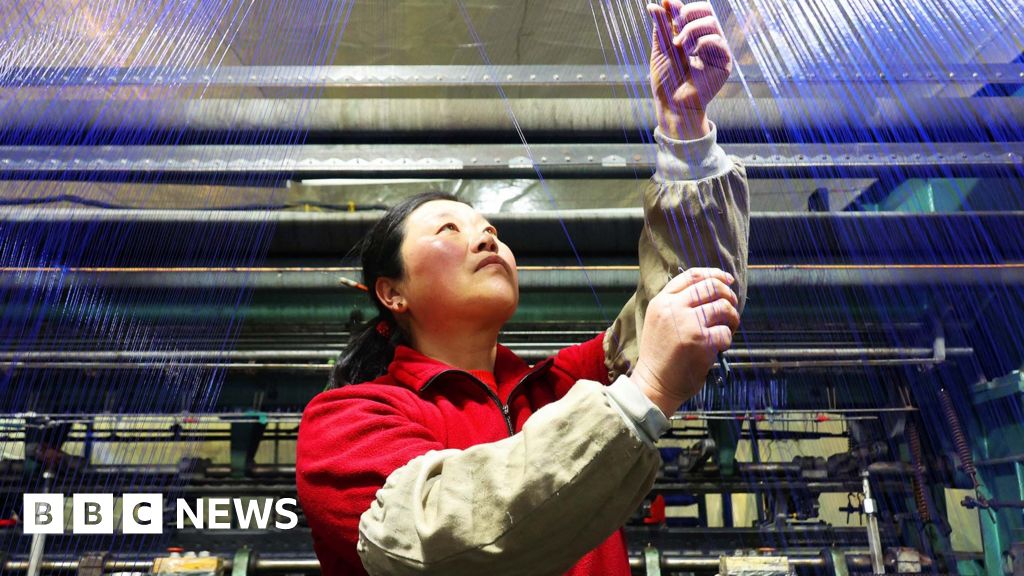
"Costs have gone up around 20%," says one trader who didn't want to be named, as she organises workers to move cylinders of fabric from the back of a truck to a line of carts, which will take them to local factories to be cut and sewn into clothes for the world's retailers, from Zara to Shein to Temu.
This is the world's largest fabric market – in Guangzhou, an hour's drive from Foshan - and the streets pulse with motorbikes laden with rolls of vibrant textiles, as small vans and trucks honk their way through to pick up and drop off loads. The shops are hard to distinguish among the piles of nylon, polyester and silk, but each owner and seller had a similar story.
Their trade needs a cheap and steady supply of oil in the form of petrochemicals, without which they cannot produce fabric. And higher oil prices are now hitting them hard. "It means fewer orders," says one trader over tea in a back room office. He adds that some customers are refusing to pay more and rolls of fabric are piling up in the warehouse.
If they don't pass the rising cost on to the customer, they absorb it themselves. That is hard for those who're already working with slim margins.
A year ago, when the US and China were locked in a trade war, there was defiance on the streets of Guangzhou. This time, there is resignation.
But there is still opportunity amid the uncertainty.
A short drive away, manufacturers are welcoming buyers from around the world in the cavernous halls of the Canton Fair. Humanoid robots wave and sing as international visitors take selfies.
This is the China that leaders in Beijing want the world to see. A country looking towards the future and building new technology while its rival, the United States, is embroiled in a war in the Middle East.
There are large queues to try on AI glasses that claim to translate foreign languages and robotic legs to help climb mountains. There are plenty of everyday gadgets too, from vacuum cleaners that can clear stains in seconds to shiny espresso machines and hair curlers.
The one thing that is common is that their price is going up, traders say. For one, they are made of plastic, which uses oil in the manufacturing process.
But buyers are still turning up because businesses are ploughing on to serve the market - and the war has driven home China's edge in one key sector in the wake of fuel shortages: electric vehicles (EVs).
Chinese manufacturers exported 350,000 EVs in March alone, a 30% increase from February, and a 140% increase from March last year, according to data from the Chinese Passenger Car Association.
EVs are also one of China's biggest exports to the Middle East, but now trader Joyce Liu is finding it tough to get shipments to customers.
"Last year 90% of our cars went to the Middle East but this year because of the war we almost stopped doing business with them," she says. "Some of the cars are still waiting at Chinese ports."
She's at the fair to find new buyers from Africa or South America, but there are also those from India, Bangladesh and Turkey at many of the EV stalls. In some countries waiting lists for Chinese EVs have been growing as petrol and diesel costs soar.
But there is also a delegation from Oman, inspecting the cars under bright spotlights and an advertisement written in English and Arabic. They have decided to do a deal and are haggling with the trader.
"We are here to co-operate with Chinese companies. It's hard right now, but Inshallah [God willing] the war will finish and business will be good," says Zahir Mohammed Zahir al-Kaabi.
While the war will strengthen Beijing's ongoing push towards self-reliance, China is not really winning in this scenario, says Yu Jie from London-based think tank Chatham House.
"Ironically, a declining US is something that China hoped to see. But is this the America that China wanted? It would prefer a US that is more predictable, and that is perhaps easier for Beijing to manage."
And yet, a balancing act lies ahead because Beijing also "does not want to irritate Trump", she adds. She believes the summit scheduled for May will temper China's response to the war.
"Beijing wants to do whatever it can to secure that meeting."
From the sidelines China is calling for a ceasefire, while pushing its friend Iran towards the negotiating table. And Trump seems to want that too. Xi is also holding meetings and phone calls with the crown princes of UAE and Saudi Arabia.
This is China flexing its diplomatic muscle, says William Figueroa, professor of History and International Relations at the University of Groningen. "It wants to show both the United States and its partners in the region that it's serious about its commitments there - and that obviously has a global audience."
It's a reminder that China is no longer just at the centre of the global economy. It is increasingly at the centre of global power.
But this means little to the workers in Foshan, who are frustrated by stagnant wages.
One of them shows his pass from the Canton Fair. "I cleaned the toilets," he says, laughing as he takes another puff of his cigarette.
He got paid 150 yuan ($20; £14.80) for his 14-hour work day.