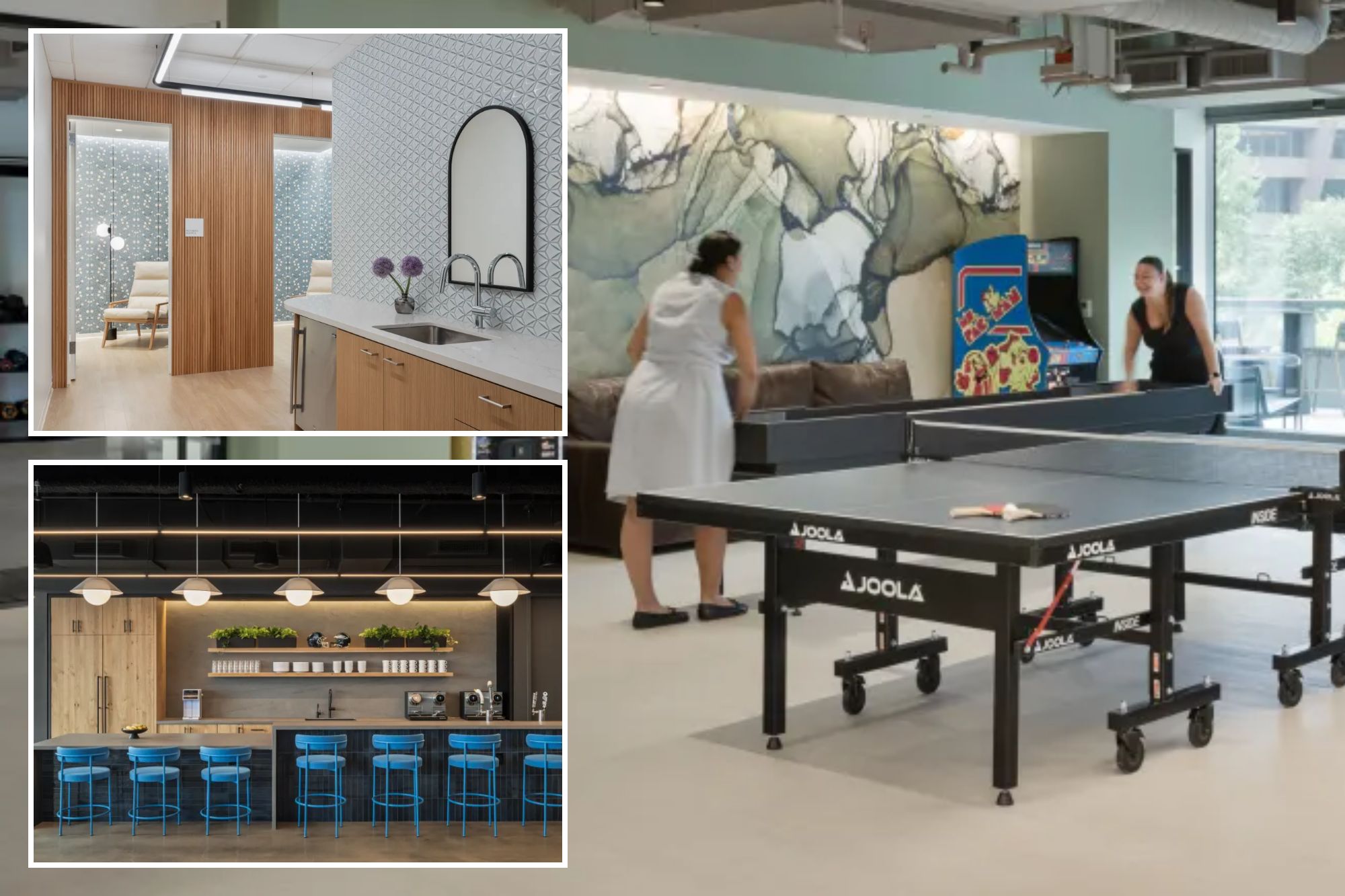
Offices are going beyond ping-pong, engineering spaces for real connections. Will Ellis The modern office is no longer just a place to work — it’s a place to belong.
In the wake of the pandemic, employers were forced to confront a fundamental question: Why should anyone come back at all? The answer, increasingly, is the experience.
Today’s workplaces are being reimagined from the ground up, with architects and designers creating environments that prioritize wellness, flexibility and human connection — while delivering a level of hospitality once reserved for luxury hotels.
Companies are investing heavily in thoughtful, high-end details designed to attract and retain talent. From premium food programs to curated materials and finishes, the office has become a reflection of both brand identity and employee expectations.
Those expectations vary, as financial firms still gravitate toward private offices, while fast-growing AI companies demand flexible, scalable layouts that can evolve alongside them.
Joseph Lauro of Gensler, who is working on projects at 70 Hudson Yards and 625 Madison Ave. for Related, sees the shift as part of a broader urban dialogue. “We need to make buildings that are connected to our city,” he said. “The fabric of our city is going to complement that building.”
That philosophy is showing up in a surge of outdoor spaces — terraces, setbacks and rooftop areas designed not just for views, but for real use.
“It says our city is beautiful, and you can participate in it as an occupant of the building,” Lauro said.
Inside, the very structure of office buildings is changing. Lauro said they provide the “chassis” that allows companies to do their best work.
Traditional center cores are giving way to side-core designs that open up expansive, column-free floors. The result is adaptable spaces that can support a range of workstyles and business models.
“Our building design has to be agile … and forward-thinking enough that anyone can utilize it,” he said.
That adaptability extends down to the smallest details. Designers are no longer focused on how many people can fit into a space, but on how each individual experiences it.
“The level of hospitality we are seeing is extraordinary,” said Sarah McCann of Vocon. McCann’s projects include 345 Hudson and 555 Greenwich with Hines and 51 W. 52nd St. with with MdeAS for Harbor Group International.
Forget the standard office pantry. Today’s workplaces feature full-service cafés with barista-quality, bean-to-cup coffee, cold brew on tap, kombucha and even flavored sparkling water.
These curated offerings aren’t just perks — they’re incentives, drawing employees back into the office with experiences they can’t replicate at home.
Even greenery has evolved. Living walls have given way to more nuanced, integrated plant designs that feel organic rather than ornamental, and there are specialists tasked with ensuring they are watered and thrive. Sustainability is now a baseline expectation.
“It’s a differentiator,” Lauro said. “Any [building] coming out now is embracing a mode of decarbonization.”
Inside, the overall aesthetic is shifting toward warmth and comfort, with furnishings that echo residential and hospitality settings. The goal is to create spaces where people feel at ease — spaces that support both collaboration and focus.
“People want buildings to reflect the way they live their lives,” Lauro said. “There are moments you want to be together and moments you need to concentrate.”
That balance is reflected in the growing emphasis on mental health and restorative environments. Quiet zones, wellness rooms and private retreats offer employees a break from the buzz of open offices. Ergonomic furniture, natural light and acoustically sensitive designs are no longer luxuries; they’re essentials.
Recreation is evolving, too. While foosball tables, ping-pong and even high-end racing sims are still being added to the latest offices, a greater emphasis is being placed on meaningful interactions.
“Breaking bread with your teammate has much more value than the ability to play ping pong,” Lauro said.
Flexibility also remains a driving force. Designers are creating a wide range of environments — such as sit-stand desks, quiet nooks, collaborative hubs and lounge-like retreats — to accommodate different tasks and moods throughout the day.
Workplace design is also responding to broader societal needs. Mothers’ rooms have become a standard feature, often managed by specialized providers, while some companies are exploring ways to integrate childcare directly into their buildings.
“The childcare dilemma is definitely impacting work in the US,” McCann noted.
Underlying it all is a new generation of smart technology, seamlessly integrated into the workplace to enhance both efficiency and experience. From advanced video conferencing to intelligent building systems, these tools are redefining how people interact with their environment and with each other.
The office of the future isn’t just smarter or more flexible. It’s more human.