The state of “current” affairs is not good.
An Atlantic current that’s key for maintaining the climate could collapse sooner than we thought, potentially bringing about a global weather apocalypse, per an alarming study in the journal Science Advances.
“This is a key result with implications for the future climate of the Atlantic and beyond,” the international team of researchers wrote in the paper.
The at-risk current in question is the Atlantic Meridional Overturning Circulation, or AMOC, a “conveyor belt of the ocean” that circulates warm water toward the ocean surface from the tropics to the Northern Hemisphere.
This oceanic artery, which includes the Gulf Stream that runs from the Gulf of Mexico to the US East Coast and across the Atlantic to Europe, helps maintain the mild climate of Europe, the UK and the US East Coast. It also helps sustain marine life.
According to the study, the AMOC will slow down between 43% and 59% by 2100, marking a 60% greater weakening than past projections estimated.
If this is true, the Earth’s eco-librium could be past the point of “no return,” the authors wrote.
A total collapse would reportedly spell disaster. It would persist for hundreds or even thousands of years and potentially cause sea levels to rise across North America, Livescience reported.
Meanwhile, southern Europe would suffer from brutal droughts while the mercury in northern Europe could plunge by nearly 60 degrees Fahrenheit.
This temperature bedlam could disrupt both ecosystems and food production, potentially halving the amount of land available for growing wheat and maize, which supply around 40% of global calories.
There have been various studies on the decline of this marine circulatory channel, including a recent one that found that the AMOC had been weakening across four ocean monitoring sites for the past two decades.
However, this latest paper was unique in that, unlike prior scholarship, it used real world data that factored in multiple observable variables.
They reportedly used different statistical methods to compare the performance of various climate models concerning AMOC.
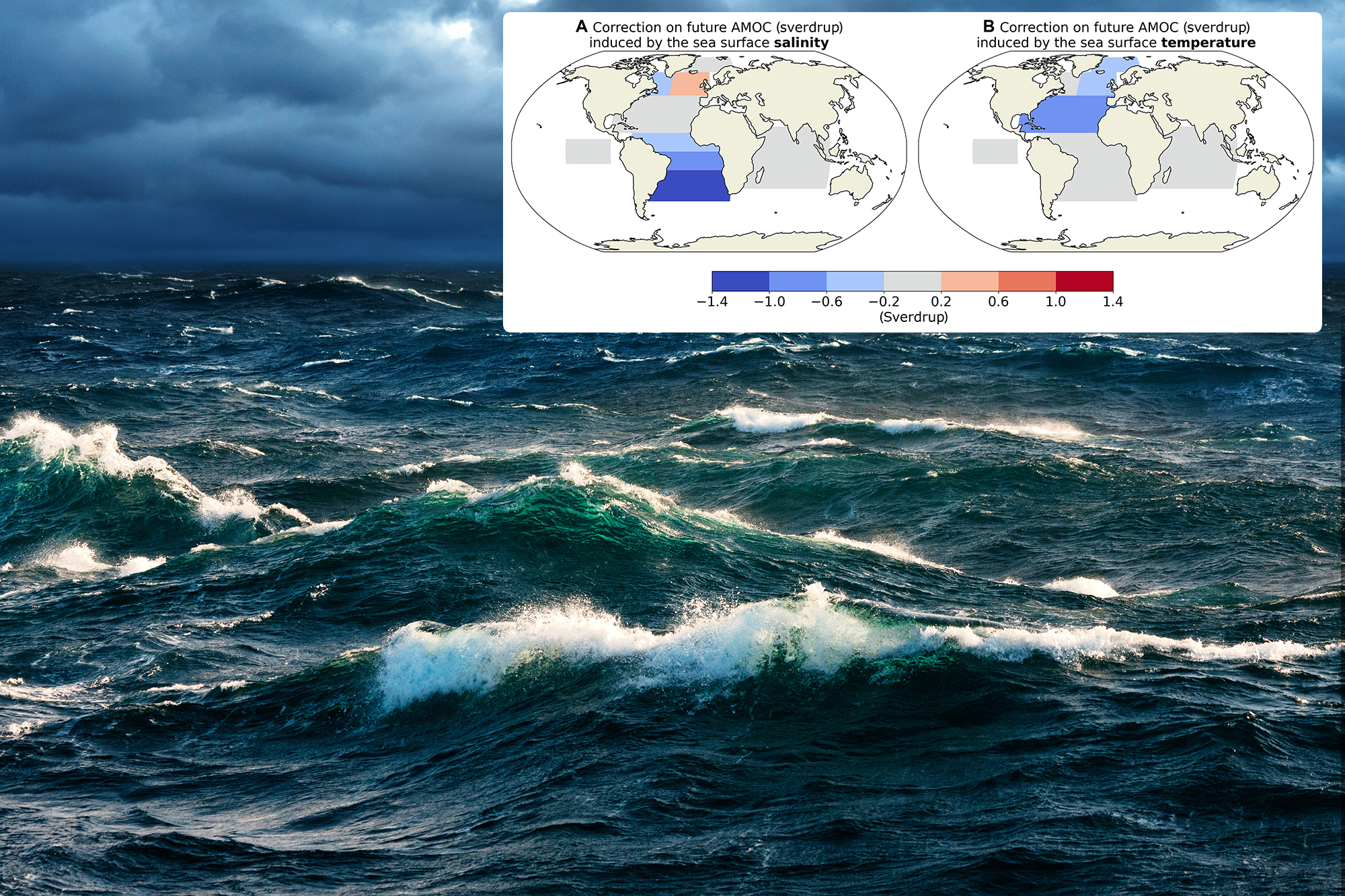
The most accurate one, per their experiment, paired the temperature and salinity of the Atlantic Ocean’s surface with “ridge-regularized linear regression” — a mathematical technique rarely used in climate modeling.
According to this predictive method, the AMOC will slow by around 51% compared to its 1850 to 1900 average — a “substantial weakening,” according to the Intergovernmental Panel on Climate Change’s (IPCC) 2022 report.
There “remains uncertainty in how well models can simulate and predict changes in the AMOC,” David Thornalley, a professor of ocean and climate science at University College London UK, who was not involved in the research, told Live Science.
Meanwhile, María Paz Chidichimo, an expert on ocean circulation at the National University of San Martín in Buenos Aires, Argentina, stressed the need to interpret each study’s results in a “wider context.”
“I think the magnitude and timing of AMOC decline are still uncertain given the large spread in model projections,” she said.