Blaming global forces for California’s high gas prices may be convenient — but it misses the point.
Prices have risen nationwide, yet Californians still pay significantly more than the rest of the country, just as we long have.
Over the last 10 years, California has lost significant in-state oil production and refining capacity. In-state crude production has fallen by roughly 60% since the mid-1980s, and refinery capacity has steadily declined as facilities closed or converted operations.
Today, California imports the majority of its crude oil, much of it from foreign countries, despite still consuming millions of barrels per day.
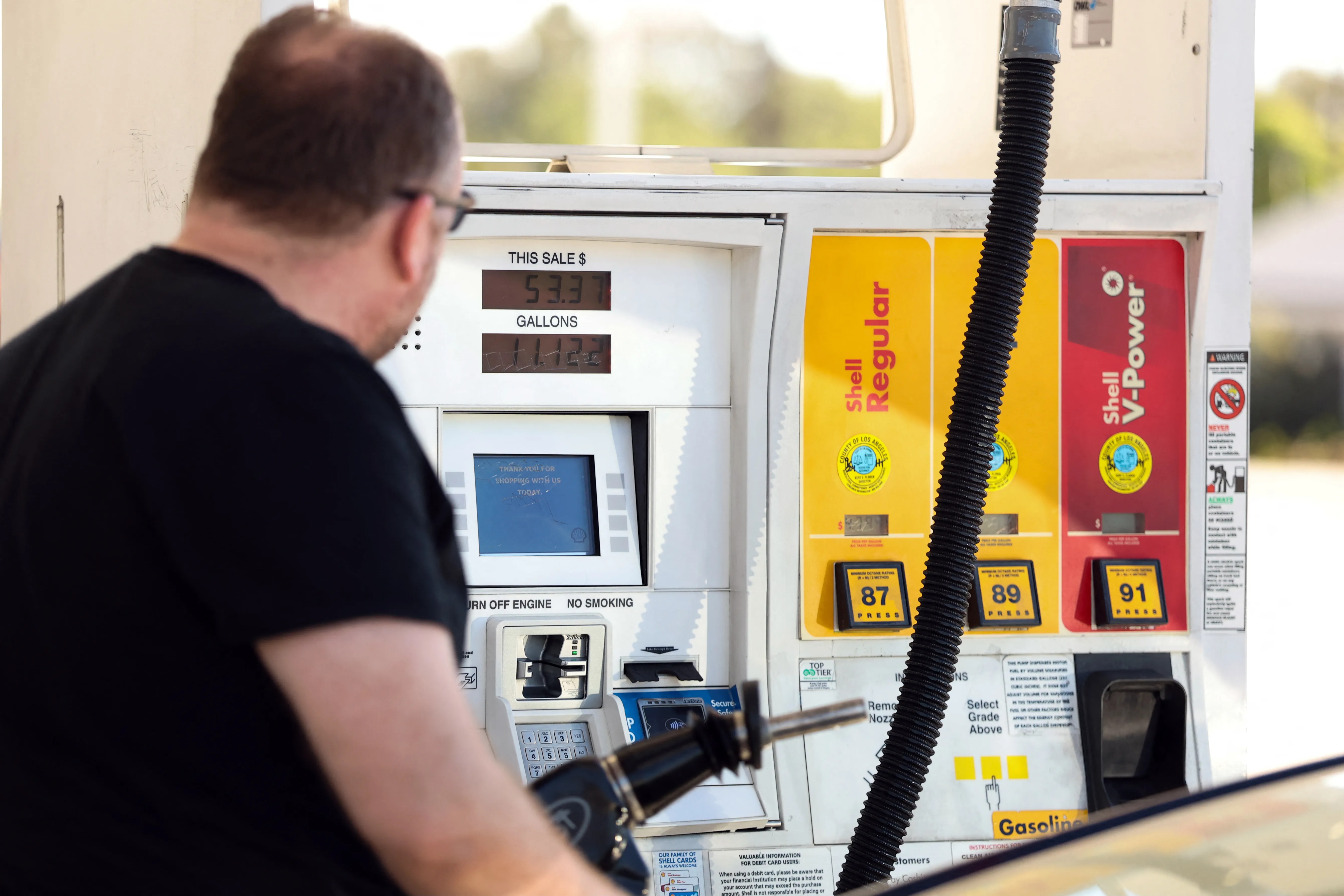
A man pumps gasoline into his vehicle at a gas station in Los Angeles. AFP via Getty Images Legislators layered increasingly complex regulations on in-state production, expanded low-carbon fuel standards, signaled long-term phaseouts, and repeatedly discussed punitive measures such as windfall penalties.
Investors do not ignore that kind of messaging. Capital moves where it is welcomed and stable.
California made it clear that traditional energy investment had no future here.
Refineries require billions of dollars in capital investment and operate on decades-long timelines. No company will commit that level of investment when policymakers openly say the sector is temporary.
The result has been predictable: tighter supply, thinner margins for disruption, and greater volatility at the pump.
The sign of a Chevron gas station displays current prices as drivers pump gas in Rosemead on March 18, 2026. AFP via Getty Images Electrification requirements accelerated. Fleet conversion deadlines tightened. Building codes shifted toward all-electric construction.
But those mandates were not paired with equivalent investments in firm, dispatchable power or rapid infrastructure expansion.
Energy demand is rising — driven factors such as electrification and the rapid expansion of AI-powered data centers — yet stable in-state generation has not kept pace.
Meanwhile, California’s residential electricity rates have climbed to nearly double the national average.
For working families, that is not theoretical. It shows up every month.
And while demand grows, sources of reliable power have been weakened.
The state initially moved to shut down the Diablo Canyon nuclear plant, a zero-emission facility providing nearly 9% of California’s electricity, before replacement capacity was fully secured.
Only after warnings from grid operators did leaders partially reverse course.
Removing reliable baseload power while increasing electrification mandates is not climate leadership.
We’ve also relied on imports to mask declining in-state supply.
Today, California depends heavily on crude oil imported from Alaska, Latin America, and the Middle East, as well as electricity from neighboring states during times of peak demand.
But imports are not a safety net. They expose Californians to global supply chain disruption and price volatility.
The current events in the Middle East are a perfect example of why relying on imports is destabilizing.
They also shift emissions rather than eliminate them. Shipping specialized fuels across oceans does not make California cleaner. It moves production and jobs elsewhere.
Permitting paralysis has compounded the problem.
Major energy infrastructure projects — pipelines, storage, transmission lines —routinely face years of delay under overlapping regulatory regimes.
Even projects aligned with state climate goals can take a decade to advance. When timelines stretch indefinitely and regulatory standards shift midstream, private investment retreats.
We’ve been eliminating supply faster than demand has fallen.
Every warning sign was visible: declining refining capacity, shrinking in-state production, stalled infrastructure, grid strain, growing reliance on imports, rising electricity rates. None of this was unforeseeable.
Now Californians are absorbing the consequences. Gasoline is not a luxury in our state. It is how parents get to work, how goods move through ports, how agriculture operates, and how emergency services function.
Electricity is not optional. It powers homes, hospitals, and the digital economy that state leaders are simultaneously encouraging to expand.
Energy policy is not about slogans. It is about sequencing, stability, and long-term planning.
California once proved that environmental progress and economic strength could coexist. But that progress was grounded in realism, not mandates detached from infrastructure readiness.
We arrived here through a series of decisions that discouraged supply, underestimated demand, and assumed imports would always close the gap.
And if we don’t change course, we will be looking at $10+/per gallon and gas shortages.
Suzette Valladares, a Republican, represents the 23rd District in the California Senate.