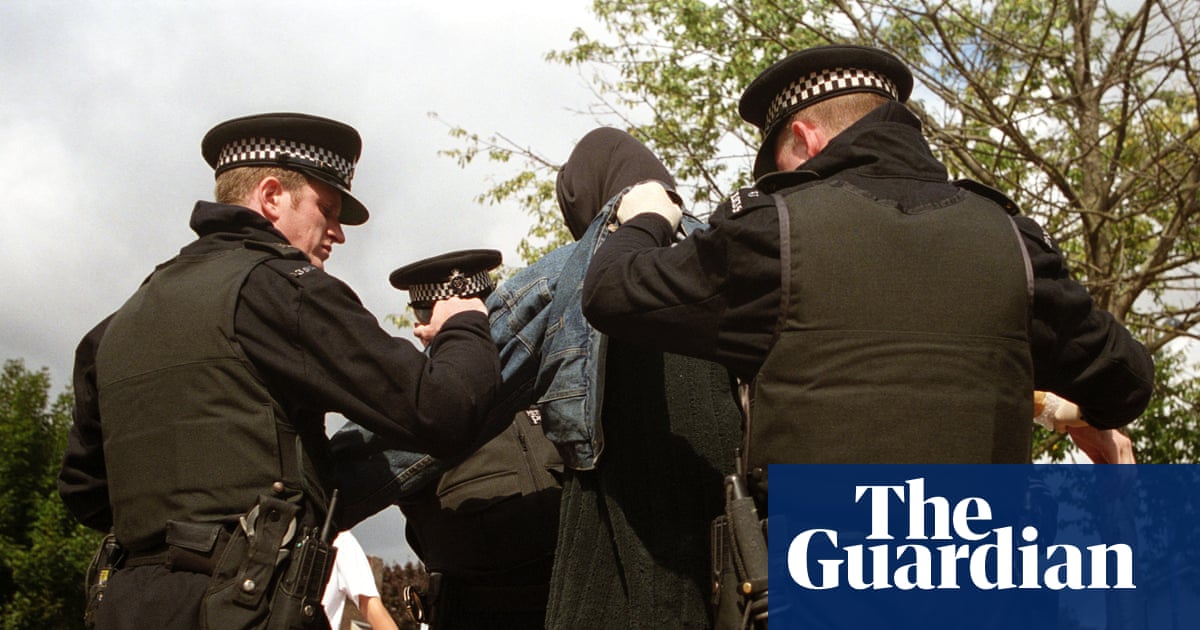
In cases where force was used against a Black child during a search, police officers were more likely to cite their size or build as justification, the report said. Photograph: Janine Wiedel Photolibrary/AlamyView image in fullscreenIn cases where force was used against a Black child during a search, police officers were more likely to cite their size or build as justification, the report said. Photograph: Janine Wiedel Photolibrary/AlamyBlack children in England and Wales almost eight times more likely to be strip-searched than white peers – reportDemographic also overrepresented when police officers use force such as handcuffs, firearms or Tasers, says children’s commissioner
Black children across England and Wales are almost eight times more likely to be strip-searched by police than their white counterparts, a report has disclosed.
Rachel de Souza, the children’s commissioner for England, said Black children are also overrepresented when officers use force and were more likely to have their “size, gender or build” cited as justification.
The findings, which point to a worsening of racial disparities, come more than five years after the case of Child Q, the Black 15-year-old schoolgirl who was strip-searched while menstruating by police officers.
Last summer, a disciplinary panel found two officers had committed gross misconduct during the “disproportionate” and “humiliating” incident at a school in east London. The pair were dismissed from the Metropolitan Police without notice.
Wednesday’s report found that the “deeply intrusive and potentially traumatic experience” is usually used because of the suspicion of drugs possession, but nearly half of all searches still result in no further action.
The latest findings from De Souza’s office are based on data from July 2023 to June 2024 across all 44 forces across England and Wales.
There were a total of 362 strip-searches of under-18s over that period. Half were white, 31% were Black, 11% Asian, 1.7% of mixed ethnicity and 12% other. In 3.9%, the child’s ethnicity was unknown or not recorded.
Taking into account the proportion of the general population, the commissioner’s office found that Black children are disproportionately almost eight times more likely to be strip-searched than white children and over five times more likely than Asian children.
Some searches were still being carried out in public view and with no appropriate adult present, the report found. The data also showed that three in 10 strip-searches – 30% – involved children who had already been searched at least once before.
According to a different data set, Black children were almost five times as likely to have force used during a search than white children.
In cases where force was used against a white child during a search, officers were more likely to note them as having a mental health need, but for Black children the reason identified was more often their size or build, the report said.
De Souza said too many strip-searches are still unnecessary, unsafe and underreported.
“My latest research presents an uncomfortable truth. Despite some promising green shoots of progress as overall searches of children have fallen since 2020, racial bias continues to influence practice drive numbers – and the strip-searching of children is far from being eliminated.
“Black children are consistently more likely than their peers to be strip-searched by police. And while this disparity had started to narrow in my last report, the trend appears to be reversing.
“This imbalance persists when looking at the use of force against children. Once again, Black children are overrepresented in the numbers: they are five times more likely to have force used against them by police officers than their white peers, and more likely to have their ‘size, gender or build’ cited as justification for force.
“It’s been my longstanding concern from this five-year long investigation, since Child Q’s story: the ‘adultification’ of Black children, where they are perceived as older than they are, and somehow less deserving of protection. We cannot accept a system that treats children differently based on how they look. Children must, first and foremost, be treated as children.”
Force, such as handcuffs, firearms or Tasers, was used in almost a fifth (17%) of all stop and searches of children between April 2024 and March 2025, her report added.
But in 43% of instances where force was used, no further action was taken, which the commissioner said called into “question the use of necessary and proportionate tests”.
A Home Office spokesperson said: “We’re introducing extensive safeguards for children and young people for strip-searching and bringing in reforms to drive up standards in policing, improve vetting and tackle misconduct.”
The National Police Chiefs’ Council lead for stop and search, deputy chief constable Andy Mariner, said policing has made changes to policy about strip-searching and has been working closely with the College of Policing to update its policies.
“While there are positive signs in that the number of strip-searches have been falling over time, we continue to work with policing partners, stakeholders and academics to understand and address the disproportionate use of stop and search, which we understand can undermine trust between policing and communities,” he said. “We are committed to increasing transparency around our use of stop and search, including strip-search, which is a legitimate and useful policing tool to help us in removing dangerous weapons and drugs from the streets, but we know that when it is used inappropriately, it can damage our relationships with affected communities.”