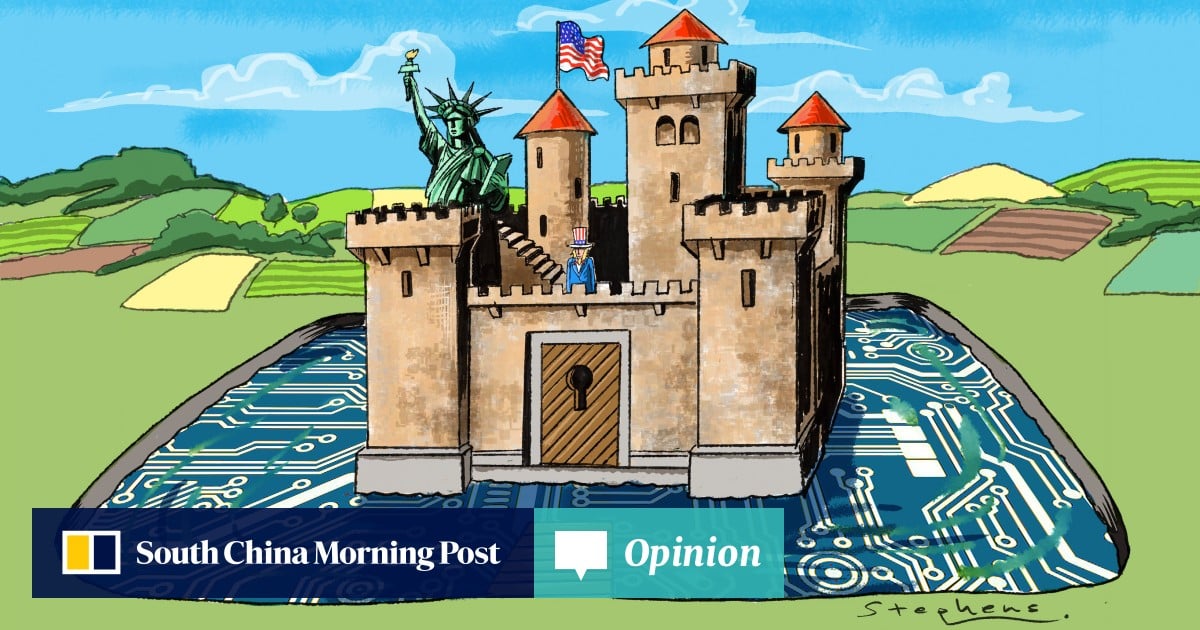
Raising barriers to entry in tech in the name of national security could stifle global AI development
4-MIN READ4-MIN ListenXiao QianXiao Qian is deputy director of the Centre of International Security and Strategy and vice-dean of the Institute for AI International Governance at Tsinghua University. Published: 5:30am, 22 Apr 2026The United States House Select Committee on China recently released a report on artificial intelligence. Titled “Buy What It Can, Steal What It Must: China’s Campaign to Acquire Frontier AI Capabilities”, it captures a hardening view in Washington that Beijing’s artificial intelligence rise is closely tied to both market access and security concerns.Whether fully substantiated or not, such beliefs are increasingly shaping the policy lens through which technology competition between the two countries is understood in the US – less as a matter of innovation, and more as one of national security.
At first glance, the debate over model distillation concerns technical pathways and intellectual property boundaries. Distillation is a widely used machine learning technique that enables smaller models to approximate the performance of larger ones, reducing computational costs and accelerating adoption. Its legal status remains ambiguous, and even US firms have used similar methods among themselves.
However, in today’s geopolitical environment, the issue has been reframed. Some US policymakers and companies argue that distilled models could be misused for cyber operations, disinformation campaigns or even military applications. What was once a question of optimisation has been elevated to one of national security.