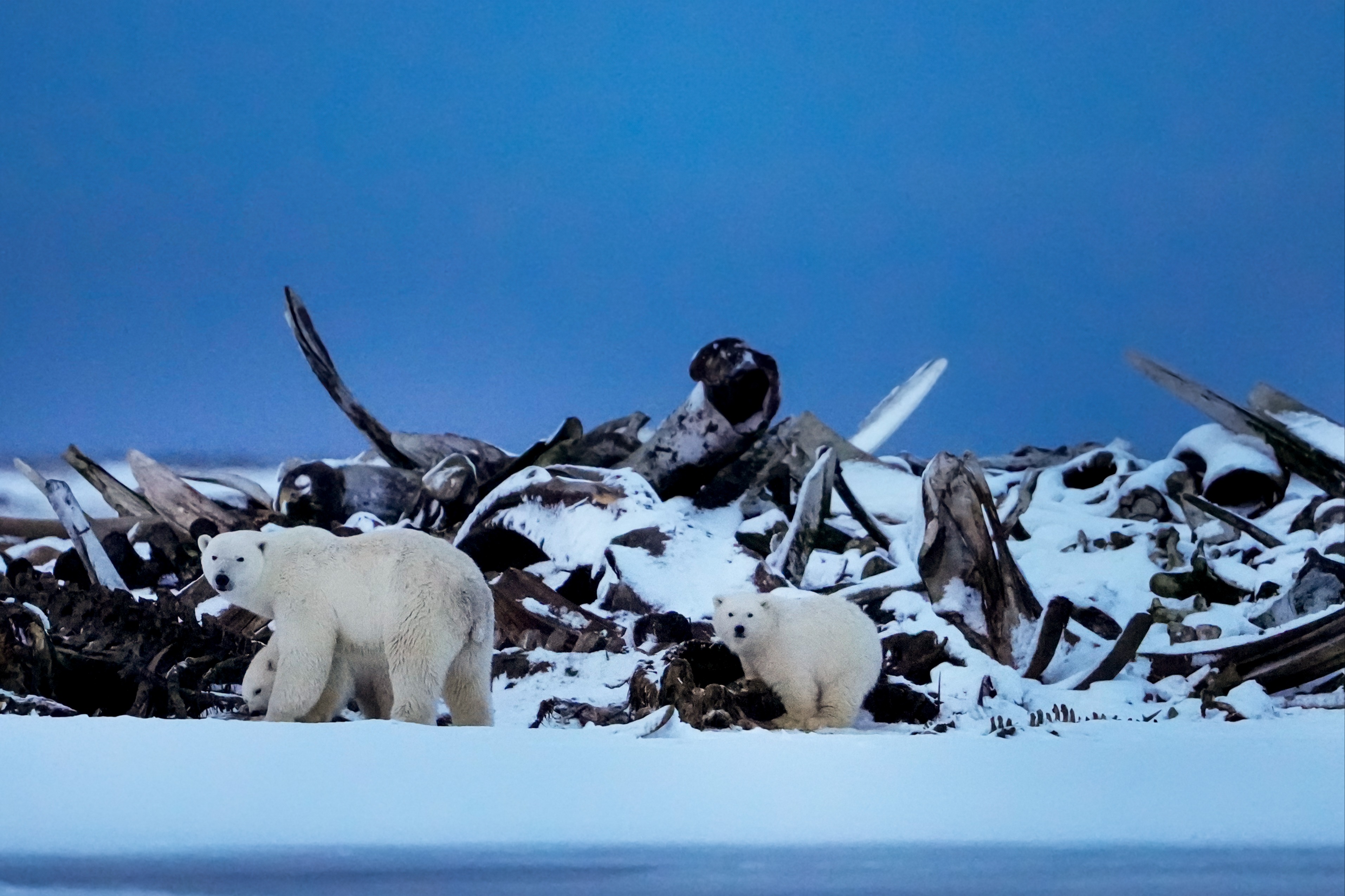
WASHINGTON — Some polar bears and their cubs already in danger of extinction could be legally killed by private oil-drilling projects in northern Alaska, according to proposed new regulations.
The planned regs — part of of President Trump’s oil lease program and awaiting approval by the US Fish and Wildlife Service — would allow for the “incidental, unintentional take” of a small number of the majestic white bears, as well as Pacific walruses, by energy companies in a critical habitat without facing legal consequences.
“Take” is a broad legal term that includes any form of killing or harassment. While the proposed rule does not flat-out authorize the killing of the animals, it does protect the companies from legal prosecution if some bears and walruses die during the course of the work, the agency conceded as part of a review.
Polar-bear cubs also could be abandoned to the deadly elements if the drilling activities scare off their mothers, while the walruses are in danger of being trampled to death by other walruses if human activity spooks them into a stampede.
The proposal is going through the federal regulatory process ahead of an auction of oil and gas leases in the Arctic National Wildlife Refuge (ANWR), which is home to more than 300 animal species, including polar bears, caribou, wolves and moose.
The auction is scheduled for June 5 and is part of Trump’s plan to expand oil and gas drilling in Alaska.
The Interior Department told The Post that no killing is planned — including of bear cubs — but didn’t deny it may occur.
“The regulation includes strict mitigation, monitoring, and reporting requirements designed to minimize impacts and protect these species while allowing lawful energy activities to proceed,” a rep said.
“No lethal take of polar bears or Pacific walruses is anticipated for the proposed activities, including cubs.”
But the leasing area includes the Beaufort Sea, a critical denning area and breeding ground for polar bears.
Animal-rights groups said they worry that the drilling activity in that area could scare off the mother bears, leaving their cubs alone and helpless in the Arctic tundra.
The Fish and Wildlife Service conceded in its review that “if unintentional disturbance of a female polar bear by human activity during the denning season caused the female to abandon her cubs in the den before the cubs can survive on their own, incidental lethal take of polar bear cubs would occur.”
The Southern Beaufort Sea polar bear population has faced serious challenges and is in danger of extinction, having declined approximately 40% during the 2000s and showing no signs of recovery. There are only about 900 bears in that area.
Nicole Whittington-Evans, senior director of the Alaska and Northwest programs at Defenders of Wildlife, said the deaths of these cubs could only further endanger the bear population, despite the agency’s argument the impact of such a tragedy would be “negligible.”
“The agency’s analysis suggests that potential Southern Beaufort Sea polar bear cub deaths resulting from these activities would have a negligible impact on the population overall, which is incorrect and a notion we dispute,” she said.
The proposed Fish and Wildlife Service’s rule would allow energy companies to disturb the animals while conducting operations such as drilling, transporting oil and seismic tests.
Those disturbances could result in animal deaths, the agency conceded.
“Human actions can result in the mortality of polar bears,” the agency notes. “Incidental lethal take of walruses could occur if the animal were directly struck by a vessel or trampled by other walruses in a human-caused stampede at a walrus haulout site.”
But the small number of deaths anticipated would have a “negligible impact on the species,” the Fish and Wildlife Service wrote, citing its own studies on the matter.
The Alaska Oil and Gas Association petitioned the agency for the rule.
But it did not specifically request “authorization for lethal take of polar bears or walruses,” spokesman Steve Wackowski told The Post in a statement.
“And we do not expect it would ever be necessary,” he said.
But it is “routine” to include that authorization because “the remote possibility of lethal interactions is always evaluated as part of the regulatory process,” the rep said.
Polar bears could be a fatal danger to human workers in the region.
From mid-July to mid-November, there are a large number of bears in that area, Fish and Wildlife noted, meaning “the chances for human-polar bear interactions increase.”
To try and keep the danger at a minimum, the agency is requiring companies to develop plans to try to reduce the number of interactions and to “prevent polar bears from associating humans with food.”
If finalized by the agency, the permits to these companies would last five years and, notably, protect the energy companies from any legal liability tied to the harm or deaths of endangered animals.
The Trump administration has aggressively pushed for energy development and expansion in Alaska. The Bureau of Land Management said the coastal plain area could contain 4.25 billion to 11.8 billion barrels of recoverable oil.
The June auction will be the first lease sale in ANWR’s coastal plan, as approved under Trump’s One Big Beautiful Bill Act.
But the area is also the largest wildlife refuge in the country. Environmental groups have decried plans to open it for drilling.
“Simply put, these new leases will harm and kill polar bears,” said Hallie Templeton, legal director for Friends of the Earth, in a statement.
Overall, there are between 4,000 and 7,000 polar bears in Alaska, the only place in the United States where the bears inhabit. Polar bears are listed as threatened under the Endangered Species Act, meaning they are a species likely to become endangered.
Polar bears live on average 15 to 18 years. Adult polar bears have no natural predators except other polar bears — and humans.
Walrus interactions are expected to be less likely, given rare sightings of them in the area.
The animals migrate between Russia and America so their population is difficult to estimate. Figures range between 50,000 and 500,000.