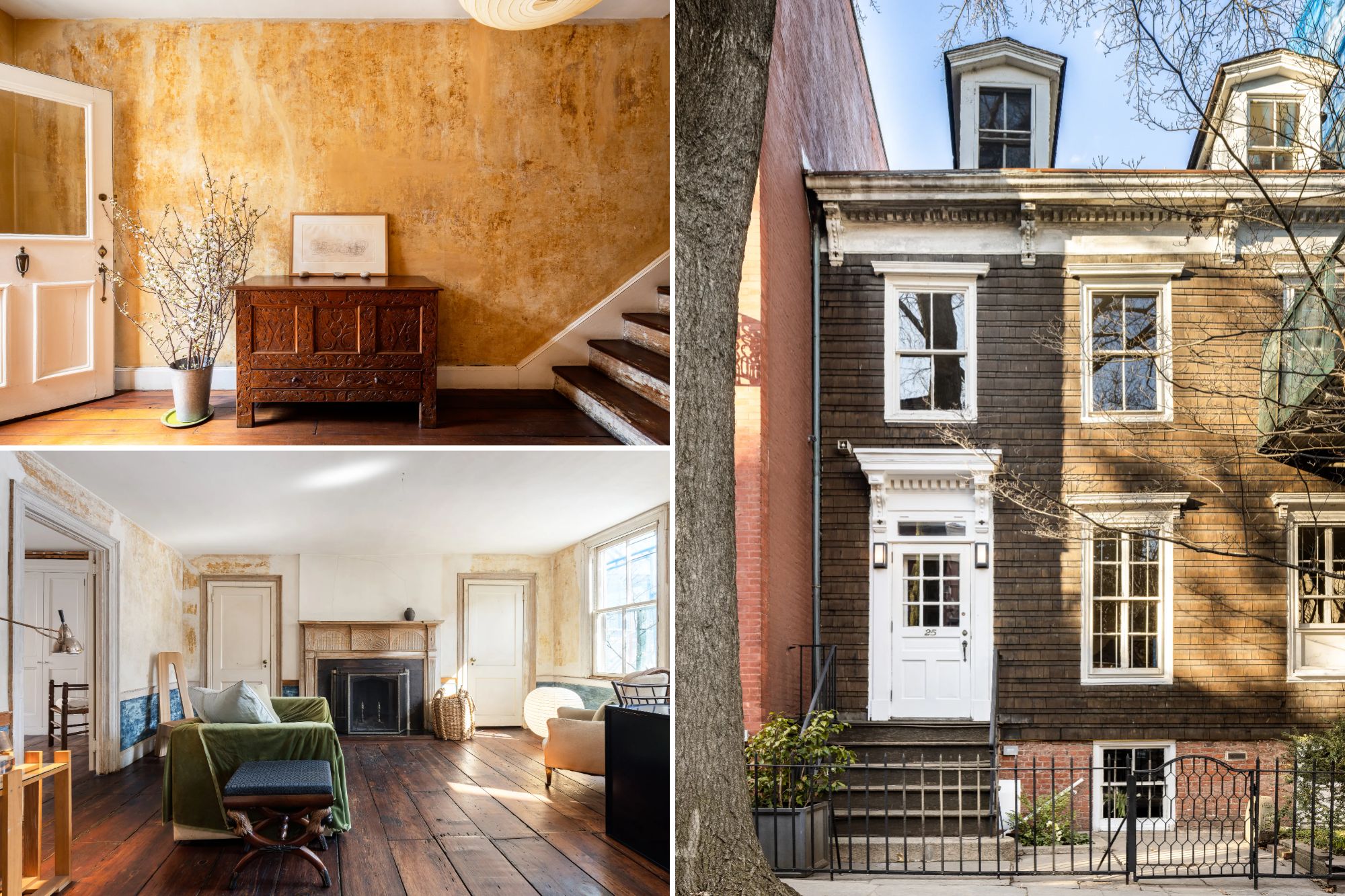
At 25 Cranberry St. in Brooklyn Heights, a Revolutionary War-era farmhouse emerges from obscurity for the first time in three decades — and it may be the most authentic address in New York City.
From the sidewalk, it announces itself quietly, its Federal frame stepping just slightly forward from its neighbors, as though reluctant to fully blend in. Inside, wide-plank floors — their wood arriving centuries ago as ship ballast from England, offloaded in the colonies before being planed and laid — run the length of rooms that still read like an early American home: a parlor, a library, three woodburning fireplaces, and stairwells with their original banisters intact. The walls, stripped back to their first chalky patina, carry the ochre and indigo hues of plaster that hasn’t been papered over, painted out, or touched since long before this city had its grid.
“Everything original has been saved,” Joan Goldberg of Brown Harris Stevens, who holds listing, told The Post. Goldberg has now brought the property to market at $4.9 million — the first public offering since 1995. She has handled perhaps two other properties like this in her career spanning more than two decades.
“This house is in a class by itself,” Goldberg said.
Built in the very late 1700s and formally recorded by the New York City Registrar in 1828 — during a period when the city was reconstituting property records lost to fire and flood — 25 Cranberry predates the street grid imposed on Brooklyn Heights and most of what would become the borough’s residential fabric.
Goldberg, who studied architectural history sleuthing through the Municipal Art Society, explains that the city’s recording of all structures in the 1820s was a bureaucratic fresh start. The house, she believes, is likely from around 1790 to 1795.
“Everyone with any knowledge of the building styles feels that,” she said.
The building’s very floorboards carry a transatlantic story. Massive logs crossed the Atlantic as ballast in trading ships, stabilizing the vessels on their westward voyages. Once unloaded on these shores, the timber was planed into the very planks that survive underfoot today.
By some combination of fortune and landmark protection, the house survived intact while its neighbors were modernized, subdivided or rebuilt entirely. It is, by Goldberg’s reckoning, the last original wood-frame farmhouse in Brooklyn Heights available for purchase.
“There is the occasional wood-frame house here and there,” she said. “This is the last original one.”
When art dealer Peter Freeman and Elisabeth Cunnick purchased the property in 1995, they found a house that had accumulated decades of postwar improvements: layered flooring, papered-over walls, the residue of mid-century taste. Rather than clear it all and start fresh — what Goldberg pointedly refuses to call a gut renovation (“If you were a fisherman you have to gut your fish,” she says, “I don’t think it should be gutting a house”) — the couple worked in the opposite direction entirely.
They pulled up 1950s and 1960s flooring to reveal the extraordinary original planks beneath. They stripped the walls of accumulated wallpaper, layer by layer, until they reached the first plaster and its original pigment.
Freeman, a New England native with a connoisseur’s instinct for early American furniture — he started collecting 17th-century pieces while at Harvard — applied to the house the same archaeological patience he brought to his gallery work, which included exhibitions of Ellsworth Kelly and Gerhard Richter mounted for institutions, not commerce.
Cunnick, meanwhile, brought her own acute sensibility: she had served as fiction editor at the renowned literary journal Conjunctions before founding A/D, a firm that commissioned living artists to create functional objects for production.
The house became a container for both lives: a 1964 Sigmar Polke drawing in the dining room, hand-blown glass vases by Jennifer Bartlett on a circa-1840 New Hampshire table, a Claes Oldenburg plaster sculpture, desks by Donald Judd, a wire sculpture by Richard Tuttle. A solid-lead cylindrical work by Richard Serra from 1968 shares space with a 17th-century Italian coral tree and paper picnic plates by Roy Lichtenstein. A Chinese altarpiece dating to around 3000 BC sits inside the original carved-wood fireplace alongside a Tuttle piece from 1971. On one wall, the trompe-l’oeil painting Almanac and Pipe by John F. Peto from the 1890s; in the library, a marble-topped guéridon signed by its Belgian maker, Jean-Joseph Chapuis, circa 1815.
The result was, in the couple’s own framing, something deliberately unfinished. The kitchen ceiling still exposes its laths. A naked lightbulb remained because no fixture ever fully satisfied. The dining table was, for years, a hollow-core door on aluminum trestles.
“There’s a thin line between a fine carelessness and squalor,” Cunnick observed — a formulation that became something of a household motto and the philosophical spine of the entire project.
The home was featured in World of Interiors in December 2005, photographed by Simon Upton. The spread captured what the magazine called an “intensely private affair, where each rough edge is as considered.” For those who encountered it then, the images carried an almost hallucinatory quality: a New York interior that genuinely looked like no other.
The house sold one work to buy the house itself. As Cunnick has explained, it was “the largest drawing Andy Warhol ever made — a portrait of Chairman Mao, which is now in a museum.” That drawing was still in residence when two Tibetan monks came to bless the property.
“The artist Richard Tuttle inspected the house right at the beginning and he saw the ghost of a woman,” Cunnick recounted. “In fact, the previous housekeeper would always leave her a little whisky on the mantelpiece. So we had two Tibetan monks come to bless the house, chanting prayers, making a bonfire for all the local ‘hungry ghosts’. Then they saw Mao, fell very silent and left soon after.”
The house also attracted the living. Pianist Cedric Tiberghien stayed there before his Carnegie Hall debut, using the couple’s grand piano to rehearse. Chanel desired to stage the rooms for a fashion shoot, but the owners politely declined due to time restraints. Artists, writers, and figures from the New York and international art worlds passed through its parlor with some regularity.
“Their milieu is artistic,” Goldberg said simply.
The house now measures approximately 3,263 square feet across four floors, with four bedrooms, one full bath, one half bath, a dressing room, a proper library, a parlor, a kitchen and a dining room.
The sole concession to the postwar era is a 1950s blue ceramic bathroom, left in place as an artifact of a different kind. Two woodburning fireplaces remain active. The lot stretches 101 feet deep, with mature trees and garden stones that once marked an old farm boundary.
Goldberg notes that the property carries genuine potential for thoughtful expansion: the rear of the top floor, tucked beneath a steeply pitched roof, could be opened to create a full primary suite with a terrace that would remain invisible from the street.
“That would make it much more usable and appealing to a new family,” she said.
Cunnick, who is now the sole owner following the couple’s separation and subsequent divorce settlement in 2020, is selling because she has a house in Connecticut and, practically speaking, does not require two full properties.
She will keep a smaller foothold in New York for cultural life: the ballet, the opera, the choral society at Grace Church where she sang for years.
“People who are coming want this,” said Goldberg. “They’re looking for authenticity. Many townhouses, look like condos now, frankly. They’ve taken on that very modern feeling. But we’re getting a big response from the audience that longs for something real.”
That audience will find, at 25 Cranberry Street, something New York almost never produces. It is a home whose owners understood, as Freeman once put it, that “there’s a pleasure in looking at things hard enough to understand them and enjoy what they can tell you.”