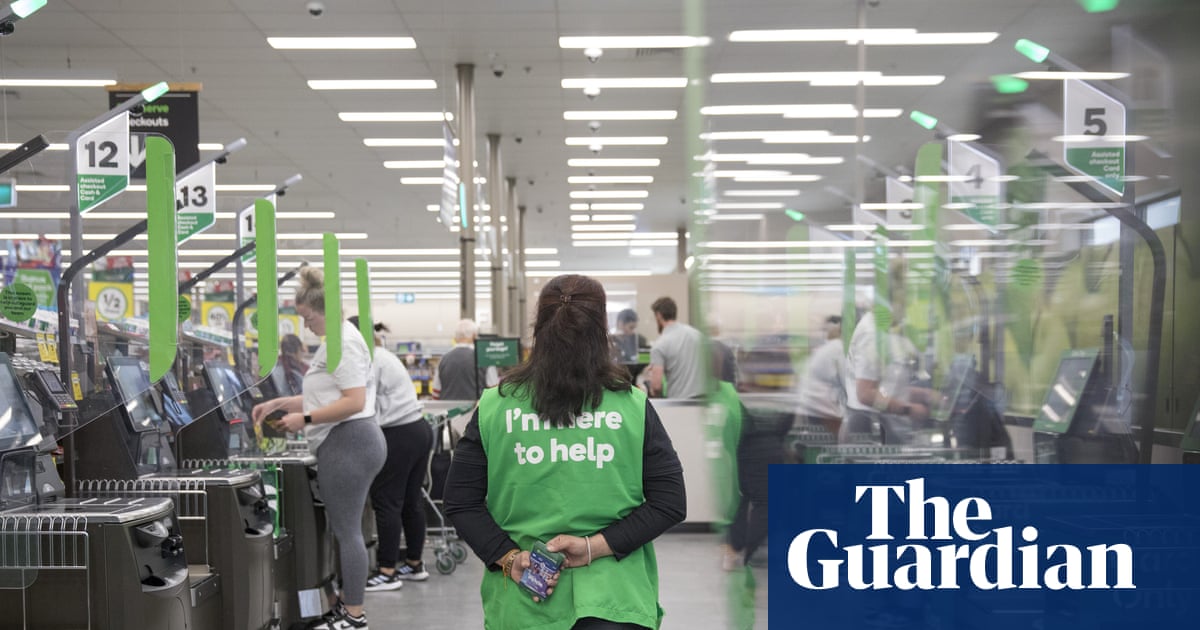
The ACCC alleges Woolworths broke Australian consumer law by offering ‘illusory’ discounts through the misleading use of its ‘Prices Dropped’ promotion program. Photograph: Bloomberg/Getty ImagesView image in fullscreenThe ACCC alleges Woolworths broke Australian consumer law by offering ‘illusory’ discounts through the misleading use of its ‘Prices Dropped’ promotion program. Photograph: Bloomberg/Getty ImagesWoolworths engaged in ‘marketing magic’ to trick customers, consumer watchdog tells courtThe trial between the Australian Competition and Consumer Commission and the supermarket giant began in the federal court in Sydney on Tuesday
Get our breaking news email, free app or daily news podcast
Woolworths engaged in “marketing magic” to trick customers into thinking they were getting genuine discounts as part of the supermarket’s “Prices Dropped” promotion, the consumer regulator has told a court.
The landmark trial between the Australian Competition and Consumer Commission (ACCC) and Woolworths began in the federal court in Sydney on Tuesday, almost two months after hearings ended in its very similar case against Coles.
The ACCC alleges Coles and Woolworths broke Australian consumer law by offering “illusory” discounts on hundreds of everyday products through the misleading use of their respective “Down Down” and “Prices Dropped” promotion programs.
Read moreThe court heard opening statements from the ACCC and Woolworths on Tuesday.
During the ACCC’s opening statements on Tuesday, Justice Michael O’Bryan pressed the consumer watchdog’s lawyers on one of its central claims.
The ACCC alleges that, between September 2021 and May 2023, Woolworths temporarily increased the prices of at least 266 products before placing them on “Prices Dropped” promotions to make shoppers think they were getting a discount.
The strategy is known as comparative or “was/is” pricing. Woolworths marked these products with red-and-white shelf tickets, displayed in store and online, with the “dropped” price alongside a “was” price.
The third “dropped” price was in most cases higher than the original long-term price had been before the short-term price spike, which the ACCC argues was a deliberate strategy to soften price increases that had been planned in advance.
Court documents show the products were sold at their first price for 180 days or longer, before their prices were increased by at least 15% but only for a period of 45 days or less.
O’Bryan questioned whether the length of time the items were sold at the second, increased price was relevant to the ACCC’s argument that Woolworths had falsely communicated to customers they were getting a discount on the third price.
He said shoppers probably would not analyse the “was/is” prices on an item’s promotional ticket to such a degree, and the ACCC’s case relied on a “level of analysis that consumers aren’t going to think about”.
“Whether … the saving is … real might depend upon a range of factors including the period [of time] in which the ‘was’ price had been in the market, but also including: how was the ‘was’ price established?” he said.
O’Bryan asked similar questions of the ACCC in its case against Coles in February. On Tuesday, the watchdog’s barrister, Michael Hodge, pushed back.
Hodge said consumers “at least” understood “very simple” concepts, including that a “Prices Dropped” ticket meant an item’s long-term, regular price had genuinely decreased.
“It communicates to a consumer that Woolworths has done something remarkable or unusual, it has dropped the regular shelf price,” Hodge said.
He described the strategy as “subtle magic” and “marketing magic”.
Hodge presented to the court an example of a family pack of Oreos, which was at a first price of $3.50 for nearly two years, then lifted by 43% to $5 for 22 days before it was placed on Prices Dropped program at a price of $4.50.
He said that while the item’s new ticket told consumers the packet of biscuits “was” $5, they were paying a dollar more than the month before.
“If they were to contrast this price history with what is conveyed to them on the product, the view that they would form is that the ticket was misleading or false,” he said.
2:42Coles and Woolworths are fighting claims of fake discounts and a lack of competition - videoRobert Yezerski, SC, representing Woolworths, rebuffed the ACCC in his opening submissions later on Tuesday.
Yezerski said the period of time being examined was one of high inflation where suppliers were requesting “very large cost increases” and consumers were “expecting” prices to increase.
“The idea that the consumer is approaching their weekly shop on the basis that there’s some assumed level of price stability … we think is just not correct as a matter of evidence,” he said.
The statement of agreed facts between the ACCC and Woolworths shows the supermarket often negotiated with suppliers to offer “discounts” on products at the same time as it agreed to raise their prices.
Of 245 products identified by the ACCC, Woolworths and the supplier had agreed on the item’s final “discounted” price in advance before the products were temporarily inflated.
However, Yezerski said Woolworths denied the ACCC’s allegation that in many cases the second inflated price was only implemented in order to establish a higher “was” price for the purpose of permitting the supermarket to later advertise at a discounted drop price.
“We say that it’s just not a correct characterisation of what was occurring,” he says.
Yezerski said the court must consider the “true commercial context” at the time.
He took the court through the example of Lucky Dog Bones, one of 12 products sold at Woolworths that the trial will scrutinise in detail.
The dog treats were sold at $4.50 under the “Prices Dropped” promotion for more than a year.
Woolworths then increased the price to $6.50 for 29 days before putting it back on the “Prices Dropped” promotion at $6 for several months.
Yezerski said Nestle Purina, the supplier of the dog treats, had recommended the retail price be lifted to $6.50.
“The ACCC’s contention that that increase in price to $6.50 was artificial or was only for the purpose of showing a drop in price, we say is just not reconcilable with the true facts and with the negotiation,” he said.
Woolworths phased out its use of the “Prices Dropped” program at the end of 2024.