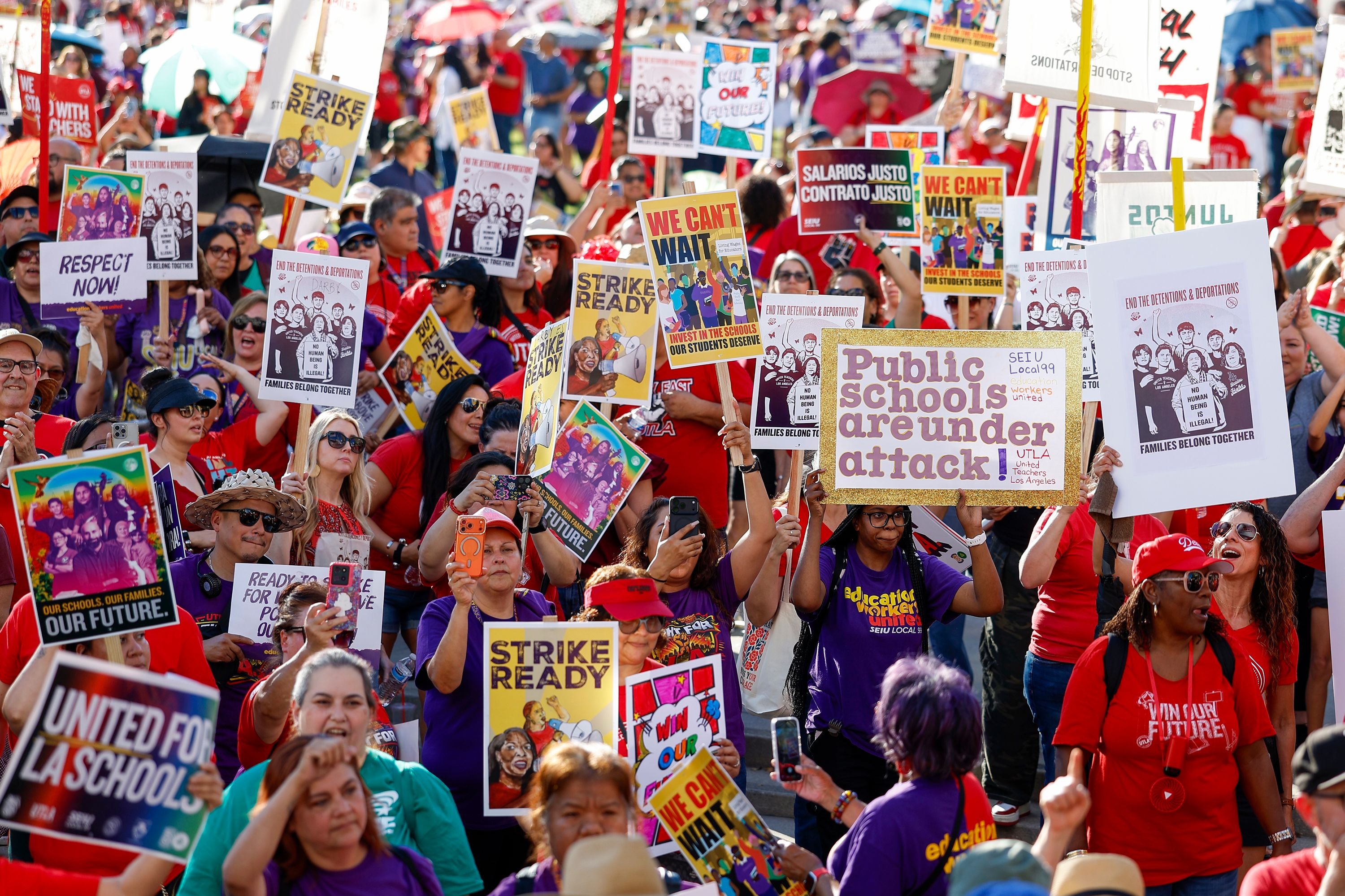
The Los Angeles Unified School District narrowly avoided a strike that could have shuttered schools for nearly 400,000 students. That is the good news.
The bad news is that the price of avoiding that disruption appears to be labor deals costing the district nearly $1.2 billion annually.According to news reports, the final tentative agreement, reached with SEIU Local 99 in the early morning hours, includes:
No serious observer should pretend these are modest adjustments.
The price of avoiding a strike appears to be nearly $1.2 billion annually. CHRIS TORRES/EPA/Shutterstock They are substantial permanent obligations layered onto a district already struggling to live within its means.
The immediate political crisis may have been avoided. The underlying fiscal crisis was not. In fact, it was almost certainly made worse.What makes this settlement difficult to defend is the condition of the institution that agreed to it.
LAUSD is already confronting structural deficits, declining enrollment, depleted reserves, and legal liabilities.LAUSD operates with an annual budget of roughly $18.8 billion, yet it faces multibillion-dollar structural deficits in the years ahead. It has been drawing down reserves that once approached $5 billion.
Enrollment has fallen sharply, and the district has lost roughly 75,000 students in recent years. Because state school funding is driven in substantial part by attendance, fewer students mean less operating revenue.Staffing has not been reduced in proportion to the district’s enrollment decline. During the pandemic, LAUSD expanded parts of its workforce with temporary federal funds. The money is gone, but too much of the spending structure remains.
Mayor Karen Bass joined the public celebration once the agreements were reached. David Buchan for California Post Add the district’s staggering legal exposure, including more than a billion dollars already committed to sexual-abuse settlements, with additional claims pending, and the overall picture is bleak.This is the context in which district leaders agreed to large compensation increases.Sonja Shaw put the matter plainly in comments reported by The California Post: “Schools must be able to attract and retain teachers, and good educators deserve fair pay and support. However, we cannot continue throwing hundreds of millions more into a broken system without real accountability, especially when more than half of students can’t even read or write at grade level, as is the case here.”That is a harder truth than the one offered in the self-congratulatory rhetoric surrounding this deal.
The question is not whether school employees deserve respect. Of course they do.
The question is whether a district marked by academic underperformance, financial deterioration, and bloat should expand permanent obligations without any corresponding commitment to reform.Mayor Karen Bass inserted herself into the negotiations and then joined the public celebration once the agreements were reached. She emphasized her connection to LAUSD as a graduate, parent, and grandparent and praised the fact that schools remained open rather than shutting for a strike.
Bass never publicly made the case for taxpayers, affordability, sustainability, or the basic reality that LAUSD cannot keep promising what it cannot pay.Instead, Bass played the familiar role California Democrats often play in labor disputes: facilitator for organized labor’s demands, not steward of the public interest.
Her intervention did not correct the district’s priorities. It produced a political truce purchased with money the district does not clearly have.That is not prudence. It is evasion.The broader point is not merely that Bass –– and of course, the district itself –– sided with the unions. It is that they once again displayed little appetite for the kind of fiscal restraint that governing requires.
In progressive political culture, restraint is often treated as a moral failure.
The result is that basic arithmetic is displaced by performative politics and long-term solvency is sacrificed to short-term peace.LAUSD had serious financial problems before this week. It still has them now.
What changed is that its permanent obligations almost certainly grew while the political establishment declared victory.
A strike was avoided, which is no small thing for families who would have borne the immediate burden.
But avoiding disruption is not the same as exercising sound judgment.A government system in distress should be asking hard questions about staffing, priorities, accountability, and sustainability.
It should not be ratifying expensive commitments while congratulating itself for having done so. Yet that is precisely what happened.Sooner or later, reality reasserts itself. Budgets tighten. Bills come due.
Officials who celebrated generosity begin speaking the language of emergency, and taxpayers are told the only options are higher taxes, more borrowing, or creative accounting.This agreement did not solve LAUSD’s central problem. It merely postponed the consequences while making them more severe.
Jon Fleischman, a longtime strategist in California politics, writes at SoDoesItMatter.com.
California Post News: Facebook, Instagram, TikTok, X, YouTube, WhatsApp, LinkedInCalifornia Post Sports Facebook, Instagram, TikTok, YouTube, XCalifornia Post Opinion California Post Newsletters: Sign up here!California Post App: Download here!Home delivery: Sign up here!Page Six Hollywood: Sign up here!