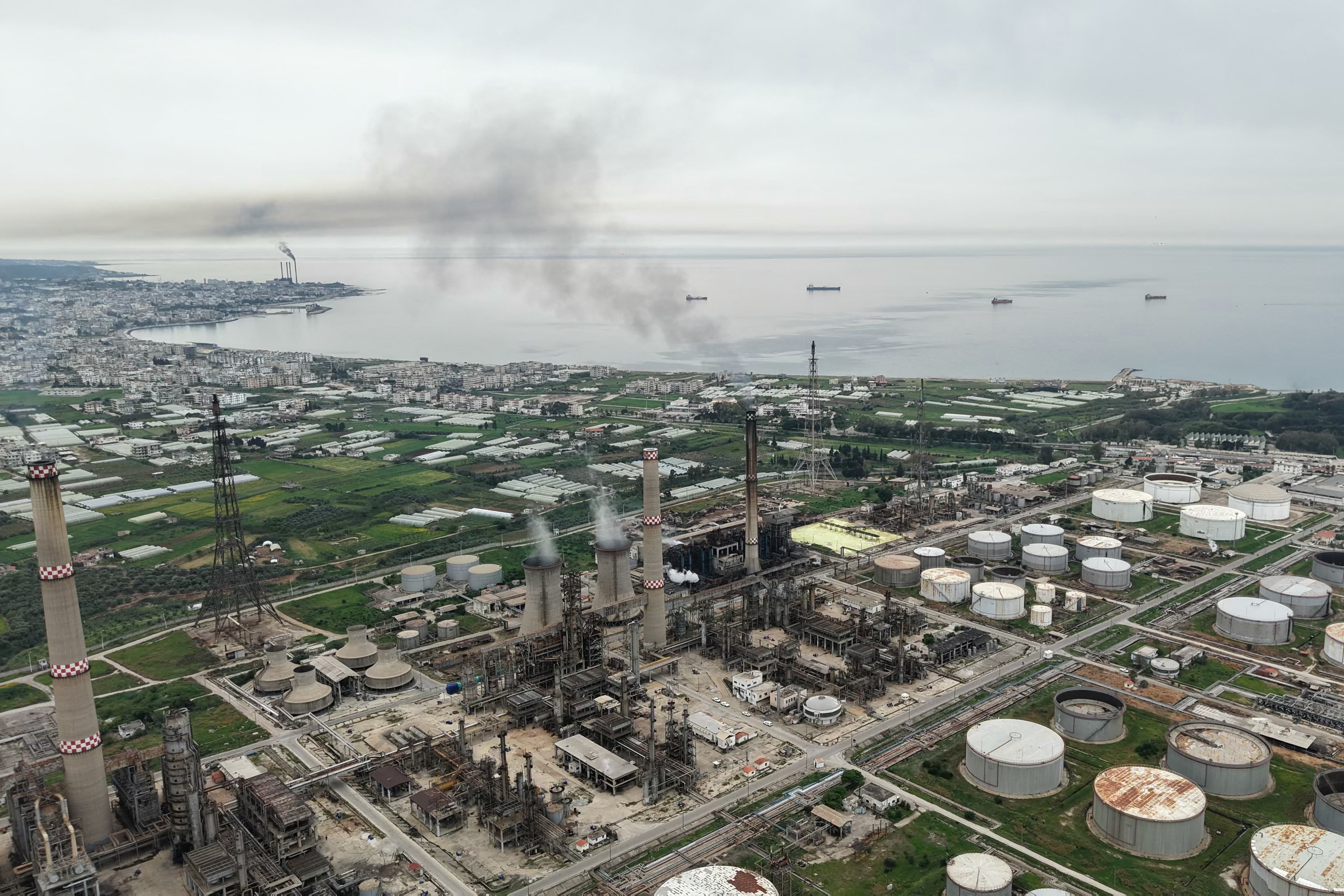
An aerial photograph shows the oil facilities at the Baniyas port refinery on the Mediterranean Sea, in Baniyas on April 15, 2026. AFP via Getty Images Preventing Iran from obtaining a nuclear weapon is a worthy goal in and of itself. But President Trump’s campaign against the Iranian regime carries far broader implications — many of them directly advancing American interests and reshaping the strategic landscape for years to come.
Here are some of the ways the war is changing the world.
Iran’s strikes on Gulf ports have come at great expense — in lives, infrastructure and economic damage. But rather than force its neighbors to capitulate, Iran is hardening the resolve of Gulf states to build permanent alternatives to the Strait of Hormuz.
Saudi Arabia and the United Arab Emirates are already leveraging existing infrastructure — such as the East-West Pipeline and the Abu Dhabi Crude Oil Pipeline, which distribute oil across land to the Red Sea — to make up for some lost capacity through the strait.
They are also considering whether to expand these pipelines or build out new infrastructure altogether. One option worth the Trump administration’s attention is ramping up political and financial support for IMEC, the India-Middle East-Europe Economic Corridor, and facilitate the construction of pathways to move Gulf energy to India and Europe in ways that bypass the Strait and strengthen regional partners.
Even if the strait fully reopens once hostilities end, the strategic calculus will have shifted. A region that has invested in redundant export infrastructure cannot be held hostage to Hormuz — eliminating the choke point’s value as an instrument of coercion for any future adversary.
Iran sustains itself through shadow banking networks and shell companies that route cash to the Iranian regime, violating US sanctions and leveraging financial hubs like Dubai.
In 2024, 70% of those funds passed through opaque companies in the United Arab Emirates. The UAE appears be taking initial steps to cut off the cash taps, after threatening to freeze billions in Iranian assets and finally close its secrecy banking loopholes. America needs to push Dubai to shut down Iran’s shadow banking networks for good — sealing off the financial pipelines that move Iranian illicit oil proceeds.
A prolonged strait closure has hurt China, but it also damages America’s Asian partners. Japan imports roughly 90% of its oil from the Middle East. South Korea depends on Hormuz for nearly 70% of its crude. Taiwan’s semiconductor sector is acutely exposed, and India draws a third of its crude from the Gulf. All four face constrained supply and price spikes.
Even if the Strait of Hormuz fully reopens, the oil market will be completely upended. NY Post Design America is helping to fill in the gaps, and could lock in long-term supply agreements for key partners. Already, US crude exports have surged to a record 5 million barrels per day. This conflict could result in a major boost for the US oil and liquefied natural gas markets.
China’s role as a key supporter of the Iranian regime is also under increased scrutiny. China has purchased approximately 90% of Iran’s exported crude in recent years and has, in exchange, provided precursors for Iran’s ballistic missiles as well as the satellite technology that the Iranian regime has used to target US military outposts.
Now, the Treasury is threatening sanctions for banks in China and Hong Kong that, like Dubai, have long funneled cash to the Iranian regime. Cutting off these shadow banking pathways will be vital to economically starving Iran’s military.
Spiking oil prices gave Vladimir Putin a brief boost, but he’s bogged down in Ukraine. And now he’s lost his key Middle East allies — first Bashar al-Assad in Syria and now Iran. Putin should see clearly that much of Trump’s economic playbook in Iran could also be taken against Moscow. Trump could move to blockade Putin’s shadow fleet tankers and take aim at the banks facilitating the flow of funds to Moscow.
If Putin is unwilling to return to the negotiating table and agree to an end of the war on America’s terms, President Trump should make clear that Moscow’s energy cash could be at risk.
No matter how the conflict ends, Iran’s ability to fund its terror proxies like Hamas, Hezbollah and the Houthis will have been hit hard. The joint US and Israeli strikes have taken aim at the key sectors of the Iranian economy that fund these groups.
It will take decades to rebuild this lost capacity, but these groups don’t rely on Iran alone. They engage in organized corruption, extortion and criminal racketeering — and they are expanding their foothold, and increasingly in the Western Hemisphere.
Washington must not mistake a weakened Iran for a defeated one. The infrastructure of terror runs deep, and finishing the job will require sustained pressure — financial, military and diplomatic — long after the last strike.
Elaine K. Dezenski is senior director and head of the Center on Economic and Financial Power (CEFP) at the Foundation for Defense of Democracies (FDD). X: @ElaineDezenski.