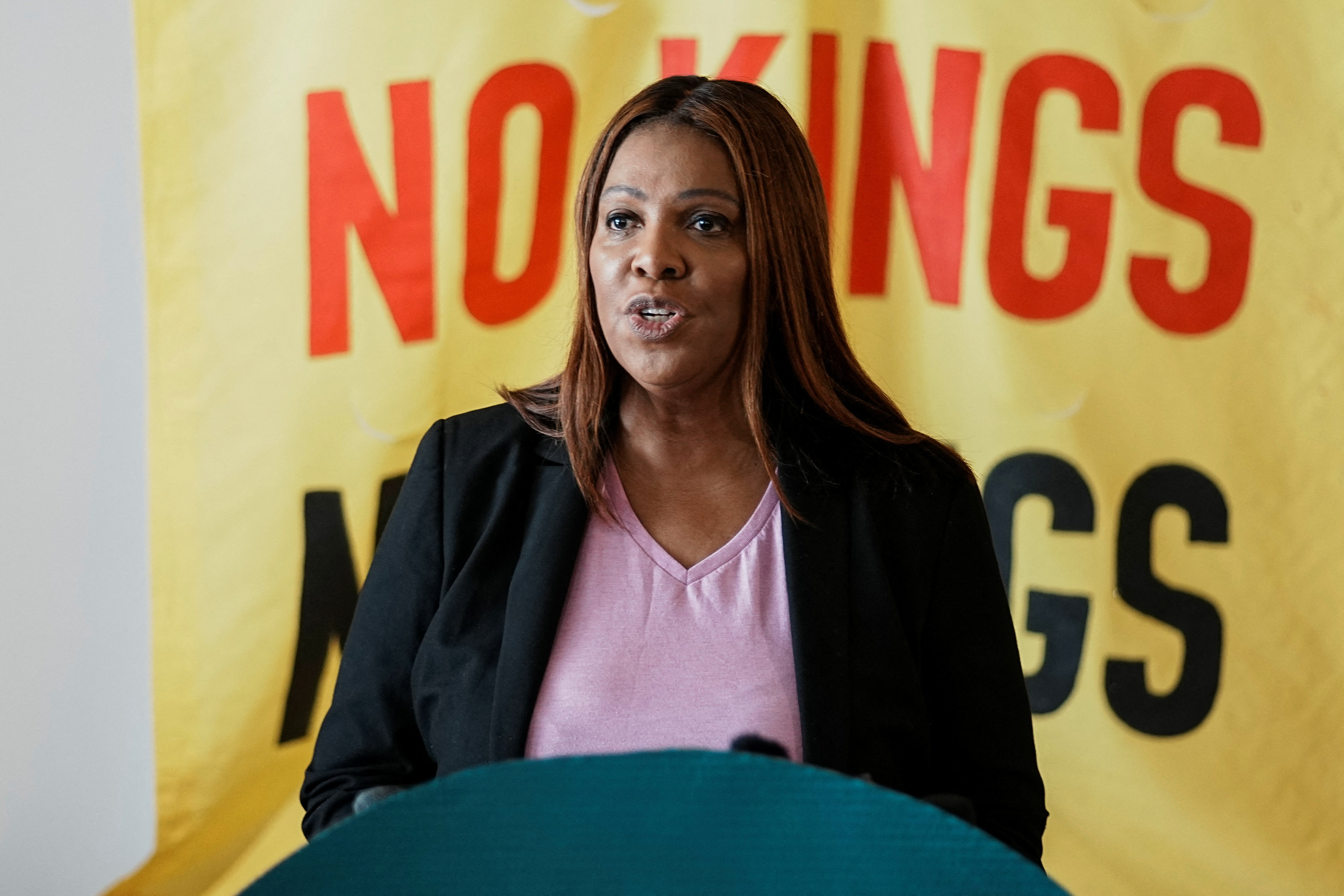
Albany and Attorney General Letitia James are targeting real-estate owners and developers -- weakening private property rights and destroying equity. REUTERS/Eduardo Munoz A stone’s throw from the Brooklyn Bridge, at 70 Middagh St. in the historic Fulton Ferry neighborhood, stands a charming 10-unit apartment building, built in 1897.
But more than a century of residential use took its toll on the rent-stabilized building, and by 2019 few of its essential systems had been replaced.
That’s when David Gomez found a way to square the math.
State law exempted “substantially rehabilitated” buildings from rent-stabilization rules, allowing their owners to charge market rents.
Gomez’s real-estate-development firm, Peak Capital Advisors, could thus restore the building and recoup its multimillion-dollar gut-renovation investment.
But now, Peak has become the latest victim in New York state’s war on developers.
Albany is retroactively challenging $150 million of investments the company poured into restoring 70 Middaugh St. and 30 other buildings across the city — investments made under rules that the state itself created to incentivize housing rehabilitation.
For decades, the Division of Housing and Community Renewal, the state agency tasked with administering rent stabilization, operated under a clear framework: A substantial rehab that replaced 75% of major systems would exempt a building from rent stabilization, provided the building was at least 80% vacant when work started.
At the time of Peak’s renovations, state law didn’t require developers to obtain explicit approval from DHCR.
But in 2023, DHCR abruptly — and without notice — sought to compel Peak to acknowledge that its newly renovated units were still subject to rent stabilization, forcing rents to revert to a fraction of the market rate.
All based on a change in state law that didn’t go into effect until Jan. 1, 2024.
DHCR has already begun challenging the owners of some 11,000 additional units that had also been decontrolled in alignment with state regulations over the prior three decades.
But for Peak, the stakes are especially high: Deeming its buildings still subject to rent stabilization could wipe out as much as $40 million in property value.
Peak sued DHCR in federal court last November, asserting that the state’s actions amount to an unconstitutional regulatory taking without just compensation.
One week later, New York Attorney General Letitia James sued Peak in the state Supreme Court, claiming that it had illegally deregulated its units and engaged in fraud by telling banks and tenants that its buildings weren’t subject to rent stabilization.
James Walden, Peak’s attorney, highlighted the abrupt change in enforcement: “In 30 years of administrative hearings at DHCR, not once did they seek re-regulation of units where a building met the criteria outlined in the Operational Bulletin, until 2023,” he told City Journal.
The crucial legal question for the state’s case is whether Peak’s rehabilitations originally qualified as “substantial” under the established rules at the time.
Peak made significant investments to renovate buildings with systems that were more than a century old.
To say that such a building is not by definition “substandard” in 2026 — even if the structure remained technically “habitable” — is to redefine the word beyond any recognition.
If the court allows DHCR’s stricter interpretation to stand, it sets a dire precedent.
It would mean that no DHCR operational bulletin or directive, past or present, provides a reliable guarantee for developers or investors.
This would open the door to unimaginable bureaucratic overreach: DHCR could arbitrarily decide to go after developers who are abiding by the rules as written and as previously interpreted.
The result would be complete paralysis of New York’s housing market.
Peak’s $150 million investment ensured the structural integrity of dozens of architecturally beautiful buildings for generations to come.
In the case of 70 Middagh St., its new tenants signed leases ranging between $4,750 and $6,880 a month.
These tenants likely include finance-industry workers, lawyers, engineers and other urban professionals — not people living paycheck to paycheck who need rent-stabilization protections.
DHCR’s actions would force Peak into insolvency and push losses onto investors, banks and even taxpayers.
All to provide $1,194-a-month rents to residents inhabiting what are now luxury apartments.
Both DHCR’s and the attorney general’s actions are part of a pattern of targeting property owners and developers.
Whether this pattern is the product of ignorance or a calculated attempt to weaken the institution of private property and destroy equity, the result is the same: making New York an unfriendly environment for real-estate development.
Adam Lehodey is a City Journal investigative reporter. Adapted from City Journal.