A sanctioned Chinese oil tanker crossed the Strait of Hormuz — then was forced to double back and return to Iran after President Trump blockaded the vital shipping lane, according to ship tracking data.
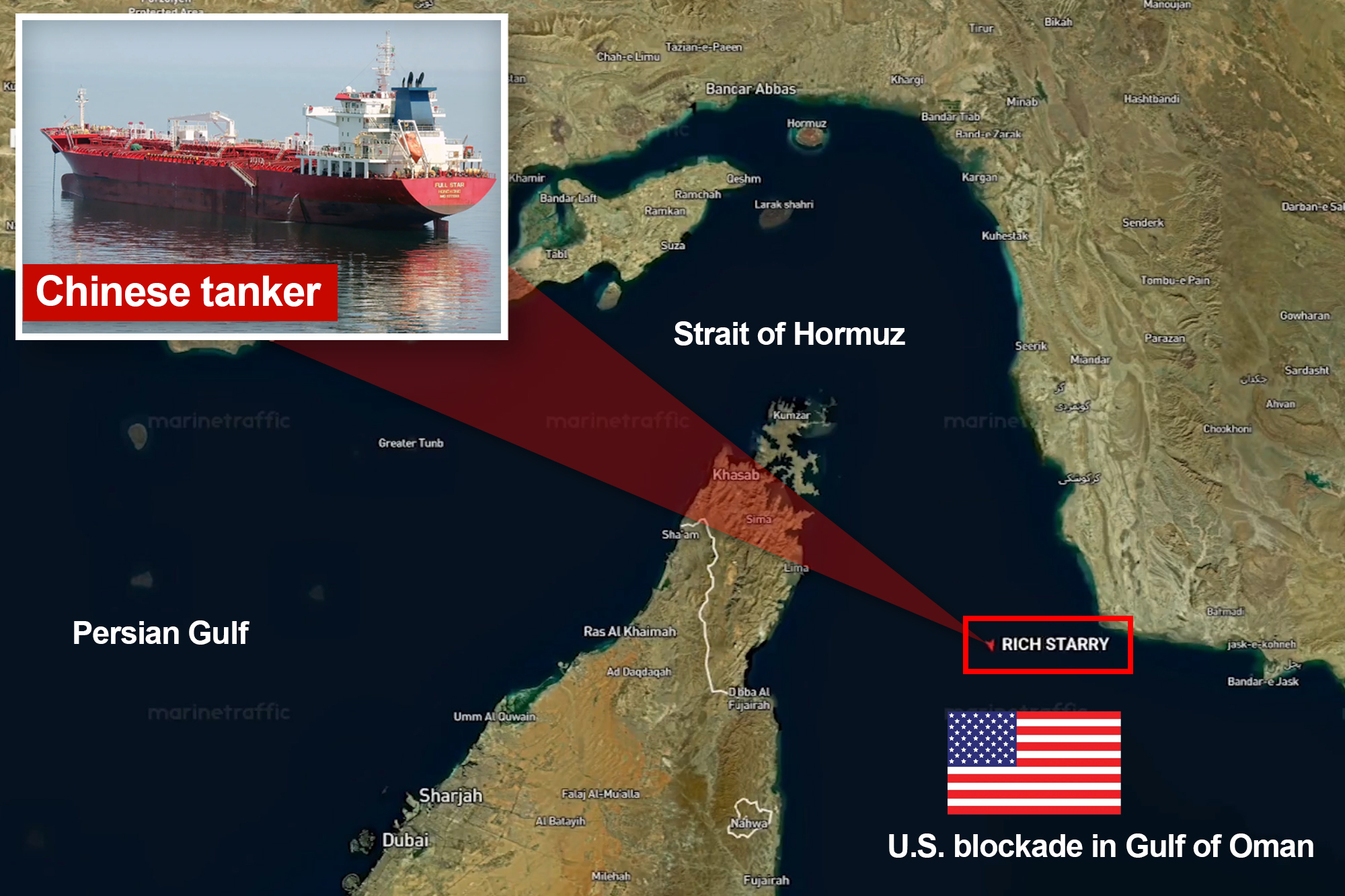
The aborted voyage of the Rich Starry — a Malawi-flagged, Chinese-owned tanker that was blacklisted by the US in 2023 — shows how the US Navy successfully blocked the flow of ships carrying Iranian oil.
Since the war began, most vessels that have traveled out of the Strait of Hormuz have been loaded with Iranian exports — giving the cash-strapped regime vital funds.
So far, the US blockade on the eastern side of the Straight in the Gulf of Oman has stopped at least five ships from heading out into the open ocean, according to the trade analysis firm Kpler.
Iran has stifled nearly all other traffic through Hormuz, which previously carried 20% of the world’s oil, by threatening to attack tankers that don’t pay a ransom.
The Rich Starry, which was previously accused of helping Tehran skirt oil sanctions, had masked its location in the Persian Gulf for more than 10 days before attempting to leave the Strait of Hormuz on Monday night, according to Kpler.
The tanker, owned by the Shanghai Xuanrun Shipping Company and loaded with 250,000 barrels of methanol, initially appeared to make it through the blockade, but updated tracking data revealed the ship stopped in the Gulf of Oman on Tuesday.
The ship then made a U-turn back through the Strait of Hormuz before stopping off the coast of Suza in Iran’s Qeshm Island, near the mouth of the strait, where it remains.
“This is the blockade working as CENTCOM [US Central Command] described: a vessel heading toward an Iranian port, turned back before it could load,” Kpler analysts told CNN.
CENTCOM boasted that six merchant ships were caught and forced to dock along the Gulf of Oman within the first 24 hours of the blockade, which went into effect on Monday at 10 a.m. EST.
Among the ships was the Elips, a Comoros-flagged methanol carrier that was also under US sanctions, which was also caught being stopped at the same place the Rich Starry was intercepted.
Kpler’s data shows that all the tankers that tried to run the blockade were sitting idle along the Islamic Republic’s coastlines.
At least two of the tankers were directly intercepted by a US destroyer patrolling the waters, a US official told Reuters.
CENTCOM has said that more than two dozen warships were enforcing the blockade on the Strait of Hormuz, along with 10,000 service members.
It remains to be seen if the blockade can be 100% successful in stopping all of Iran’s maritime trade through the Strait of Hormuz, as its shadow fleet has spent years developing tactics to avoid detection in the high seas.
“They are experts at evading detection,” Bridget Diakun, a senior risk and compliance analyst at Lloyd’s List Intelligence, a shipping analysis firm, told the Wall Street Journal.
“It’s not just one or two of them that are doing this; it’s a lot of them,” she added.
Llyod’s found that at least 10 ships tried traveling through the Strait of Hormuz on Tuesday, including the Panama-flagged bulk carrier Manali, which had a history of spoofing its location to avoid being tracked.
Only ships leaving and dealing with Iran are subject to the blockade, according to CENTCOM, with the Manali listing its destination as a port in the United Arab Emirates.
Military and shipping analysts have warned that Iran’s shadow fleet would be trying to test the limits of the blockade and America’s ability to analyze their movements and cargo to see whether they were abiding by the new rules.
President Trump ordered the blockade after peace talks with Iran broke down over the weekend, with the US looking to inflict economic pressure on Iran to end its grip on the Strait of Hormuz, a chokepoint for about 20% of the world’s oil supply.
Since the war broke out on Feb. 28, only a handful of ships have crossed the strait each day, a fraction compared to the more than 130 that passed every day before the conflict.
The majority of the ships that have crossed were linked to Iran and China, with Tehran looking to take full control of the passage and charge tolls as high as $2 million to cross.
As China, the largest buyer of Iranian oil, faces its own economic woes due to the conflict, Trump assured Chinese leader Xi Jinping that the Strait of Hormuz is open for business.
“China is very happy that I am permanently opening the Strait of Hormuz. I am doing it for them, also – And the World,” Trump wrote on Truth Social. “This situation will never happen again.”