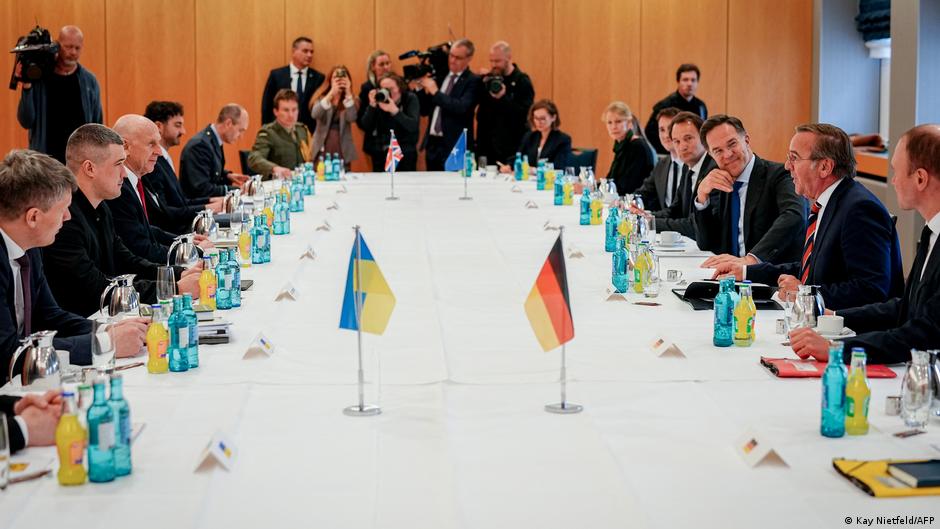
Germany's defense minister warned that Russia "benefits from current developments in the Middle East," as the Ukraine Defense Contact Group met in Berlin. He said rising oil prices were filling Moscow's "war coffers."
https://p.dw.com/p/5CEPMGermany and the UK both warned against losing focus on Ukraine amid the turbulence in the Strait of Hormuz and the Middle East more generallyImage: Kay Nietfeld/AFPAdvertisementGerman Defense Minister Boris Pistorius and his British counterpart John Healey both expressed a desire for deescalation in Iran, the Persian Gulf and the Strait of Hormuz at a Ukraine defense meeting in Berlin on Wednesday. They warned that the war in the Middle East was diverting attention and resources away from Ukraine, while also helping Russia's invasion.
The two countries pledged further military assistance for Ukraine, including Patriot missiles from Germany and drones from the UK, as well as projects to be carried out within Ukraine with international funding.
Ukraine's Defense Minister Mykhailo Fedorov and NATO Secretary-General Mark Rutte also attended the meeting.
"The eyes of the world are on the Strait of Hormuz and the events in the Middle East these days," Pistorius said in English at a press conference at the conclusion of talks on Wednesday. "Quick deescalation and an end to the blockade of the Strait are in our fundamental interest. Unfortunately, these are not in sight right now."
He said it was all the more important to "keep our attention" on Ukraine and not to "falter in our support" for Kyiv.
"One thing is certain and obvious: Russia benefits from the current developments in the Middle East," he said. "The surge in oil price is pouring money into Putin's war coffers, at least for the moment. Moscow is using this money to fund its terror against the brave people of Ukraine."
Pistorius said that the "so-called" Russia-Ukraine peace talks the US has been trying to broker were currently suspended, before adding: "But the truth is, anyway, Russia has never taken them seriously."
He said the short-lived Orthodox Easter ceasefire — which Ukraine's Fedorov told his counterparts was "violated about 2,000 times" and ended right after Easter — demonstrated Russia's intentions.
The Social Democrat politician said the quartet's joint talks in Berlin showed "our unity."
He said that given Russia's regular and widespread drone attacks, air defense was a key component of Ukraine's needs.
"Therefore, air defense is a key component of the support package that we agreed already yesterday," Pistorius told reporters. "It includes hundreds of Patriot guided missiles, that will be delivered steadily over the next four years."
He said Germany would provide additional launchers for IRIS-T air defense systems and also "fund additional deep-strike drones, which will be manufactured in Ukraine."
He said that four years after Russia's full-scale invasion, the relations with Ukraine had "intensified ... from purely military support for Ukraine in its fight against Russia's aggression, to a reliable strategic partnership based on mutual trust."
Pistorius said he wanted to stress how the partnership was "beneficial to both sides."
Germany and Ukraine agree new strategic partnershipTo view this video please enable JavaScript, and consider upgrading to a web browser that supports HTML5 video
The minister also said that he expected the EU "to put its money where its mouth is" and start granting its two-year interest-free €90 billion loan package, "finally."
"After the elections in Hungary, I expect that the blockade within the EU will be lifted soon," he said, in reference to Peter Magyar's recent election victory over longstanding Hungarian Prime Minister Viktor Orban and his Fidesz party, who had been blocking a multibillion-euro loan package to the war-ravaged country.
The money would both enable Ukraine to procure military equipment "sustainably," and to "rebuild the infrastructure Russia destroyed," Pistorius said, adding that he expected EU member states to fund the loans in addition to their existing bilateral commitments, not instead of them.
How the Iran war is hurting Ukraine's chances at peaceTo view this video please enable JavaScript, and consider upgrading to a web browser that supports HTML5 video
Like Pistorius, UK Defence Secretary John Healey said that the consequences of the war in Iran and the wider region were being "felt across the world by all of our citizens," and said that all eyes were on the Middle East, even as Putin "has continued his relentless assault on Ukraine."
Healey praised Kyiv in particular for the assistance it provided to Gulf states in defending against drones, after four years' experience trying to fend off Russian kamikaze drones styled on Iran's Shaheds.
He cited his Ukrainian counterpart Fedorov as saying that in the past 24 hours alone, Russia had launched 1,000 such drones at Ukraine.
"Mykhailo reported that Russian casualties rose by a third and reached more than 35,000 in March, the most on record in a single month," Healey said. "Drones caused 96% of those casualties. Drones have defined this war, they will be decisive to its outcome."
Because of this, Healey said, the UK was planning to deliver some 120,000 drones to Ukraine in its latest wave of assistance.
NATO chief Rutte refrained from criticizing the impact of the war in Iran, but did praise Ukraine for helping Gulf states fend off "indiscriminate attacks" from Iran.
He praised Fedorov, a former deputy prime minister who is relatively new in his current post in Kyiv, saying "your efforts are making Ukraine's military even stronger."
Rutte also welcomed the further commitments for support for Kyiv, saying it was "vital that equipment continue to flow into Ukraine."