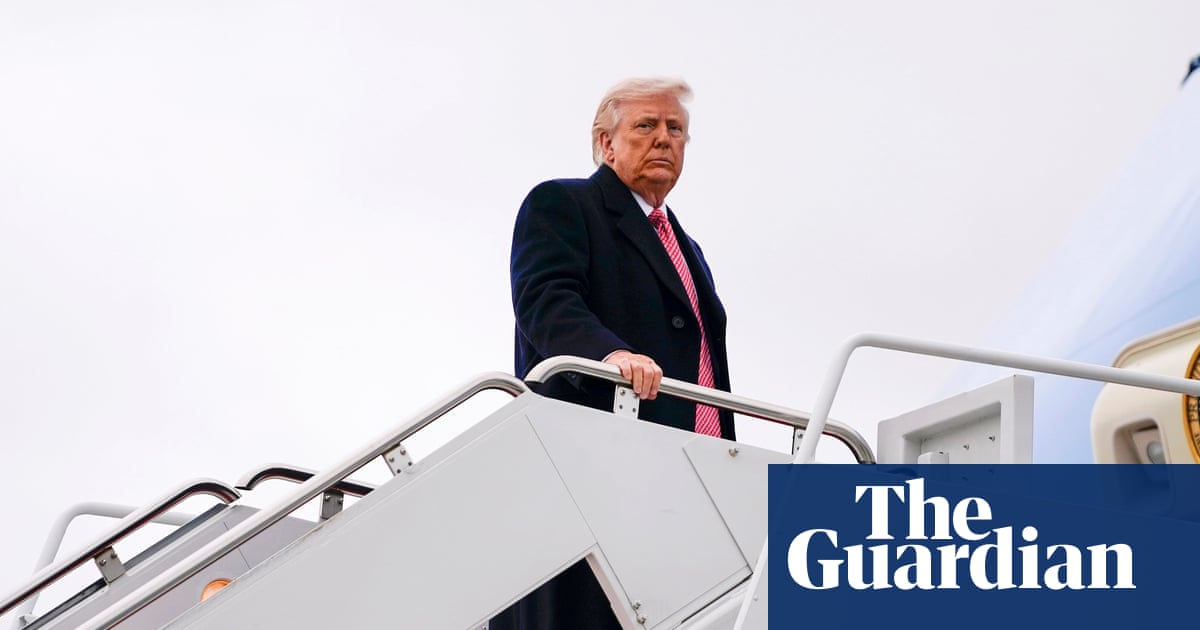
Donald Trump pauses as he boards Air Force One on 27 March 2026 at Joint Base Andrews, Maryland. Photograph: Nathan Howard/Getty ImagesView image in fullscreenDonald Trump pauses as he boards Air Force One on 27 March 2026 at Joint Base Andrews, Maryland. Photograph: Nathan Howard/Getty ImagesFisa surveillance vote sparks fierce debate as Congress splits on warrantless monitoringDonald Trump says he is ‘working very hard’ with House Republicans to extend Section 702 without changes
A controversial law that grants the US government sweeping powers for warrantless surveillance is set to expire next week. Replacing it has inspired fierce debate within the White House and Congress, including a scheduled vote cancelled the day of.
A coalition of progressive Democrats and far-right Republicans is pushing for reform of Section 702 of the Foreign Intelligence Surveillance Act (Fisa), but they face strong bipartisan opposition from lawmakers advocating for an 18-month renewal with no changes, in line with Donald Trump’s demands. House GOP leaders delayed a procedural vote on a clean extension of Section 702 on Wednesday, after the chamber’s rules committee approved the measure on Tuesday night. Republican leadership was expected to bring the measure to the floor on Wednesday but canceled the scheduled vote, amid dissent from privacy advocates in their own party. Legislative action on the bill could still occur later in the day, as Republicans address their internal disagreements.
The US president said on Wednesday that he is “working very hard” with House Republican leadership to get a clean extension of Section 702 approved by the chamber this week. “I am asking Republicans to UNIFY,” he wrote in a Truth Social post. Trump has described the law as an “effective tool to keep Americans safe”, and said that it is “extremely important to our military”, especially during the war in Iran. That marks a dramatic shift from his call two years ago to “KILL FISA” after accusing the FBI of misusing the law to spy on his 2016 campaign. The CIA credits Section 702 with helping to rescue hostages overseas and prevent a terror attack at a Taylor Swift concert in Vienna.
Section 702, first enacted in 2008, allows national security agencies to collect and review texts and emails sent to, and from, foreigners living outside the country, without a warrant. If Americans are talking to a non-American target living abroad, their communications can get swept in, too. The law includes a provision that notes the law will expire without periodically being reauthorized; the current deadline is 20 April.
“It’s intended to facilitate the surveillance of foreigners outside the U.S., but the government also uses it as a tool to spy on Americans without a warrant,” says Hannah James, counsel in the Brennan Center’s liberty and national security program. Intelligence agencies have argued that a warrant requirement would be too burdensome because some queries would not meet the legal standard, and, for those that do, the process could take too long.
Surveillance under Section 702 can continue through March 2027, even if Congress doesn’t extend the law by then, because it operates through yearlong certifications approved by a special federal court that provides judicial oversight of intelligence agencies’ activities. The New York Times reported last week that the Fisacourt renewed its approval of the program for another year.
Congress last reauthorized Section 702 in 2024 when lawmakers passed the Reforming Intelligence and Securing America Act (RISAA). That law extended the program by two years with some changes, including limits and mandatory audits for queries on US citizens. Two years ago, a bipartisan group of lawmakers had supported an amendment that would have created a warrant requirement for Americans’ communications “incidentally” collected under Fisa. But it failed to pass after a dramatic 212-212 tie.
Mike Johnson, the Republican House speaker, delayed this year’s reauthorization vote to mid-April following concerns raised by hardline Republicans about warrantless surveillance. Several Republicans plan to vote against a procedural step up for consideration on Wednesday, POLITICO reported.
“Warrants or bust,” Lauren Boebert, a Colorado representative who is one of several Republican holdouts, has said. Johnson told reporters on Tuesday that he is not willing to add any amendments to the law because doing so “jeopardizes its passage. And it’s far too important.”
Johnson previously said that the reforms Congress adopted two years ago “are working just as planned”. Privacy advocates disagree, describing these changes as “ineffective tweaks to a fundamentally broken law” – and that abuses of the law will continue without a warrant requirement.
These critics also say the federal government has repeatedly violated internal rules about how searches can be conducted. The Department of Justice states that the FBI made 7,413 queries about Americans last year. Privacy advocates say that while this reflects a significant drop from prior years, the FBI’s use of a filtering tool has led to many searches not being counted. The FBI, is required, by law, to track all of its US person queries.
The Foreign Intelligence Surveillance Court has said, in 2022, that compliance problems with the FBI’s querying procedures under Section 702 have “proven to be persistent and widespread”. FBI agents have used Section 702 to search for the communications of protesters, members of Congress, a state court judge, journalists and political commentators.
Republicans are divided on the issue. Jim Jordan, a US representative and chairman of the House judiciary committee, voted against extending Section 702 two years ago. He wrote in a Washington Post Op-ed last April that without a warrant requirement, “the government’s surveillance power will always be subject to abuse”. But last month, he, like Trump, called for a clean extension.
Some Democrats appear to be on the opposite trajectory. Jamie Raskin, a US representative and ranking member of the same committee as Jordan, voted to renew the law in 2024 and against the warrant amendment. He now opposes a renewal without reform.
Raskin wrote in a letter to his colleagues that he believes the “safeguards put in place in 2024 have been badly eroded by the Trump Administration”. “These reforms relied on internal watchdogs to keep the intelligence agencies in line and on the Administration to accurately report its own abuses to Congress and the courts,” he wrote.
Last year, Trump fired all three Democrats on the board of an independent agency that is supposed to ensure the federal government’s counterterrorism and related national security programs have appropriate safeguards for privacy and civil liberties. “The canaries in the coal mine are dead,” said Jake Laperruque, deputy director of the security and surveillance project at the Center for Democracy and Technology.
The looming renewal of Section 702 comes as the Trump administration appears to be widening its surveillance arsenal. The FBI said last month that the agency has resumed buying sensitive location data, which can help the government bypass warrant requirements to identify individuals and their patterns of life.
Travis LeBlanc, one of three Democrats fired from the Privacy and Civil Liberties Oversight Board (PCLOB), worries that the information collected on Americans through Section 702 may be “shared more broadly across the government than we may know” and for purposes unrelated to terrorism and national security. He is concerned about how loosely the Trump administration is defining terrorism, as well as its willingness to use data to surveil protesters and deport immigrants.
Privacy advocates are focused on pushing for a warrant requirement. “We are saying: do the hard and responsible thing and come to the table to put in real protections for Americans. That sort of thing requires debate and compromise,” says India McKinney, the director of federal affairs at the Electronic Frontier Foundation. “By just doing a straight up clean extension, you’re abdicating your responsibility to the people that you are elected to represent.” That the warrant requirement amendment ended in a tie two years ago shows “there is clearly the political will to work on this,” McKinney says. “But the leadership is just not there.”
Xiaoxing Xi, a physics professor at Temple University, only learned the federal government surveilled him under a Fisa order after he was in handcuffs. The DOJ accused Xi, an American citizen, in 2015, of wire fraud and sharing sensitive technology with scientists with China. The charges were dropped four months later. “This is not a joke. It’s not a game,” Xi says. “They turned the lives of my family upside down.”
“If you ask me, there’s no such thing as privacy. If the government wants to know anything, they will know it,” Xi says. “But if they want to surveil an American citizen, they should at least get a warrant.”