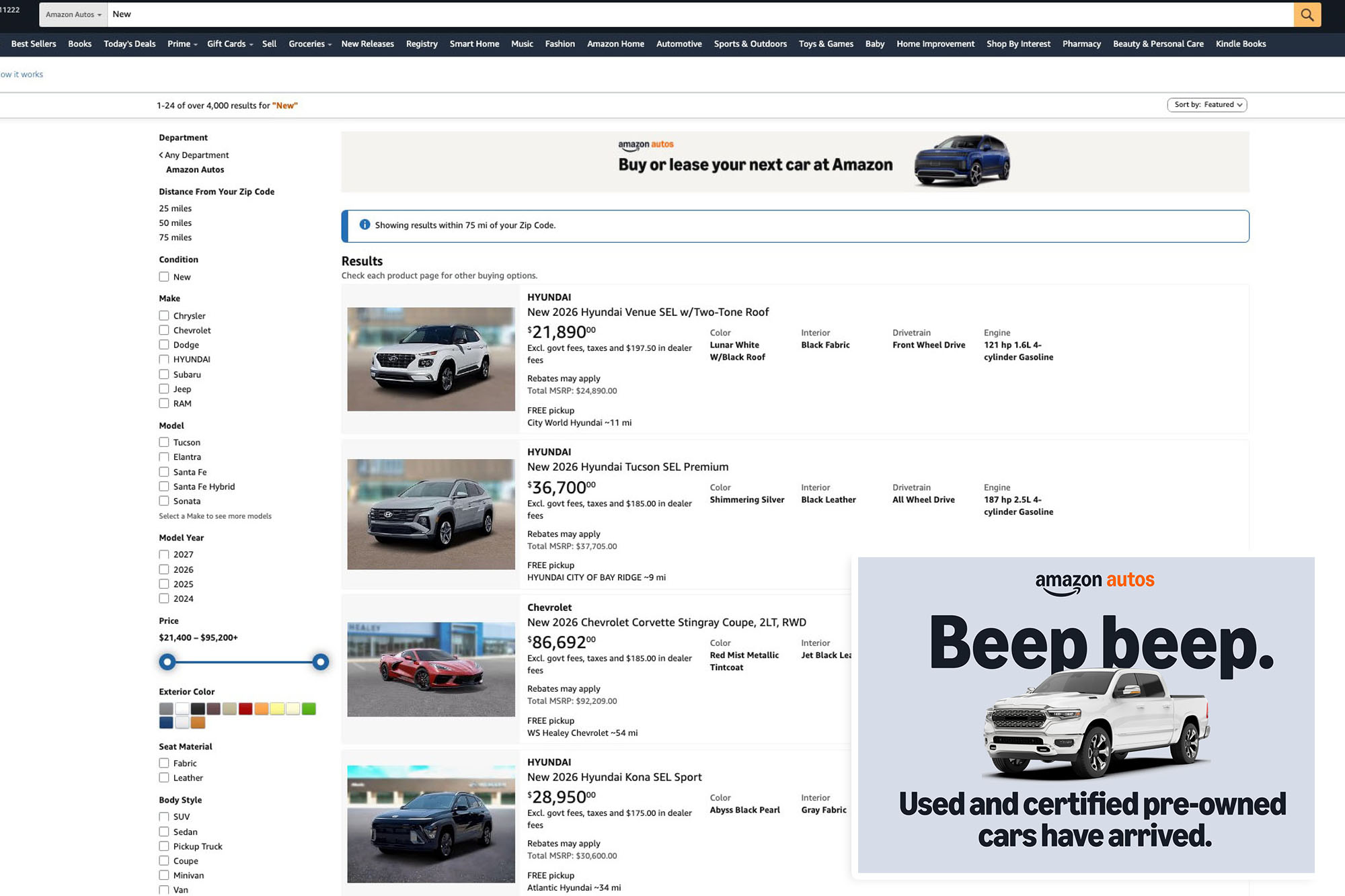
Amazon has quietly expanded its car sales business over the past year and a half, now active in over 130 cities, including New York, Los Angeles and Dallas, the company said, per the Wall Street Journal.
The e-commerce giant’s car sale venture started as a test with Hyundai Motor and has grown to include vehicles from Kia, Mazda, Subaru, Chevrolet and Jeep.
Amazon Autos initially launched at the end of 2024, allowing customers to search for and purchase a car from nearby participating dealerships.
The goal of the program is to have customers do most of the purchasing process and financing paperwork from home, cutting down time spent in a physical dealership or store.
Amazon said it’s not replacing the dealership, where buyers often spend hours processing paperwork with a salesperson. Instead, it acts as a remote middleman, allowing customers to do most of that legwork at home.
Surveys have shown that many people would do pretty much anything to not deal with the hassle of going to a dealership in person.
“One car survey showed customers would rather have a root canal than negotiate a car at a dealership,” Jesse Toprak, a former automotive analyst who now runs OptiCar.AI, an online marketplace for cars, told WSJ.
Plus, Americans are now used to buying things online, and as millennials start to grow their families, car buying could grow into an online process.
“A suburban parent buying a Kia is a digital native,” Toprak said. “It’s the new baseline.”
According to the company, its online brokerage could completely change the traditional process of buying a car.
Dealers have to pay a fee to have their cars listed on Amazon, but consumers don’t have to pay any additional costs if they buy a car through the online platform.
The plus side for dealers is the ability to get their products in front of potential customers while they’re scrolling through their phones on their couches at home.
“I think it’s a really innovative product,” Matthew Phillips, owner of a Kia dealership in Glendale, CA, that recently began listing new vehicles on Amazon, told WSJ.
So far, Phillips has only sold one vehicle on Amazon in the past month and a half — a $55,000 Kia Carnival minivan, but he expects it to gain momentum with time.
“Customers have a level of comfort with Amazon, but it’s definitely just in the starting phase,” he said.
So far, hundreds of dealers have signed up to sell their vehicles on Amazon.
“While still early days, we are seeing a strong response from customers and dealers and we continue to expand vehicle availability across the country,” Fan Jin, the director of Amazon Autos, told the Journal.
With the expansion of the program, Amazon is now taking on one of the largest retail businesses in the US with a major purchase that’s still not common or easy to make online.
Buying a new car is a big financial decision that’s heavily regulated by state and federal law, and generally, it has to be done at an actual dealership with lots of physical paperwork, which has led to some drawbacks for the Amazon program.
Dealers have said that currently, buying a new car remains mostly an in-person process due to the complex nature of it, which involves lenders, manufacturer discount programs and credit checks — which aren’t easy to do online in the same way.
For customers, the downside is mostly being unable to see a car in person before they fork over thousands of dollars. This makes dealers skeptical that Amazon or any other e-commerce platform will ever be able to make the majority of car sales translate to the internet.
“Before it was click, click, click and then the buyer would show up, sign four documents and leave with the car,” Alex Ruiz, general sales manager at South Bay Hyundai in Torrance, CA, told the Journal of the early days of Amazon Autos. As more people started to use it, “we started to run into issues.”
Customers were showing up with incomplete or incorrect paperwork or tried to trade in vehicles registered in a spouse’s name rather than their own, Ruiz shared.
In some cases, the vehicle the consumer on Amazon wanted was already purchased by someone who came in-store.
“I think it will take off, but it will take time,” Ruiz said, noting that his dealership sold around 10 vehicles a month in the early days of their partnership with Amazon, and now it’s around five.