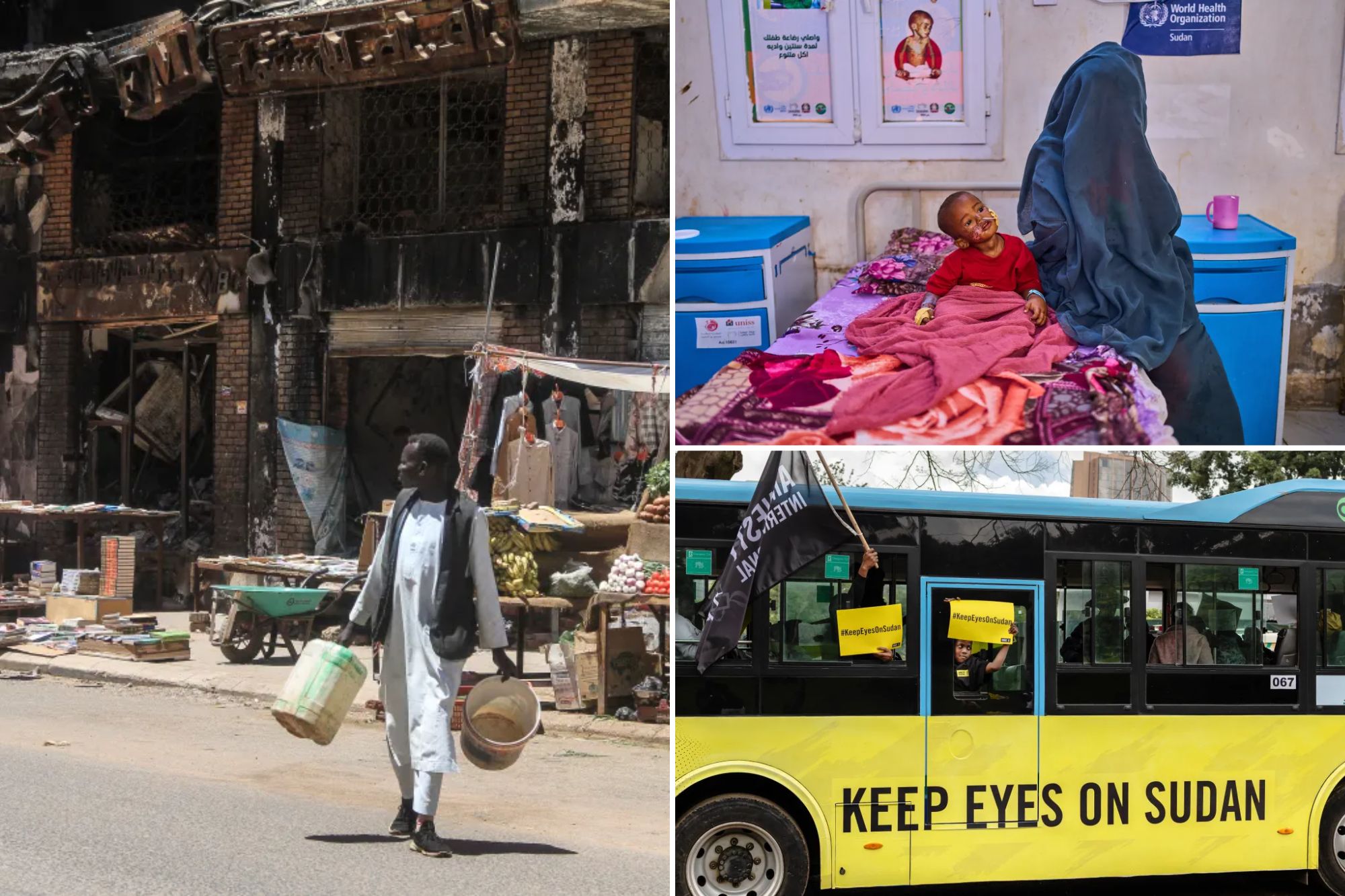
PORT SUDAN, Sudan (AP) — Famine. Massacres. And now badly needed food and other supplies are under strain. Sudan on Wednesday enters a fourth year of war that’s being called an “abandoned crisis,” as a new conflict in the Middle East throws into shadow the fighting that has forced 13 million people to flee their homes.
The North African country has been described as the world’s largest humanitarian challenge, notably in terms of displacement and hunger. There is no end in sight to the fighting between the military and the paramilitary group Rapid Support Forces, or RSF, which witnesses and aid groups say has laid waste to parts of the vast Darfur region.
Growing evidence shows regional powers like the United Arab Emirates backing combatants behind the scenes. Attempts by the United States and regional powers, now distracted by the Iran war, have failed to establish a ceasefire.
“This grim and chastening anniversary marks another year when the world has failed to meet the test of Sudan,” U.N. humanitarian chief Tom Fletcher said.
At least 59,000 people have been killed. At least 6,000 died over three days as the RSF rampaged through the Darfur outpost of el-Fasher in October, according to the United Nations, with U.N.-backed experts concluding that the offensive bore “the defining characteristics of genocide.”
More than 11,000 people were missing over the course of the war, the Red Cross says.
The war has pushed parts of Sudan into famine. The number of people with severe acute malnutrition, the most dangerous and deadly kind, is expected to increase to 800,000, the world’s foremost experts on food security, the Integrated Food Security Phase Classification, said in February.
About 34 million people, or almost two out of three Sudanese, need assistance, the U.N. says. Only 63% of health facilities remain fully or partially functional amid disease outbreaks, including cholera, according to the World Health Organization.
At a center for malnourished children in the Red Sea city of Port Sudan, health staff weighed crying babies and fed some through a tube in their nose.
The number of severely malnourished children entering the center has doubled since the war began, to 60 a week, staff said. The clinic has 16 beds, often forcing several children to share a mattress, they said.
“I don’t know what will happen in the coming days,” said Dr. Osman Karrar, a physician there.
And now fuel prices in Sudan have increased by more than 24% because of the Iran war and its effects on shipping, driving up food prices.
“A plea from me: Please don’t call this the forgotten crisis. I’m referring to this as an abandoned crisis,” the top U.N. official in Sudan, Denise Brown, said Monday, criticizing the international community for failing to focus on ending the fighting.
The conflict exploded from a power struggle that emerged following Sudan’s transition to democracy after an uprising forced the military ouster of longtime autocratic President Omar al-Bashir in April 2019.
Tensions sparked between military chief Gen. Abdel-Fattah Burhan, who chairs the ruling sovereign council, and RSF commander Gen. Mohamed Hamdan Dagalo, who was Burhan’s deputy there.
Neither side can achieve a decisive victory, said Shamel Elnoor, a Sudanese journalist and researcher, adding that Sudanese “have become powerless and are subjected to foreign dictates.”
Germany was hosting a Sudan conference in Berlin on Wednesday for governments, U.N. agencies, and aid groups. The aim is to rally humanitarian donors and “promote an immediate ceasefire,” the German Development Ministry said.
The Sudanese government in Khartoum, however, slammed the conference as an “unacceptable” interference and said Germany didn’t consult with Sudan before convening it.
Sudan is now essentially divided between a military-backed, internationally recognized government in the capital, Khartoum, and a rival RSF-controlled administration in Darfur.
The military has established control over the north, east, and central regions, including Sudan’s Red Sea ports and its oil refineries and pipelines.
The RSF and its allies control Darfur and areas in the Kordofan region along the border with South Sudan. Both regions include many of Sudan’s oil fields and gold mines.
While Egypt supports Sudan’s military, the UAE is accused by U.N. experts and rights groups of providing arms to the RSF. The UAE has rejected the accusation.
The Yale School of Public Health’s Humanitarian Research Lab, which tracks the war through satellite imagery, said this month that the RSF had received military support from a base in Ethiopia. The RSF didn’t comment on the allegation.
Josef Tucker, senior analyst for the Horn of Africa at the International Crisis Group, told The Associated Press that the war could spill over Sudan’s borders, making the conflict “even more intractable.”
Three years of fighting have seen widespread atrocities, including mass killings and rampant sexual violence, including gang rapes.
Hospitals, ambulances, and medical workers in Sudan have been attacked, with more than 2,000 people killed, WHO has said.
The International Criminal Court has said that it was investigating potential war crimes and crimes against humanity, particularly in Darfur, a region that two decades ago became synonymous with genocide and war crimes.
Most of the latest atrocities have been blamed on the RSF and their Janjaweed allies — Arab militias that were notorious for atrocities in the early 2000s against people identifying as East or Central African in Darfur. The RSF grew out of the Janjaweed.
The military’s seizure of Khartoum and other urban areas in central Sudan in early 2025 did allow the return of about 4 million people to their homes, the U.N. migration agency said in March. But they struggle with damaged infrastructure and other challenges.
“It’s not really a return to normal. It is trying to survive amid a new normal,” said Tjada D’Oyen McKenna, CEO of aid group Mercy Corps.