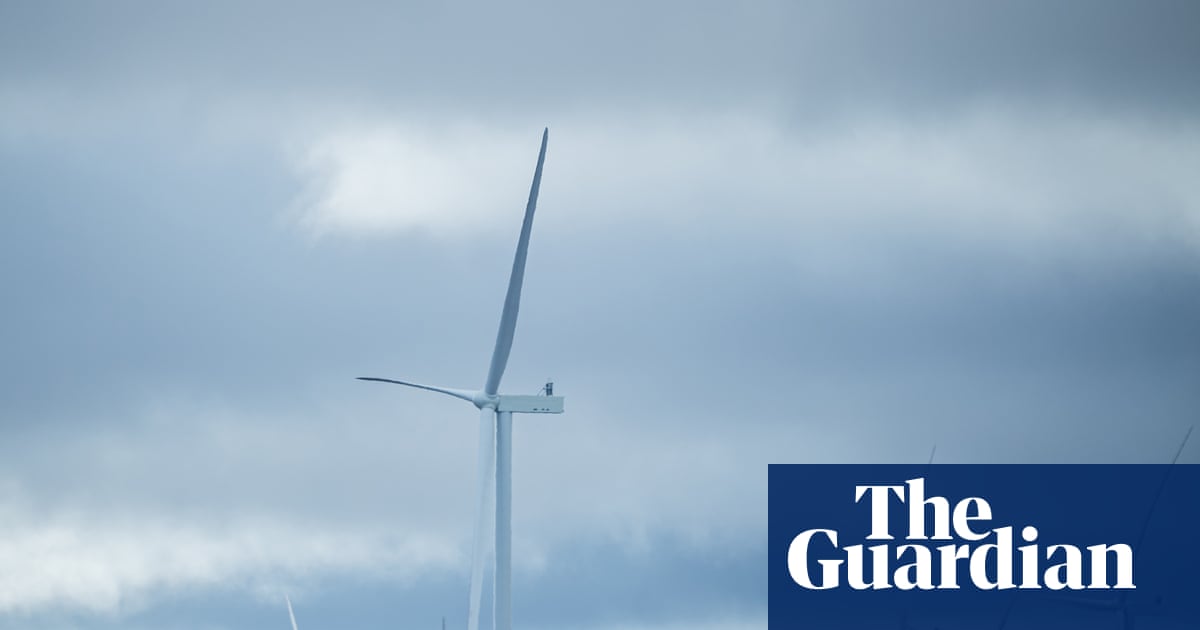
Amazon has entered into agreements with Victoria’s Golden Plains windfarm and a solar and battery storage farm in Muswellbrook, NSW. Photograph: Stuart Walmsley/The GuardianView image in fullscreenAmazon has entered into agreements with Victoria’s Golden Plains windfarm and a solar and battery storage farm in Muswellbrook, NSW. Photograph: Stuart Walmsley/The GuardianAmazon enters agreements for nine Australian renewable projects to power datacentresTech company has signed on to nine deals as it aims to reach net zero carbon emissions by 2040
Get our breaking news email, free app or daily news podcast
Amazon has entered power agreements with nine new renewable projects in New South Wales and Victoria, as the technology company seeks to source renewable power for its datacentre operations in Australia.
The nine deals, including one windfarm and 10 solar and battery projects, will take the amount of renewable energy Amazon is sourcing in Australia from 430MW to nearly 1GW.
The power purchase agreements are contracts between energy providers and datacentre operators to meet the expected demands of their centres. Amazon has entered into agreements for more than 20 projects in Australia as it aims to reach net zero carbon emissions by 2040.
These include power from Victoria’s Golden Plains 2, the largest windfarm in Australia, which began operating in 2024. It also includes the solar and battery storage farm in Muswellbrook in New South Wales, which is being built on a former coalmine site.
The funding for battery sites was the first time Amazon had invested in solar-battery hybrid projects outside the US.
Matt O’Rourke, Amazon Web Services’ head of infrastructure and energy policy in Australia and New Zealand, said the battery investment would help stabilise the grid.
“Contributing utility-scale batteries so they can get charged up when the sun is shining and the wind is blowing, and then de-charge during the peak times when the sun might not be shining and the wind might not be blowing,” he said. “It’s really about just trying to strengthen the stability of the grid.”
There is growing pushback in Australia to datacentre construction as the country is encouraged to fast-track new developments to meet demands for artificial intelligence.
A NSW parliament inquiry this month heard from a number of Sydney councils which had raised concerns about the environmental impact, as well as power and water use for planned datacentres.
While Amazon promotes how much renewable energy it is buying in Australia, the company would not say how much its datacentres would consume in the electricity grid.
O’Rourke said: “We don’t break down the power consumption at the individual country level.
“If you think about it from an economy-wide perspective, all of the datacentres in Australia collectively consume the same amount of electricity as all of the shopping centres, but the datacentres are … facilitating new renewable energy coming into the grid.”
The comparison to shopping centres is one that has been favoured by the datacentres industry in Australia in recent months, with Data Centres Australia using the same statistic. It originated from a Mandala report from November 2025 that was commissioned by AirTrunk, Amazon Web Services, CDC Data Centres and NextDC.
The report was aimed at addressing growing concerns over water and electricity use at datacentres.
O’Rourke said the partners with whom Amazon had signed the agreements had “done extensive community consultation”.
He said: “We are focused on making sure that all of the community can benefit from the renewable energy that becomes available.”
3:16Labor opts for political solution to emissions reduction with Oprah-style target – videoThe chair of the Superpower Institute and former competition regulator chair, Rod Sims, said last month the issue with many power purchase agreements entered into by datacentre companies was that they were not bringing in additional power – just supplying power for datacentres.
He said: “That’s my central concern, and we don’t have the market signals to give the incentive to people to actually build renewable energy, and that’s why I think we’re just not having enough focus on the urgent need for a carbon price.
“No carbon price – the construction of renewables just won’t meet the demand.”
Amazon entered into eight of the nine agreements announced on Thursday when the projects were in the development stage, the company said.
Dr Hao Wang, a senior lecturer in Monash University’s data science and AI department, said datacentres investing in renewable energy through power purchase agreements was a good thing.
He said: “If it’s adding new renewables, it’s definitely welcome [but] I think we need to have better transparency. [We need to] try to get a better sense of how much [datacentres] really consume. Not only the total amount but the temporal pattern.”
Wang said operators should be upfront about how much centres use in peak demand times. “We are in the dark. We don’t know exactly how the centre actually operates and how much they consume over time.”