From longer routes to higher fares, the Middle East conflict is exposing vulnerabilities in India's fast-growing airline sector.
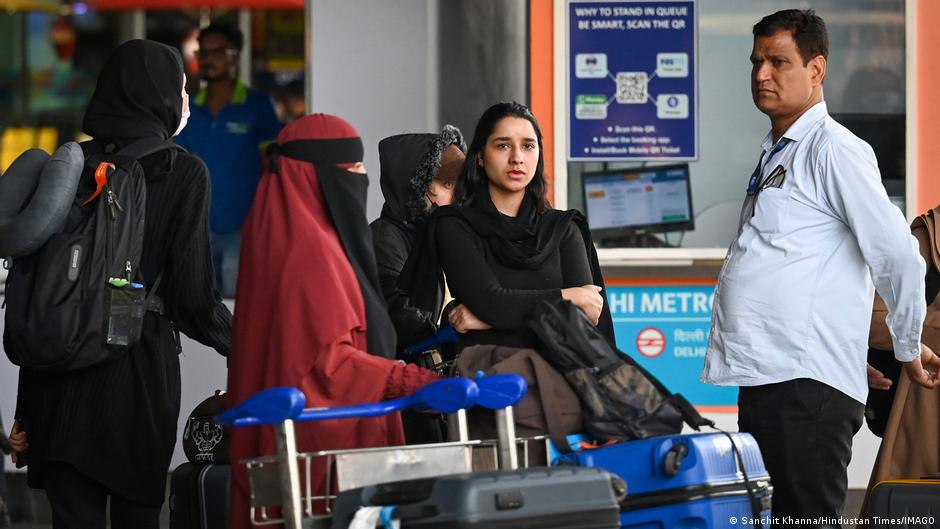
https://p.dw.com/p/5CCeYPassengers have had their travel plans scuppered by the war [FILE: March 2026]Image: Sanchit Khanna/Hindustan Times/IMAGOAdvertisementSandip Sikdar was meant to fly from India's capital, New Delhi, to Munich in Germany with a layover in Sharjah. He had planned his holiday months in advance. But then, just days before he was set to depart, the US-Israeli war with Iran broke out, upending his plans.
Sikdar had to rebook both legs of his journey, even as some prices for one of the legs had risen almost fivefold.
Sikdar is just one of millions of passengers in India whose travel plans have been affected by soaring prices or cancellations due to airspace closures amid the war.
India's aviation sector had been one of the fastest-growing in the world before the conflict. Now, the ongoing geopolitical crisis is reshaping flight paths and the economics of air travel for Indian carriers.
At the heart of the crisis is the restricted airspace in the Middle East due to the Iran war, which is a vital route for flights connecting India with Europe and North America.
Airlines that once relied on the shortest, most fuel-efficient routes are now being forced to take lengthy detours to avoid flying over Iran.
Indian carriers have the added strain of avoiding Pakistani airspace, which was closed to their airlines in April 2025 after the hostilities following the Pahalgam terrorist attack.
Flight durations on some routes have risen by 15-40%, while shorter regional sectors have seen journey times more than double in extreme cases, experts say.
In some cases, flight times have increased dramatically. A New Delhi-Tashkent route that previously took just over two hours now stretches to more than five and a half hours, according to the FlightRadar24 tracking service.
Nitin Sarin, an aviation lawyer, told DW that the constraints are particularly punishing for Indian carriers.
"Because they [Pakistan] are very strategically geographically positioned that if we can't fly through them, we have to burn a lot of extra fuel and waste a lot of extra time getting from here to Europe or North America," he said.
Foreign carriers, unconstrained by Pakistani airspace restrictions, have been able to maintain shorter routes and more stable schedules.
The rerouting comes at a time when the Iran war has severely disrupted global energy supplies and sent oil prices soaring, including aviation turbine fuel (ATF) rates, the single largest expense for most airlines.
Fuel typically accounts for 30-40% of operating expenses and can rise to nearly 45% in India due to high taxes, according to reports.
Earlier this month, jet fuel prices in India rose dramatically with international flight rates more than doubling. While the government moved to limit price increases for domestic operations, airlines remain under intense cost pressure.
For an industry that typically operates on thin margins, the combined impact of longer routes and higher fuel prices is severe, said Sarin.
"Global oil prices are rising, and because India is a high-tax jurisdiction, the cost for the airlines is tremendous," he added.
Carriers have already begun passing some of these costs onto passengers through fuel surcharges and higher ticket prices, particularly on long-haul routes.
But there are limits to how much can be transferred before it impacts demand.
"It will be quite a large part of leisure travel and non-work travel, which will get affected," Sarin said.
Beyond fuel and fares, the disruptions are straining airline operations.
"Longer routes increase costs across the board, from higher fuel burn and aircraft maintenance to additional crew requirements and longer layovers needed to meet duty time regulations," a pilot for one of India's leading airlines, who asked to remain anonymous, said.
Longer routes translate to extended crew duty hours, more complex scheduling, and stricter compliance with rest regulations. Aircraft use, a key driver of airline profitability, is also taking a hit, as planes spend more time completing fewer journeys.
For example, an aircraft that would normally complete two rotations per day can only manage one and a half on some routes. That directly hits airline revenues because the same asset is flying less efficiently.
These changes can ripple through entire networks, impacting the fleet, staff and crew.
Indian carriers are facing a structural disadvantage compared to their global peers, offering shorter routes and more stable pricing.
At the same time, the disruption in the Gulf threatens a key revenue stream: traffic between India and the Middle East, which has long been a "cash cow" for many airlines ferrying workers and travelers between the regions.
There are, however, potential opportunities. Sarin suggested that India could lobby China to open new air routes over the Tibetan region "for much shorter routing, especially from India to North America by completely bypassing Pakistan."
For travelers like Sikdar, the consequences are already clear: longer journeys, higher fares and increased uncertainty.
As flights get more expensive, airlines can expect to lose the budget-conscious passengers who have helped drive India's aviation boom.
There are early signs of stress within the industry as well. The Economic Times newspaper reported on Thursday that budget airline SpiceJet is looking at layoffs amid reduced operational capacity.
Before the outbreak of the war, India's aviation sector had been gearing up for rapid expansion, driven by growing demand for air travel. But the current crisis underscores how vulnerable that growth remains to external shocks.
However, experts say that the industry has its fundamentals in the right place.
"India's aviation sector is firmly on a growth trajectory, with a vast, underpenetrated market still to be tapped — only about 2-3% of the population currently travels by air," said journalist Jagriti Chandra. "That leaves enormous headroom for expansion as incomes rise and connectivity improves."
Chandra, who has been covering the aviation industry for over a decade, says that while external shocks like the conflict in the Gulf might disrupt travel in the short-term, they are unlikely to affect long-term demand, which typically rebounds quickly once normalcy resumes.
She pointed out that Air India, backed by the Tata Group, can sustain its expansion despite the volatility, while IndiGo Airlines' strong liquidity of ₹36.945 crore ($3.9 billion or €3.39 billion) in cash reserves supports continued growth and market dominance.
"In short, the sector's underlying momentum remains intact — low penetration, strong balance sheets, and structural demand will keep India's aviation story on course," she said.
Iran war exposes global dependence on Middle East energyTo view this video please enable JavaScript, and consider upgrading to a web browser that supports HTML5 video