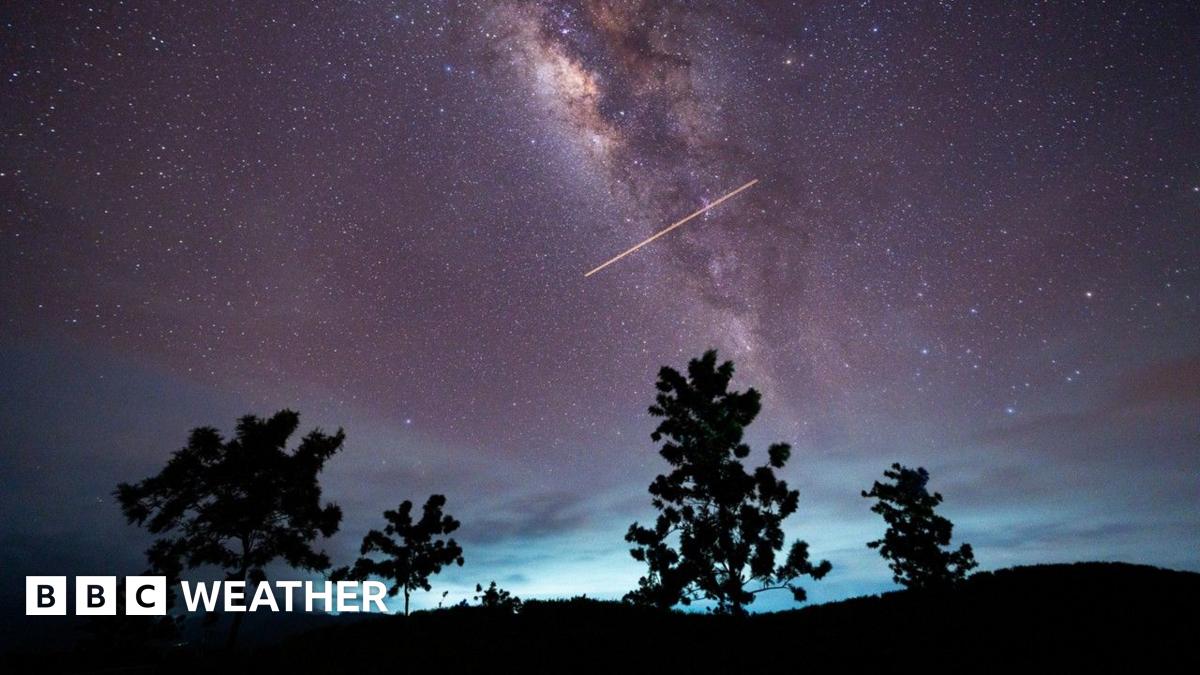
Image source, Getty ImagesPublished1 hour agoIf you enjoy meteor spotting then you are in for a treat with the oldest recorded shower set to light up our skies from 16 April.
The Lyrid meteor shower is a result of the Earth passing through dust left behind by Comet Thatcher centuries ago.
Expect 10 to 15 meteors an hour but with surges that can occasionally deliver up to 100 per hour.
Named after the constellation of Lyra where they appear to originate from, the shower peaks on 22 April.
Image source, PAImage caption, A Lyrid meteor is seen in the sky above Liverpool, UK, in April 2025.
Distinctive features of the Lyrids are their colours and brightness, along with exceptionally bright fireballs from time to time, outshining the planet Venus.
The colours are created by very small dust particles - no bigger than a grain of sand - interacting with the particles and ions in Earth's atmosphere. The light this interaction creates is what we can see as the grains heat up and ionise. The trail is produced as the meteor cools and fades.
Fireballs are made when much larger pieces of debris, external - more like the size of a grape or an acorn - pass though the atmosphere. As they are so much bigger when they heat up they create a flash and a line, often called a train, behind them.
The Lyrid meteor shower was first recorded in 687 BCE by Chinese astronomers. Comet Thatcher whose dust creates the meteors takes 415 years to complete its orbit of the Sun and won't be visible again until 2283. Fortunately though the meteor shower is an annual event.
Is a 'Super El Niño' on the way and how will it affect the UK?
The Lyrids are not the only meteor shower to visit our skies in April.
The Eta Aquarids will also be active between 9 April to 28 May, with the peak in the early hours of 6 May 2026. The average rate is around 40 an hour.
They are named after a star called Eta Aquarii in the Aquarius constellation, which is the point from which it appears to originate and created from the trail of the Comet 1P/Halley. This takes considerably less time than Comet Thatcher to compete its solar orbit - between 75-76 years.
Halley is one of the most well known and best studied by scientists.
The comet will be back again in 2061 but in the meantime we can enjoy the bi-annual meteor showers as its dust particles create passing through the Earth's atmosphere, not only giving us the Eta Aquarids in April but also the Orionids in October.
Northern Scotland looks likely to have the clearest skies on Thursday night as elsewhere thicker cloud will be spreading up from the south-west with some rain at times too.
Though some breaks are possible in East Anglia and south-east England in the early hours of Friday morning.
Friday night also might end up quite overcast for many but those patient enough to wait until Saturday night will have the best viewing chances.
Widely across the UK there'll be clear skies from Saturday evening through to Sunday morning.
You can always find out the forecast where you are by checking BBC Weather online or the BBC Weather App.
Why 2026 continues to looks bright for Northern Light sightings