Peter Magyar has promised nothing less than a "system change" in Hungary. The expectations both at home and abroad are huge. DW explores what Magyar is likely to do on the most pressing issues facing Hungary.
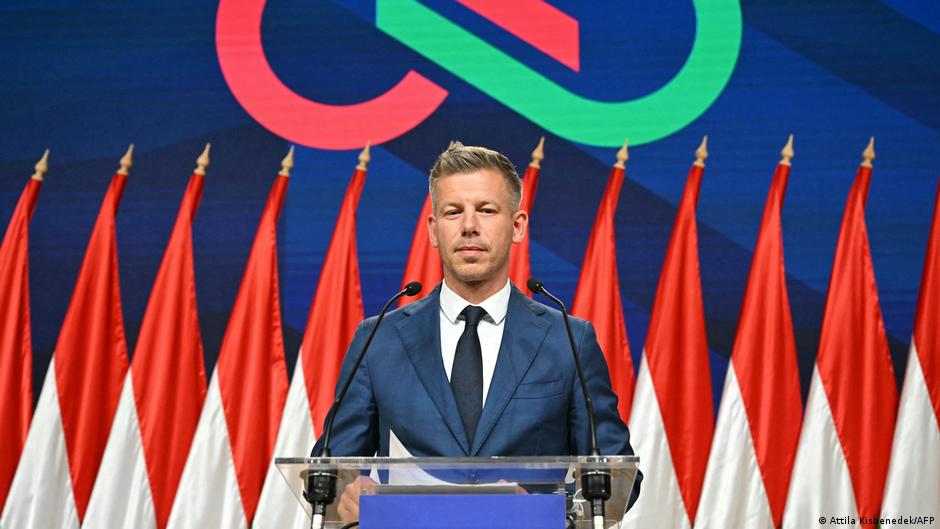
https://p.dw.com/p/5CBWhPeter Magyar outlined some of the policy changes Hungarians can expect at a press conference on the day after his election victoryImage: Attila Kisbenedek/AFPAdvertisementViktor Orban's defeat in the election on April 12 was met with great euphoria in Hungary.
The country now faces its second system change since the collapse of communism there in 1989/90.
Election winner Peter Magyar says that the task now is to "tear down the Orban system" and make Hungary a "normal, respected country" in Europe again.
How does he intend to do that? What will his first steps be? And will he manage to prove wrong those who say there is no difference between him and Fidesz on some issues?
Magyar describes himself as conservative and right-wing. He rejects being referred to as a "liberal conservative" but distances himself from the term "patriot" in the sense used by his predecessor, Viktor Orban.
He is pro-European in his outlook and is opposed to both too much EU influence on national policy and the "sovereignism" espoused by Orban.
His style of talking is often very polemical, and he frequently puts things provocatively. Nevertheless, he is far from Orban's brand of populism.
Magyar is promising to restore the system of checks and balances and to make Hungary a democratic state governed by the rule of law once again.
He wants to have a new constitution passed. Hungary's current constitution is in parts a conglomerate of propagandistic articles and provisions designed to secure the power of the Orban system.
His intention is that the new constitution will contain mechanisms that will restrict power, for example by limiting to two the number of terms a prime minister can serve.
Magyar wants to reform the country's electoral law, which was tailored to meet the needs of Orban's Fidesz party, to reverse the extreme centralization of the state and restore the autonomy of the universities.
Although there is as yet no concrete plan for judicial reform, he wants the judiciary to be able to work more independently.
He also intends to relinquish certain powers as prime minister, for example the control of the intelligence services, which will be returned to the Interior Ministry.
Once in government, Magyar wants to set up an anti-corruption authority and an authority for the restitution of property. The latter will be tasked with investigating all past public tenders that were worth more than the equivalent of €25 million.
He says that Hungary will also join the European Public Prosecutor's Office and wants the country's Attorney General to be able to work more independently.
Overall, Magyar is pledging to get tough on corruption and to investigate cases from the past 16 years, when Orban was in power.
Magyar regards Hungary as being unequivocally anchored in Europe and promises that the country will once again be a reliable partner for the EU and NATO.
He also says, however, that there will be "debates about national interests."
Nevertheless, he says that Hungary will "not fight" in Brussels but will be a "constructive partner."
Magyar is also planning for Hungary to join the Eurozone, although no date has so far been set.
When in government, Tisza intends to continue Orban's strict anti-migration policy and keep the border fortifications in the south of the country.
However, Magyar is calling for a pan-European solution and is pledging not to use the issue of migration for anti-EU propaganda or to misuse it at national level.
So far, he has not made any concrete proposals regarding EU migration policy.
He is also promising to stop the recruitment of workers from non-EU countries in Hungary. However, given the labor shortage in the country, this could prove problematic.
Because of Orban's extreme anti-Ukrainian propaganda and the allegation that Tisza is a Ukrainian project, Magyar has adopted a cautious stance toward Ukraine.
Change of guard in Hungary as Magyar ousts OrbanTo view this video please enable JavaScript, and consider upgrading to a web browser that supports HTML5 video
He is calling for a normalization of relations with Hungary's northeastern neighbor but is not in favor of fast-tracking Ukraine's integration into the EU.
Like Orban, Magyar rejects Hungary's involvement in the EU's €90-billion loan package for Ukraine but condemns Orban's veto of the package after Hungary had negotiated an exemption for itself in December 2025. Nevertheless, Magyar has not so far said outright whether he would reverse Orban's veto.
He is also opposed to any peace plan for Ukraine in which Ukraine does not have a say.
Magyar has stated that the sovereignty and international borders of Ukraine are inviolable and that the aggressor and the victim in this war must be clearly named.
Magyar has described the Orban government as a "puppet of the Kremlin."
In the runup to the election, Tisza supporters were repeatedly heard chanting the slogan "Russians out!"
Magyar intends to adopt a tough stance on Russian influence in Hungary.
He says that Hungary will in future heavily diversify its energy supplies but will not completely cut itself off from Russian energy.
He has also said that any contracts with Russia, including the private contract on the extension of the Paks nuclear power plant, will be reviewed and, if necessary, amended.
How Hungary's election weakens strongmen in Eastern Europe To view this video please enable JavaScript, and consider upgrading to a web browser that supports HTML5 video
Magyar has said that were President Putin to call him, he would call on Putin to end the war in Ukraine, adding that Europe can normalize its relations with Moscow once the war is over.
Magyar sees the USA as an important partner with whom Hungary should have a "good and close relationship."
However, given Donald Trump's clear support for Orban in the Hungarian election campaign, Magyar's relationship with the US president is initially likely to be chilly.
Magyar says that from his perspective and for the time being, he sees no reason to talk to Trump on the phone.
Nevertheless, he plans to invite the US president to the celebrations marking the 70th anniversary of the 1956 revolution in Budapest in October.
Within the EU, Magyar will strive for close cooperation with the Central European states of Poland, Czechia, Slovakia and Austria and sees an extension of cooperation within the Visegrad Group to include Slovenia, Croatia and Romania as desirable.
He has said that Central Europe must be a strong force in the EU. Magyar attaches great importance to a good relationship with Poland, which is illustrated by his decision to make Warsaw his first official foreign trip as prime minister.
During Orban's time in office, several politicians from Central and Southeastern Europe were granted asylum in Hungary, including former Macedonian prime minister Nikola Gruevski and the former Polish Justice Minister Zbigniew Ziobro.
Magyar has announced that he will extradite them to their home countries if they have not already left of their own accord.
This article was originally published in German.