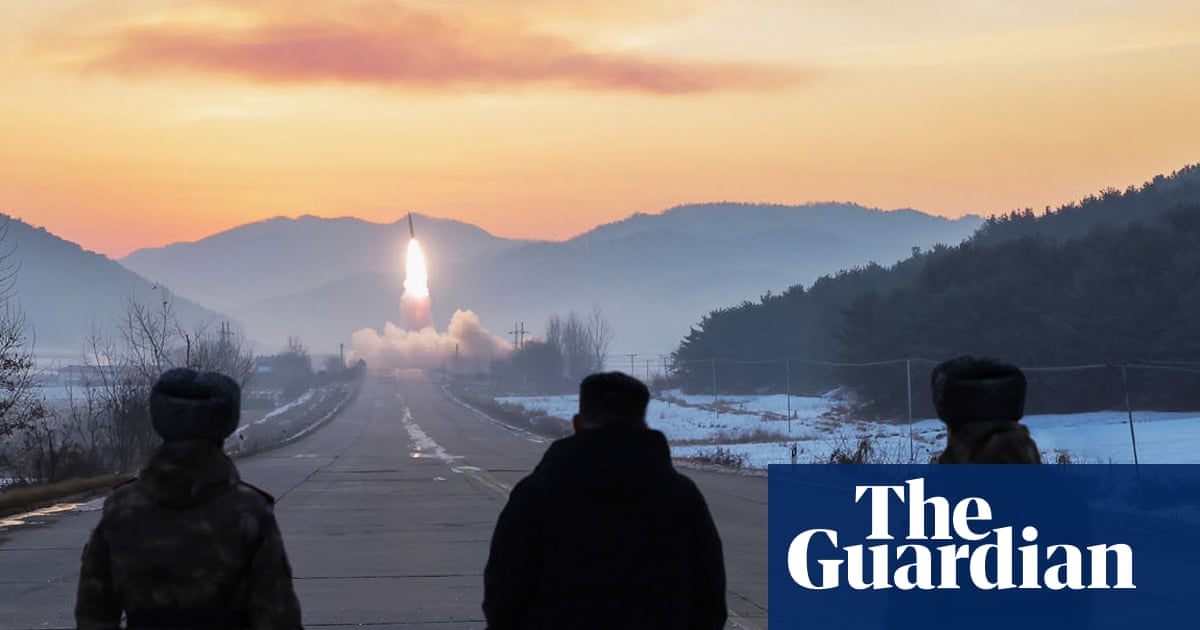
North Korea’s leader Kim Jong-un (centre) inspects a test launch of hypersonic missiles in Pyongyang, North Korea, in January. Photograph: 朝鮮通信社/APView image in fullscreenNorth Korea’s leader Kim Jong-un (centre) inspects a test launch of hypersonic missiles in Pyongyang, North Korea, in January. Photograph: 朝鮮通信社/APNorth Korea rapidly expanding nuclear weapons capability, UN watchdog warnsPyongyang making ‘very serious’ progress on producing weapons, with rapid rise in activity at main nuclear complex
North Korea has made “very serious” progress in its ability to produce more nuclear weapons, the head of the UN’s nuclear watchdog has warned, in another sign that the regime is seeking to use its nuclear arsenal to ensure its survival.
North Korea is thought to have assembled about 50 nuclear warheads, although some experts are sceptical of its claims that it is able to miniaturise them so they can be attached to long-range ballistic missiles.
Speaking during a visit to the South Korean capital, Seoul, on Wednesday, Rafael Grossi, the head of the International Atomic Energy Agency (IAEA), confirmed reports of a rapid rise in activity at North Korea’s main nuclear complex, Yongbyon.
Grossi said work had intensified at Yongbyon’s five-megawatt reactor, reprocessing unit, light water reactor and other facilities, adding that the country is believed to possess several dozen nuclear warheads.
Since conducting its first nuclear test in 2006, the regime in Pyongyang has acquired what some experts say is a workable nuclear capability that includes intercontinental ballistic missiles (ICBMs) capable of reaching the US mainland.
Under Kim Jong-un, who became leader five years later, North Korea has accelerated its nuclear weapons programme in defiance of UN sanctions, in what observers believe is an attempt to reduce the likelihood that it could one day be a target for regime change by the US.
Grossi’s comments came as a US thinktank said North Korea appeared to have completed a building intended for uranium enrichment at Yongbyon.
Beyond Parallel, at the Washington-based Center for Strategic and International Studies, said this week that satellite imagery indicated the new facility was nearing operational readiness, South Korea’s Yonhap news agency reported.
The thinktank said the suspected new enrichment facility at Yongbyon and another at a site in Kangson near Pyongyang had not been declared to international nuclear authorities.
Production of enriched uranium, it warned, “would significantly increase the number of nuclear weapons North Korea could possess”.
The report matched an assessment issued by the IAEA in June last year in which it said Pyongyang was building an enrichment facility at Yongbyon that could be used to produce weapons-grade material.
View image in fullscreenRafael Grossi, head of the International Atomic Energy Agency, speaks during a press conference in Seoul, South Korea, on Wednesday. Photograph: Kim Hong-Ji/APIn March, Grossi said there was no evidence of “significant change” at the North’s main nuclear testing site at Punggye-ri, but added that it was still capable of supporting nuclear tests.
He called North Korea’s nuclear programme a “clear violations” of UN security council resolutions, adding that the agency “continues to maintain its enhanced readiness to play its essential role in verifying [North Korea’s] nuclear programme”.
North Korea has not conducted a nuclear test since 2017, but has demonstrated advances in its missile technology and increased its stockpile of weapons, in line with Kim’s vow last August to pursue a “rapid expansion of nuclearisation”.
Diplomatic efforts to rein in North Korea’s nuclear ambitions have faltered after unsuccessful summits between Kim and Donald Trump during the US president’s first term, and a deterioration in ties between Pyongyang and Seoul.
Earlier this year, South Korea’s pro-engagement president, Lee Jae Myung, said the North Korea was producing enough material to build 10 to 20 nuclear weapons a year, as well as improving its long-range ballistic missile technology.
“At some point, North Korea will have secured the nuclear arsenal it believes it needs to sustain the regime, along with ICBM capabilities capable of threatening not only the United States but the wider world,” Lee said in January.
“And once there is excess, it will go abroad – beyond its borders. A global danger will then emerge.”
North Korea, however, has dismissed Lee’s attempts to kickstart cross-border dialogue.