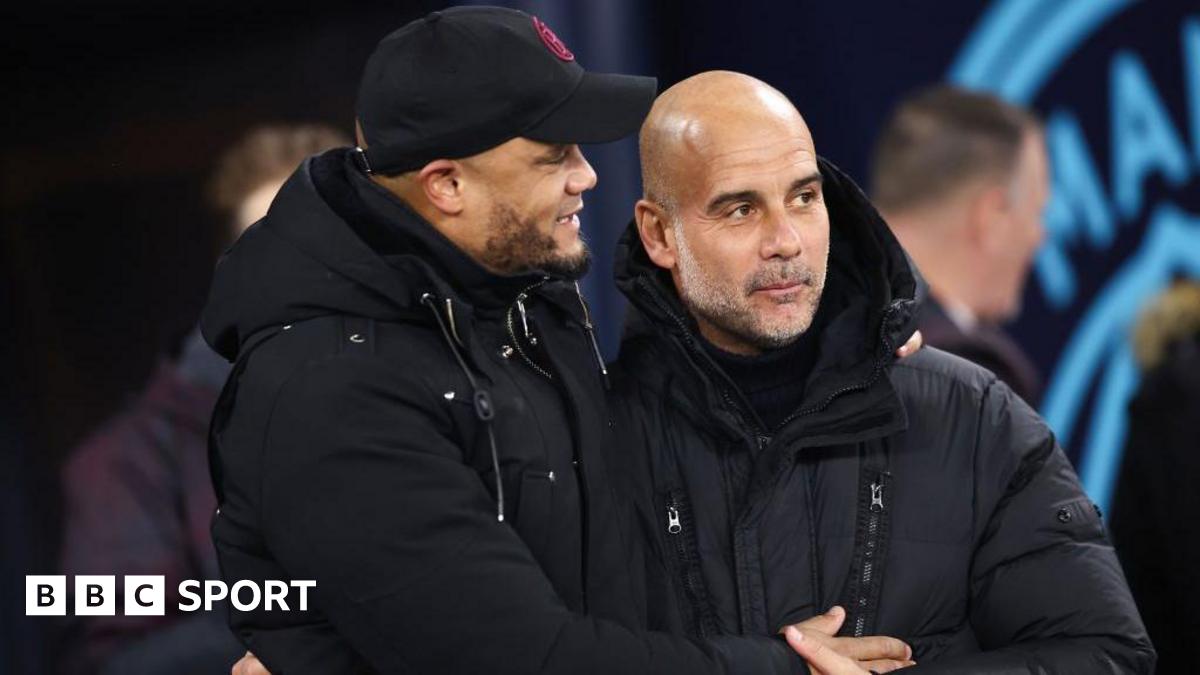
Football tactics correspondentPublished19 minutes ago22 CommentsVincent Kompany achieved so much as a player at Manchester City that he has a statue outside Etihad Stadium. With Bayern Munich, he is striving for greatness all over again.
His appointment as Bayern boss in May 2024 raised eyebrows. He had, after all, just taken Burnley down to the Championship.
But the move appears to have been a masterstroke. Under his guidance, Bayern won the Bundesliga last season. They are on course to retain their title, sitting 12 points clear at the top. And they hold a 2-1 lead over Real Madrid going into the home leg of their Champions League quarter-final on Wednesday.
As speculation continues over Pep Guardiola's future, Kompany's ties to Manchester City make him a potential future option for that job.
In the meantime, he is imposing his own style at Bayern, on and off the pitch.
There have been concerns among fans this season that the game's top teams, faced with stubborn man-to-man defensive set-ups, are taking a less risky approach in attack.
But Kompany's Bayern lean into that risk, playing freely both in and out of possession. They often dominate, and are exciting to watch - an approach that involves all 11 players and starts right from the back.
In the Champions League last 16, Bayern faced an Atalanta side who opted to man-mark across the pitch. So Kompany rotated his players around, dragging opposition defenders out of position.
For instance, attacking midfielder Serge Gnabry frequently dropped into centre-back positions to get on the ball. His Atalanta marker followed him. That opened up space for Gnabry's team-mates. As a result, Atalanta ended up with attackers in defence and defenders in attack. Bayern Munich won 10-2 on aggregate.
Juventus head coach Luciano Spalletti was particularly impressed, noting Bayern's fluidity. In his words: "They showed us a whole encyclopedia of movement and positioning in football."
Image caption, Serge Gnabry drops into a centre-back position against Atalanta's man-to-man press. Their left centre-back Sead Kolasinac follows him, becoming Atalanta's furthest player up the pitch
Image caption, Guardiola has used natural midfield players in defence during build-up to help Manchester City get up the pitch this season. This example shows both Rodri and Bernardo SIlva as 'centre-backs' from a goal kick against Leeds.
If there is one idea that epitomises Kompany's Bayern, it is arguably movement off the ball.
As Bayern got into settled possession against Real Madrid in the first leg of their quarter-final, the back four in their 4-2-3-1 formation changed positions in a way that troubled their opponents.
Against Madrid's front two of Vinicius Jr and Kylian Mbappe, midfielder Joshua Kimmich dropped deep, forming a back three with the two centre-backs. This gave Munich a three-against-two overload.
Full-backs Josip Stanisic and Konrad Laimer then moved into narrower positions high up the pitch. Madrid defended in a narrow 4-4-2 and their wide midfielders, Arda Guler and Federico Valverde, were dragged to the centre of the pitch when marking Bayern's full-backs.
This opened up a direct passing lane for Bayern from the centre-backs to the wingers. Michael Olise often burst towards the ball, receiving it under minimal pressure, able to turn and drive at the heart of the defence with momentum.
Image caption, In yellow, Bayern's two full-backs and two attackers occupy Madrid's midfield four. Joshua Kimmich has dropped in to form a the back three for Bayern. Olise, on the right wing, sprints deeper to receive the pass under no pressure
These direct dribbles, paired with relentless running off the ball in behind a defence, naturally force opposing teams back towards their own goal.
And when that happens, Bayern are able to exploit the gaps in front of an opposing defence too.
For Bayern's second goal against Madrid, Olise's direct dribble, with Gnabry and Luis Diaz running in behind, pushed Real Madrid back. This opened up space for Harry Kane to take a deeper position - just as he has done many times throughout his career - before shooting unmarked at the edge of the box.
Bayern's approach works because the front three have skills that complement each other: Olise is a creator, Diaz is a runner, Kane is an impressive striker of the ball who can drop deep or attack the box.
It mirrors the dynamics of Barcelona's successful attack, featuring former Bayern striker Robert Lewandowski and wingers Lamine Yamal and Raphinha.
Image caption, Olise cuts inside and drives at Madrid's defence. Diaz and Gnabry's runs drag their defenders away, leaving Kane in space to shoot and score
Off the ball, Bayern look to press man-to-man high up the pitch. The difference between their approach and the one that failed Atalanta is an ability to switch seamlessly between a man-marking set-up and a zonal approach.
Against Madrid, Bayern set up to man-to-man from opposition goal-kicks. And on occasion, Bayern looked to funnel Madrid down their right. In nullifying Madrid's build-up, Diaz's ability to jump aggressively to press Trent Alexander-Arnold stood out.
Image caption, Bayern pressed man-to-man against Madrid
But when Madrid got into Bayern's half, we saw this man-to-man tactic shift into a more structured defensive shape that moved between 4-4-2 and 5-2-3.
Yet even with this more conventional set-up, if Real Madrid's attackers dropped deep, Bayern defenders sometimes followed to stop them getting time on the ball.
When this happened, their Bayern team-mates would move into the back-line to maintain a solid defensive shape. Diaz sometimes dropped back to help form a temporary back five, keeping an eye on Alexander-Arnold, who played high and wide.
Image caption, Bayern Munich's 4-4-2 defensive block is seen here. Although it is a structured shape, central defender Dayot Upamecano stepped into midfield to press Arda Guler. Recognising this, midfielder Joshua Kimmich dropped into central defence picking up Madrid's number eight, Federico Valverde
Kompany's season with Burnley in the Championship - in 2022-23 - proved his ideas worked with players of a higher quality than their opponents.
It might seem as if a team with better players should always succeed. But thriving in a complex environment of high performers is a challenge many coaches have struggled with - personally and tactically - when taking the step up.
An accomplished coach such as Thomas Frank, for example, appeared better suited to leading an underdog Brentford side more willing to play his pragmatic style of football than the Tottenham team he managed this season.
Kompany, though, commands respect from players given his accomplished playing career - and he is also well known for speaking clearly and thinking intelligently.
Speaking on The Athletic FC podcast, external, journalist Carl Anka recalled receiving a book recommendation from Kompany. When he became City captain, the Belgian had read Richard Lewis' business leadership book When Teams Collide: Managing the International Team Successfully.
Even then, Kompany welcomed taking responsibility for the success of those around him.
Kompany has only just turned 40. With his tactical acumen and leadership skills, he could have a great managerial career - whether that involves building a legacy in Germany or moving back to England.