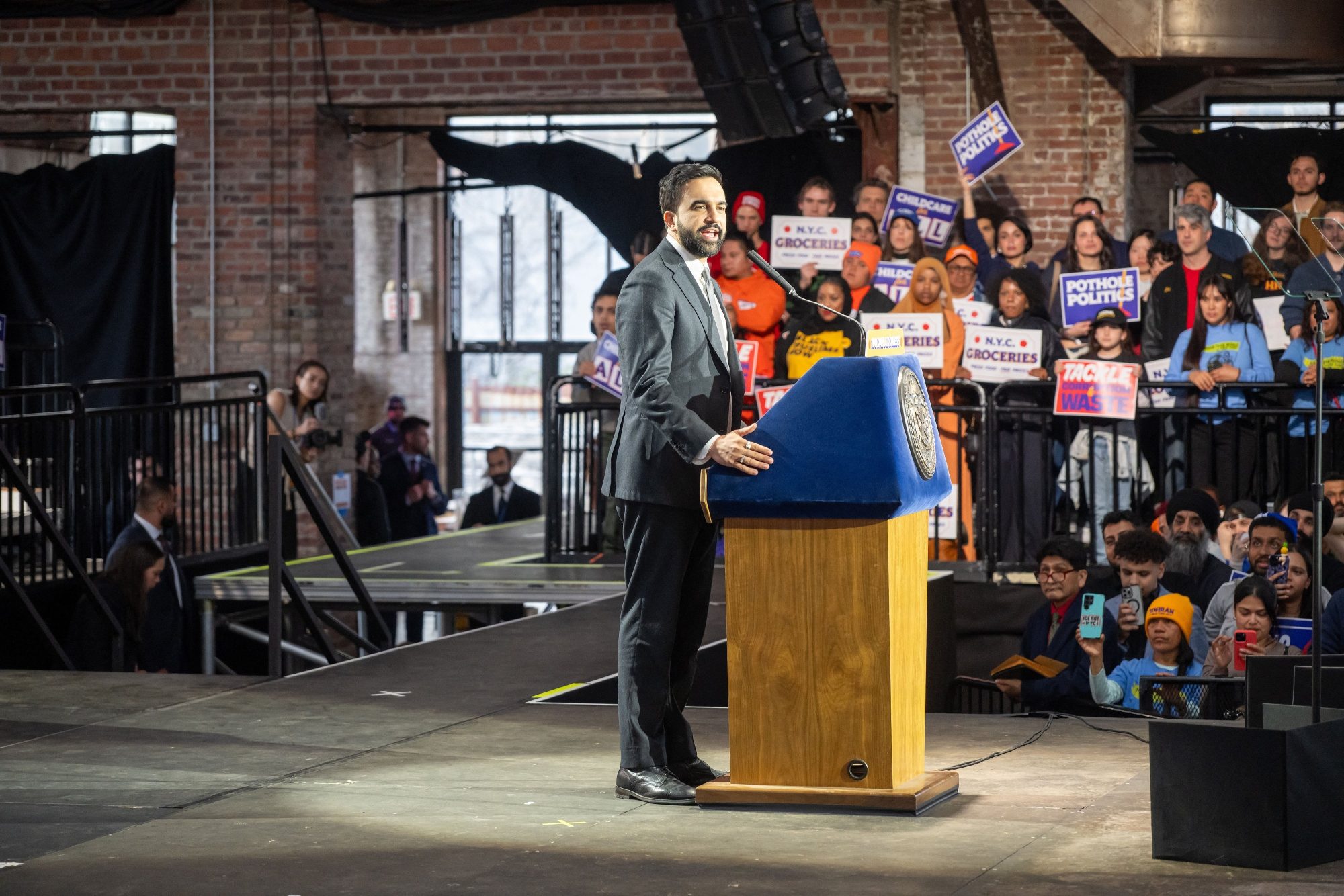
Mayor Zohran Mamdani delivers his 100 Days Address on April 12, 2026. ZUMAPRESS.com / MEGA The slow education of Mayor Mamdani is painful to watch, especially for those New Yorkers forced to pick up the tab for his willful ignorance.
His first 100 days in City Hall have come and gone but the nepo baby appears to have learned next to nothing, at least when it comes to dollars and . . . sense.
The socialist boy-wonder ran and won on a campaign of extensive wish lists decorated with fanciful promises of free this and free that.
Anyone not born yesterday knew he was selling snake oil, but he proved to be a generational political talent and played the pied piper to the young and ideologically blinded followers who turned out for him in droves.
Since he took the oath, there have been only occasional signs that he realizes the job is more complicated than concocting campaign videos you can dance to.
Thankfully, one of those areas where he has seen some light involves the NYPD.
He and Commissioner Jessica Tisch are cut from very different cloth, but they appear to have a pact of no public spats, reflecting a recognition that the city needs them to work together if it is to keep making dramatic inroads on violent crime.
Whether their partnership extends to quality-of-life issues remains to be seen.
Warm weather is sure to provide a big test, as some streets and neighborhoods inevitably become havens for the homeless and the hordes of illegal peddlers.
The low point in Mamdani’s term so far came when his foolish refusal to dismantle ragged street encampments led to at least 20 people dying from hypothermia in February alone.
The grim-reaper toll reflects his rookie determination to reinvent the wheel on long-settled issues.
Mayors of all political stripes had been following a practice begun by Ed Koch nearly 50 years ago of forcibly taking homeless people off the streets during freezing temperatures if they refused to go voluntarily.
But Mamdani’s claimed compassion for the rights of the homeless turned out to be a death sentence for those who were not capable of making the lifesaving choice to go inside.
The arrogance that he alone knows what’s best also lies at the heart of his economic agenda, which promises to level the playing field by doling out oodles of free stuff.
Two early examples illustrate that his magical thinking is already crashing into the harsh reality of the bottom line.
The first mash-up came when Mamdani announced that a 4,000- square-foot site in the David Dinkins Municipal Building would be the city’s first free child-care center.
It will cost at least $10 million to renovate the site, with the opening slated for the fall, when the center will become the daytime home of 40 children, ages 6 weeks to 3 years old, with their parents being city workers in the area.
On top of the rehab cost, the annual operating cost is projected at $2.3 million, which translates into $57,500 a year for each of the 40 children.
Meanwhile, the cost of private child care is less than half of that price, with examples ranging from $23,400 to $26,000.
The whopping difference is further proof that government is the least efficient operation under the sun and that a “free” program is extremely expensive for taxpayers.
A similar reality is coming into focus as Mamdani moves to deliver on his promise to open a government-owned grocery store in each of the five boroughs.
The first will be built on city land in East Harlem, at a projected cost of $30 million for a 9,000-square-foot facility. It is not expected to open for shoppers until sometime in 2029.
The timetable illustrates why “moving at government speed” is a private sector punch line.
The high cost for construction of the store is also far out of line given that the mayor has budgeted $70 million for capital costs at all five facilities.
The City Hall press release about the project is full of leftist mumbo jumbo about “economic justice” and the evil of private corporations.
The City Hall press release about the project is full of leftist mumbo jumbo about “economic justice” and the evil of private corporations.
It says, without a touch of irony, that “the city-owned grocery initiative is designed to lower costs on everyday staples by using public ownership to eliminate costs that are currently passed on to consumers.”
He blames the high cost of staples on private companies that “control every part of the food supply chain” and promises that a “public option allows us to intervene where the market has failed.”
The anti-free-market screed includes a deputy mayor’s silly statement that city-owned stores are crucial because they address “affordability, worker dignity and neighborhood vitality all at once.”
City Council Member Yusef Salaam sets the bar even higher, declaring that “food is a basic human right and no one should have to work more than one job to afford to put dinner on the table.”
Or maybe the one-job-per-person limit could be added to Gotham’s sanctuary-city provisions.
The larger truth at play is that the extravagantly expensive agenda Mamdani is pushing threatens to sink the city’s already deeply troubled finances.
He inherited a budget deficit that was initially said to go as high as $12 billion over the next two fiscal years, but Gov. Hochul funneled some state cash to relieve the pressure.
Yet most of what Mamdani has done and proposed so far has further alarmed Wall Street.
Three of the four top bond-rating agencies reduced their outlook on city finances from stable to negative.
That could drive up borrowing costs on city bonds, making it more expensive for the city to issue new debt.
The problem has been exacerbated because Mamdani has largely limited his proposed budget fixes to robbing rainy-day funds and demanding large income-tax hikes, which would need Albany’s approval.
His alternative, large property-tax hikes, could be imposed with council approval.
But Hochul, facing a tough re-election campaign, is saying no to the income-tax hikes Mamdani wants.
And with even the City Council, normally a soft touch for big spending, rejecting property-tax hikes, the mayor has no obvious way to fund his socialist fantasies.
Most surprising is that council leaders say the mayor has overlooked chances to trim the workforce and otherwise cut spending to save billions without harming core services or imposing ruinous tax hikes.
How these issues are resolved in coming weeks will be crucial for the city’s future.
The smart way to keep score is that if Mamdani wins, New York loses.