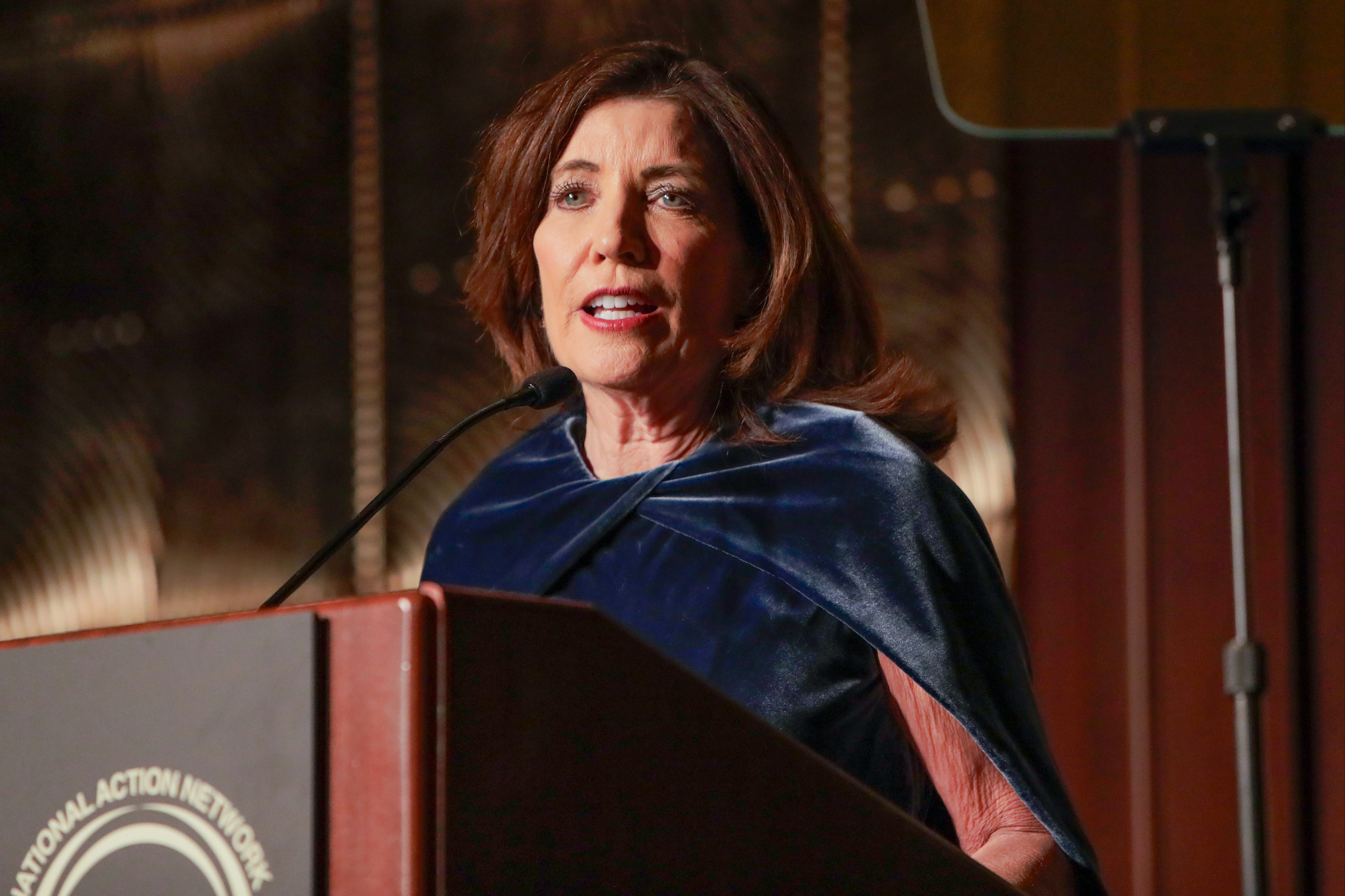
New York State Governor Kathy Hochul speaks at the Annual National Action Network Convention on April 8, 2026 in New York City. Andrew Schwartz / SplashNews.com Last month, when my work took me to India, I learned a surprising lesson: On green energy, the “developing world” is light-years ahead of New York.
And the current crisis at the Strait of Hormuz, where a fossil-fuel chokepoint has sent New Yorkers’ costs soaring, puts the Empire State’s energy airball in sharp focus.
Gov. Kathy Hochul has tacitly acknowledged Albany’s failure to grapple with the practical realities of its insistence on the need to wholly transition the state’s economy from fossil fuels to renewables.
Now she’s trying a new strategy: Memory-holing New York’s flagship 2019 Climate Leadership and Community Protection Act.
Ironically, in the years since that bill passed, the state’s dependence on fossil fuels has only increased, so badly have our leaders flubbed the green-energy side of the equation.
Hence her election-year CLCPA U-turn, despite the continued need for new energy sources.
Halfway around the world, the country best known to many New Yorkers as the origin of street-food memes is leading the way on high-tech renewables.
Meanwhile, the state that engineered the subway system, the Empire State Building and the Erie Canal has struggled to stand up a fraction of India’s windmills and solar panels.
Strategically, India has adopted a Trump-like “all of the above” approach to energy — while New York policymakers have preferred gas bans, wild pronouncements, red tape and general incompetence.
Tactically, India sees its private-sector energy producers as partners, not as piggy banks or as evil corporations that can be punished into generating electricity for the rest of us.
The net result is that India last year crossed a line: More than 50% of its electricity capacity comes from renewables — five years ahead of its 2030 deadline to hit that mark.
(Actual power generation is still 70% from fossil fuels, but the progress is still remarkable.)
For its part, New York adopted a ridiculous central-planning path toward unrealistic 2030 climate goals, which it’s now kicking to 20-maybe-never as it scrubs references to the CLCPA from its websites.
At Khavda, for example, a massive salt flat along India’s western frontier, Adani Green Energy installed the first 9 gigawatts of electric power just five years after its hybrid wind-solar project won government approval.
When completed in 2029, the site will be the largest renewable park in the world, generating a total of 30 gigawatts, enough to power every single home in New York State at peak summer load.
Adani uses a combination of solar panels, wind turbines and battery storage systems to continuously feed the grid.
Sure, the sun is a little stronger at Khavda’s latitude, but the wind is no windier, nor are its batteries made from some unknown Martian metal.
The fundamental difference is that the Indian government figured out unleashing the private sector — not regulating it to death — helps both achieve their shared goals.
Prime Minster Narendra Modi laid out a map; Adani and its competitors built the roads.
Here, Albany laid out a path full of potholes, bumps and U-turns, ensuring almost nothing happened.
It’s a pattern that holds true nationwide: Blue states like ours “lead” on climate mandates and press releases, while red states with less regulation actually execute and develop green-energy projects.
Compare New York with Texas, which is the nation’s No. 1 wind-energy producer and No. 2 in solar.
The Lone Star State focused on expanding its network of high-voltage transmission lines to allow more private landowners to connect to the grid, then gave them an expedited permitting process for turbines and solar panels.
New York, meanwhile, is nearing 20 years on its side-quest to build the Champlain-Hudson power line, drowning it in permitting problems.
That makes New York more vulnerable to the current global energy squeeze than Texas is.
Even before the federal government nixed licenses for new offshore wind projects, New York’s regulatory burdens had all but sunk their prospects.
The state tethered developers to using special turbines that had never before been built, required them to be made in imaginary factories in politically important constituencies, and deemed them to be launched from nonexistent port facilities.
All of which required hundreds of millions of dollars’ worth of subsidies to offset the unnecessary costs.
When it came to solar, scandals like Buffalo Billion got in the way — and when corruption wasn’t in play, incompetence has reigned.
The state is now using special permitting laws to fast-track the Fort Edward Solar Project, destroying 600 acres of a protected wildlife area and angering the very environmentalists who generally cheer green energy on.
The truth is, green energy deserves to play a role in New York’s future, part of the mix of energy sources powering our state.
Renewables are not the problem: Regulations are.
The sooner New York’s leaders realize that, the sooner they can start seeing their own press releases come to fruition.
In the meantime, if they want to see what a forward-thinking energy policy really looks like, India points the way.
Joe Borelli is a managing director at Chartwell Strategy Group and former minority leader of the New York City Council.