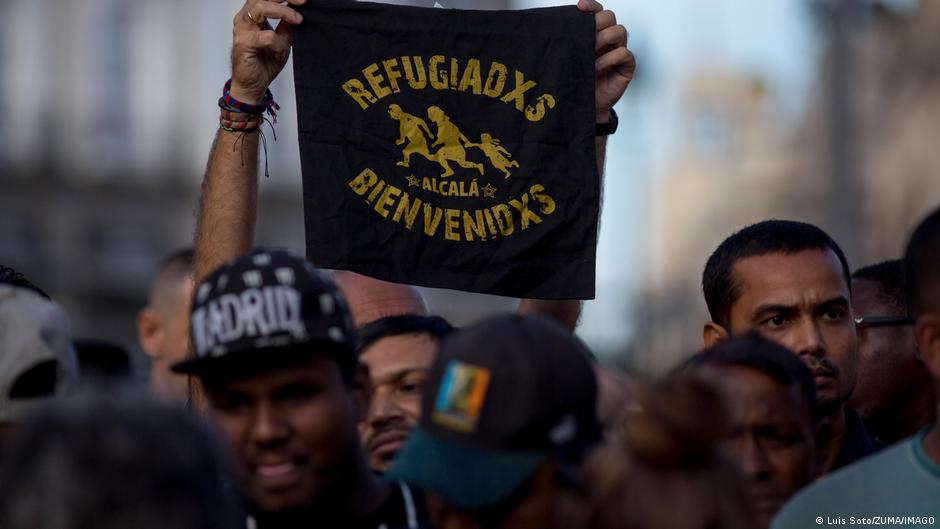
Prime Minister Pedro Sanchez's government hailed the plan as "an act of justice and a necessity." It will allow unauthorized migrants to apply for temporary residence permits instead, and to start paying taxes.
https://p.dw.com/p/5CAfCSpain's government says the move will tackle the shadow economy and increase tax revenues, among other thingsImage: Luis Soto/ZUMA/IMAGOAdvertisementSpain's left-leaning government on Tuesday finalized its plan for an amnesty measure that could pave the way for hundreds of thousands of unauthorized migrants to apply for legal temporary residence permits.
Prime Minister Pedro Sanchez's government first announced the plan earlier this year.
The policy, enacted via royal decree and not through parliament, stands in contrast to several other European governments seeking to reduce or prevent irregular migration or migration more generally.
The amnesty will only apply to people who can demonstrate they arrived in Spain before January 1 this year, before the plan was made public, in a bid not to encourage a rush to Spain after the announcement was made.
Irregular migrants will be permitted to claim a one-year temporary residence permit, provided they can prove five months' residence and demonstrate that they do not have a criminal record in Spain or elsewhere.
After this period, they will be eligible to apply for longer-term work or residency permits.
Spain's government advocates the plan both because of the importance of migration to overall economic growth and because it should enable irregular migrants to seek official taxed employement and thus reduce the size of the untaxed shadow economy.
Migration Minister Elma Saiz said migrants could apply in person starting April 20 and online on Thursday. The window will close on June 30.
A Spanish union representing immigration officers has demanded more resources to handle the applications, saying the government is not prepared to meet the likely rush.
A tiny Spanish village fighting depopulation To view this video please enable JavaScript, and consider upgrading to a web browser that supports HTML5 video
Prime Minister Sanchez announced the law being signed into effect on social media on Tuesday amid his visit to China.
He referred to the plan as "an act of normalization, of recognizing the reality of nearly half a million people who already form part of our daily life. And, also, an act of justice and a necessity."
He said he felt "proud to be Spanish" introducing the amnesty, but also urged those making use of it to contribute themselves.
"We recognize rights, but we also demand obligations," Sanchez wrote. "That those who already form part of our day to day do so on equal terms, contributing to the sustenance of our country and of our model of coexistence."
Almost 50 million people live in Spain. The government estimates that around half a million people could be irregular migrants eligible for the scheme. Some analysts put the figure higher, think tank Funcas estimates roughly 840,000.
Spain's population has risen sharply in recent years, and includes an estimated 7.2 million foreign nationals. Many of them have fled from Colombia or Venezuela, or across the Mediterranean or into Spain's African enclaves from Morocco.
Spain's center-right opposition Popular Party has criticized the move, calling it unsustainable.
However, the notion is anything but foreign to Spanish politics. Governments of all stripes in Madrid took similar steps on six occasions between 1986 and 2005.
This time, however, the government was forced to fast-track the law via a mechanism for amending immigration laws. Doing so bypassed parliament, where the law did not appear to have majority support. A previous amnesty attempt stalled.
Spain gains as travelers turn away from Gulf amid Iran warTo view this video please enable JavaScript, and consider upgrading to a web browser that supports HTML5 video