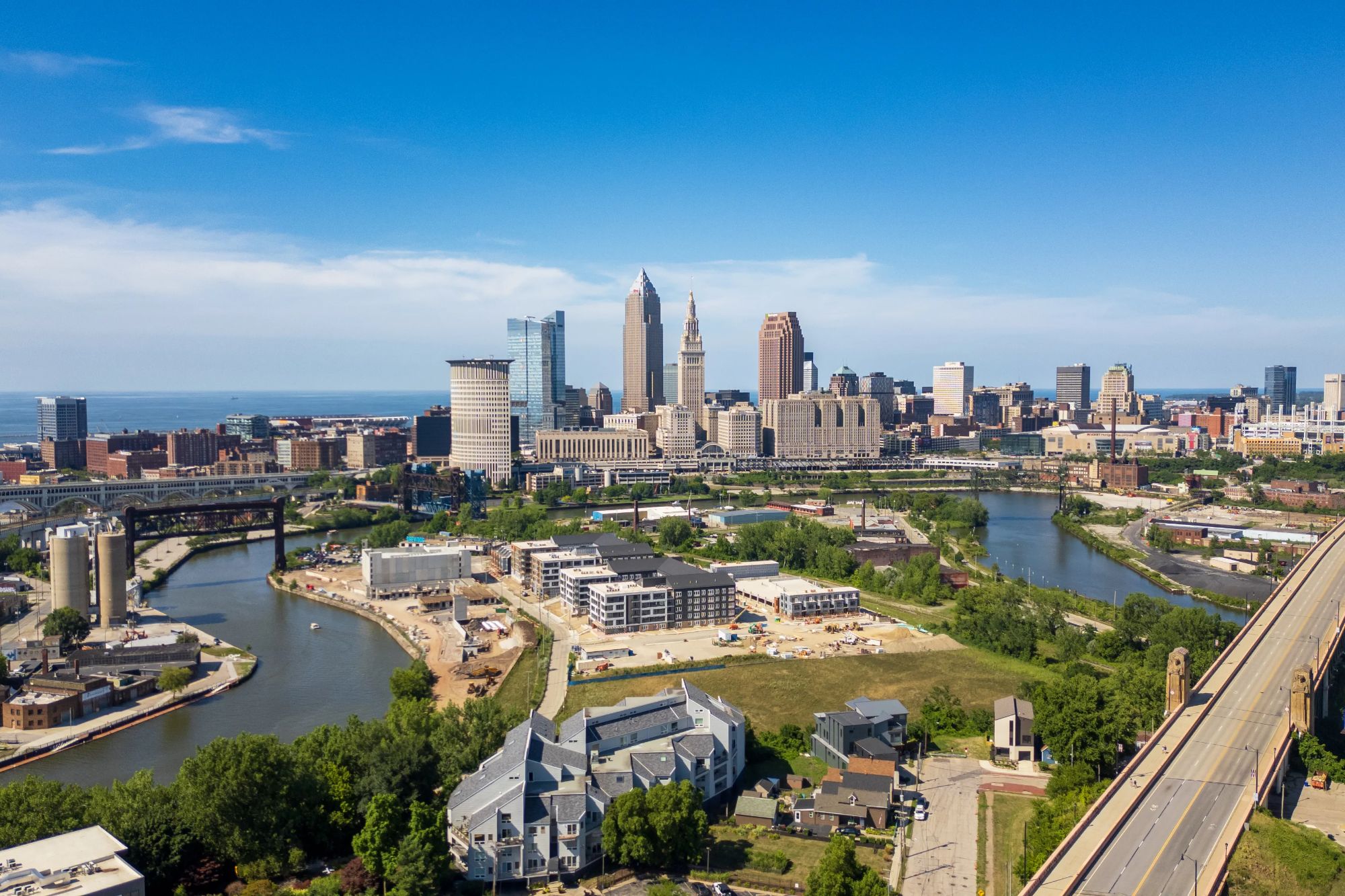
Cleveland doesn’t need Silicon Valley money or Miami heat to fill its downtown.
While coastal cities spent the post-pandemic years hand-wringing over empty office towers, this Lake Erie city in Ohio had already been quietly solving the puzzle for decades. The proof lives in its historic marble lobbies.
Downtown Cleveland’s population has climbed 12% since 2019, hitting roughly 21,000 residents, according to Michael Deemer, president and CEO of Downtown Cleveland.
The engine behind that growth isn’t new construction. It’s resurrection.
Roughly 30 historic structures have been gutted, reimagined and filled with renters since 2013 alone. And former department stores, train terminals and steel-frame skyscrapers from Cleveland’s early-1900s boom years now doing their best work as apartment buildings.
Real-estate services firm Newmark calls Cleveland a national leader in historic adaptive reuse. That reputation wasn’t built overnight. The city has been refining the practice for approximately 50 years, driven by state and federal tax incentives that make the economics work on buildings that would otherwise sit dark and deteriorating.
Two conversions define the moment. The May Company building, a circa-1915 department store anchoring Public Square, became apartments in 2020. The Terminal Tower Residences, perched above Cleveland Union Terminal, opened as rentals in 2019. Both projects required developers to solve architectural puzzles that conventional construction never faces.
“On its face, a department store doesn’t lend itself to adaptive reuse for rentals in the way an office building might, but it allowed us to be very creative,” James Witherspoon of Bedrock, the firm behind the May redevelopment, told the Wall Street Journal.
Creative is an understatement. Bedrock carved a courtyard into the building’s core and stacked parking from the basement through the fifth floor, letting residents pull their car directly onto their own level. The result includes a rooftop deck and open-air atrium that no ground-up developer would have designed, because no ground-up developer would have had the excuse to try.
The Terminal Tower project brought its own built-in selling points. Residents can reach the airport rail line and the Cleveland Cavaliers’ home arena without stepping outside. The building, considered once the tallest in the world outside New York City, still contains the Greenbrier Suite, a private 1920s residence maintained as a time capsule by the original developer brothers.
It’s not open to the public, but knowing it exists two floors away is exactly the kind of detail that separates a landmark from a luxury complex.
Douglas E. Price III, CEO of K&D Group, which developed Terminal Tower Residences, knows that pull well. Period craftsmanship, the ornate detailing, the weight of the stone, the proportions of the original architecture, would be financially impossible to replicate today, he told the Journal. And when viewed in that way, renters aren’t just leasing square footage, they’re leasing a claim to something irreplaceable.
K&D also developed the Residences at Halle, housed in an early 1920s department store nearby. Some units there exceed 4,000 square feet — a scale that pulls in former suburban homeowners who want city life without shrinking.
“You might find an architectural detail not captured on the floor plan,” Price said of the Terminal Tower building specifically.
The renter profile downtown has shifted. Gen Z arrivals are joined by a surging cohort of empty nesters done with lawn maintenance and leaf blowers. And a newer wave is the reverse commuter. These are medical professionals and others whose jobs sit outside the urban core but who choose to live inside it anyway, according to Deemer.
Downtown apartment occupancy sat at 86% as of 2025. The neighborhood, Deemer noted, doesn’t go dark after 5 o’clock.
The price story is equally compelling. Studios in adaptive-reuse buildings averaged $1,083 per month over the past three years, compared with $1,210 in purpose-built housing. One- and two-bedrooms follow the same discount pattern. The only inversion comes at the three-bedroom level, where the grand footprints of historic buildings command a premium of $4,266 a month versus $3,295 for newer builds.
Cleveland’s average rent overall sat at $1,545 in March 2026, roughly 11% below the national average of $1,740, according to RentCafe. The city has 17,246 renter-occupied downtown units compared with just 3,319 owner-occupied ones.