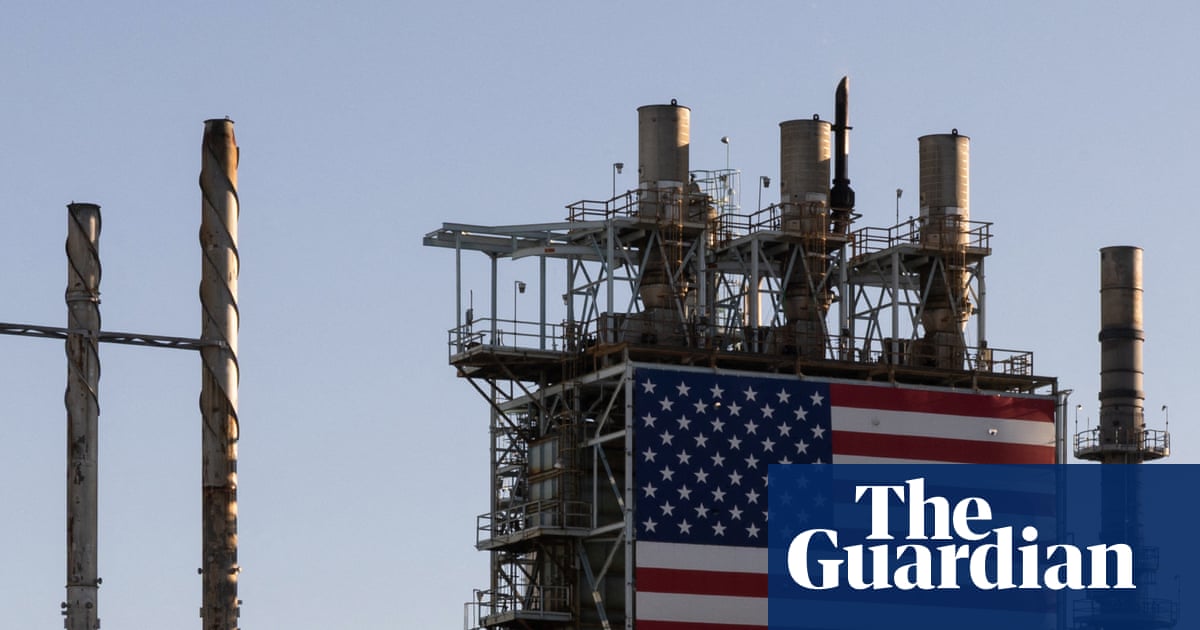
An oil refinery in Wilmington, California. Photograph: Étienne Laurent/AFP via Getty ImagesView image in fullscreenAn oil refinery in Wilmington, California. Photograph: Étienne Laurent/AFP via Getty ImagesDemocrat Ro Khanna to introduce bill to stop US exports of gas amid Iran warCongressman says keeping gas supplies at home could lower costs for Americans amid price hikes sparked by war
Amid historic jumps in gas prices triggered by the US-Israeli war on Iran, California congressman Ro Khanna is to introduce legislation on Tuesday that would ban the export of gasoline during price spikes.
“The country is crying out for a new energy policy,” said Khanna in an interview with the Guardian, “that doesn’t have us subject to the whims of the profits of big oil companies.”
The Iran war has sparked the largest-ever disruption to fuel supply, according to the International Energy Agency, with crude costs topping $100 per barrel so far this week. That has in turn caused the price of gasoline – for which crude is the main input – to spike dramatically, with Americans paying more than $4 a gallon at the pump.
Keeping domestic gasoline supplies at home, Khanna said, could lower the cost of gas for US consumers. During any period when national gas prices average $3.12 a gallon or higher, his proposed legislation would stop US shipments of refined gasoline to other countries.
The US became a net exporter of gasoline in the 2010s and the world’s largest exporter of motor gasoline in 2024.
Khanna’s proposal is unlikely to pass Congress, as Republicans are unlikely to “contradict the big oil companies”, he said. But its introduction illustrates the push from Democrats and progressives to highlight how the Iran war is not only deadly for those abroad, but also costly for Americans.
“The war in Iran has really created an energy shock in America, and this is the time for us to point out why wars of choice are morally bad, but also why they hurt Americans who are struggling to pay the bills,” said Khanna.
While the current fuel shocks have hit ordinary Americans’ pocketbooks hard, they have been a boon for big oil companies, whose share prices have jumped since the war began. Domestic fossil fuel producers could see additional $63bn in profit due to the war, according to an analysis from the market research firm Rystad Energy.
Khanna, who said the oil companies are “profiteering”, last month introduced another policy with Sheldon Whitehouse, a Rhode Island senator, which would impose a windfall tax on the largest fossil fuel companies when oil profits surge. The excise tax would fund rebates sent to US taxpayers, offsetting the high cost of gas.
“The refund checks can go to Americans who are paying over four bucks at the gas pump,” said Khanna, noting that gasoline prices have topped $6.50 in his home state of California.
Khanna previously proposed both a gasoline export ban proposal and a windfall tax during the 2022 energy shock, following Russia’s full-scale invasion of Ukraine.
In addition to passing both of his new policy proposals, Khanna called for his colleagues on Capitol Hill to highlight the need for more renewable power. The adoption of clean energy sources that do not require constant inputs of fuel could help shield Americans from geopolitical oil shocks, while also curbing planet-warming pollution.
“We need to use this moment to call for renewable energy as energy security,” said Khanna. “This shows why we need to invest in solar and wind and geothermal and battery storage and electric vehicles.”
As fuel disruptions accelerate some countries’ shift away from fossil fuels, experts say that China is positioned to benefit from the Iran war because it is such a powerful supplier of clean technologies. By doubling down on a fossil fuel-dependent economy amid the crisis, Donald Trump is also ceding “the energy revolution race for the 21st century to China”.
“Americans don’t want another costly war. They want good jobs at home and peace abroad,” he said. “Gas prices are going up and companies are driving up costs. We should be focused on competing with China and investing in American manufacturing, not spending $1bn per day on this war.”