play Live Sign upShow navigation menuplay Live Click here to searchsearchSign upHistoric but not enough? Inside Gustavo Petro's antidrug strategyThe Colombian president has intercepted record volumes of illicit cocaine. But will it be enough to lessen pressure from the United States?
xwhatsapp-strokecopylinkgoogleAdd Al Jazeera on GoogleinfoBogota, Colombia – On November 20, 2025, Colombian police burst into a shipping container in Buenaventura, Colombia’s largest port on the Pacific Coast, foiling a scheme to smuggle 14 tonnes of cocaine, valued at $390m.
It was the Colombian police’s largest cocaine seizure in a decade — and a sign of Colombian President Gustavo Petro’s ramped-up campaign to intercept drugs.
Since taking office last year, United States President Donald Trump has repeatedly accused Petro of doing “nothing” to stop the flow of cocaine, resulting in Colombia’s decertification as an ally in the "war on drugs".
But in the final months of his term, Petro is on a campaign to prove that his policy does work, in part by pointing to record cocaine seizures.
“We can say it proudly: We are the government that has seized the most cocaine in the history of the world,” said Petro at a cabinet meeting in January.
Though he took office in 2022 with a call to end the US-led "war on drugs", Petro has since adopted a modified version of it, placing a greater focus on human rights.
He has cut back on the forced removal of coca — the leafy crop that is used to produce cocaine — arguing that it unfairly targets poor farmers. His administration is negotiating with drug-trafficking groups in the hope of reaching deals that reduce violence. And his administration has petitioned the United Nations to decriminalise coca, citing its traditional uses among Indigenous peoples across the Andes region.
But even as he tries to shift away from prohibitionist tactics, Petro has kept interdiction — the process of intercepting and seizing illicit drugs before they reach their destination — as a pillar of his strategy.
Now, Colombia is seizing more cocaine than ever. In 2025 alone, authorities confiscated a historic 985 tonnes of cocaine, almost four times the weight of the Statue of Liberty.
Still, experts caution that, even with record seizures, Petro has yet to quell tensions with the US.
“I think Petro’s reasoning was: ‘I’ll seize large quantities so the United States won’t pressure me over not eradicating crops.’ But it didn’t work out for him,” said Ana Maria Rueda, a drug policy expert at the Foundation Ideas for Peace, a Colombian research institute.
The numbers themselves may be misleading. Michael Weintraub, the director of the Center for Drug and Safety Studies (CESED) at Bogota’s Andes University, is among those who believe the size of the seizures alone does not equal success.
“ It is a very convenient talking point,” Weintraub said. “But I think we should ask ourselves whether this strategy makes sense.”
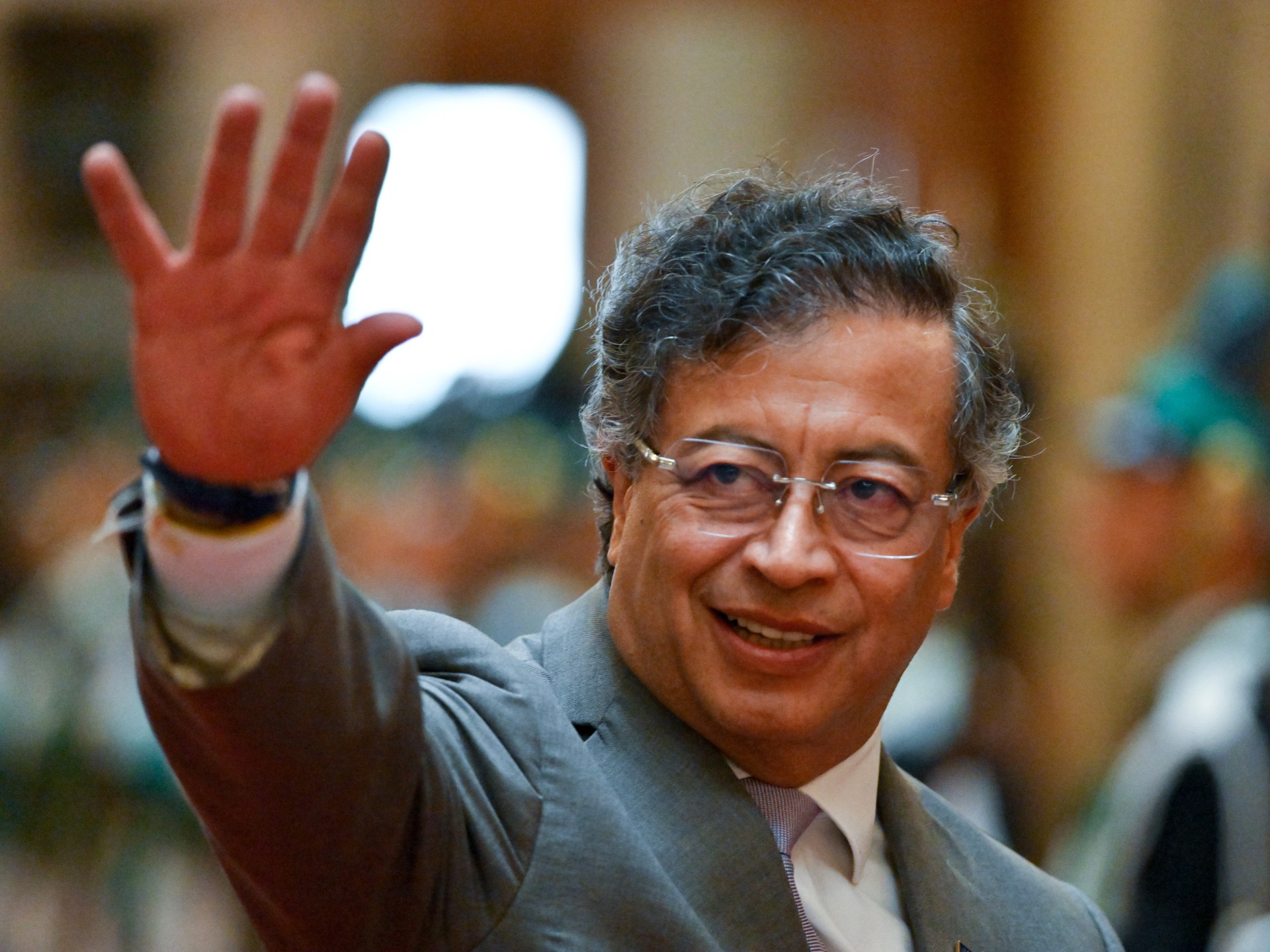
Colombia's President Gustavo Petro has faced pressure from the Trump administration to take more 'aggressive' steps against drug trafficking [File: Santiago Mazzarovich/AP Photo]Colombia's President Gustavo Petro has faced pressure from the Trump administration to take more 'aggressive' steps against drug trafficking [File: Santiago Mazzarovich/AP Photo]Questionable efficacyPetro is set to leave office in August. But his record of combatting drug trafficking in Colombia comes with high stakes.
Petro is the first left-wing president in Colombia's history, and his party, the Historic Pact, has to contend with his legacy as the May 31 presidential election approaches.
But many experts are dubious of the increase in cocaine seizures under Petro. They believe that the increase in seizures is actually a result of higher coca production in Colombia, which has reached record levels in recent years.
The United Nations Office on Drugs and Crime reported that 253,000 hectares (over 625,000 acres) of coca were planted in 2023, a 10-percent jump over the previous year.
A land mass that size is capable of producing more than 2,600 metric tonnes of cocaine.
"It shouldn't be that surprising, given the precipitous increase in coca crops over the last few years, that we would see a higher number of seizures,” said Weintraub.
The numbers are even less striking when considering the percentage of cocaine being seized.
In 2023, Colombia only intercepted about 28 percent of the cocaine estimated to be produced in the country, about 10 percentage points less than during the previous year.
Ultimately, a lot of cocaine still manages to evade authorities, according to Adam Isacson, director of the Washington Office on Latin America’s defence oversight programme.
Interdiction is a strategy that the Colombian Police and Navy have led for decades, involving the interception of drug shipments along rivers, roads and maritime routes.
The idea is that interdiction raises business costs for drug traffickers, which in turn drives up cocaine prices and reduces consumption.
But the problem with interdiction, Isacson explained, is that criminal organisations expect losses. They treat seizures as another expense in a wildly lucrative business.
"This is the frustration with the drug war,” said Isacson, pointing to the relatively small amount of cocaine seized.
"You're sort of reduced to just getting a certain amount, maybe driving prices up and making it harder for the narco traffickers, but never really stopping the business."
The Colombian Navy and the National Police did not respond to requests for comment about the efficacy of their efforts.
A coca field sits nestled in the forests on the outskirts of Puerto Asis, Colombia, on November 26, 2025 [Ivan Valencia/AP Photo]A coca field sits nestled in the forests on the outskirts of Puerto Asis, Colombia, on November 26, 2025 [Ivan Valencia/AP Photo]Turning down the pressureAnother concern is that Petro’s interdiction strategy has not achieved its goal of defusing US pressure, according to Rueda, the drug policy expert.
The strategy came to prominence in 2000, with the launch of Plan Colombia, a US-backed strategy aimed at fighting drug trafficking and armed groups.
At the time, interdiction became one of the most important metrics to gauge Colombia’s success in the US-led "war on drugs", said Rueda.
But under the Petro administration, the strategy has taken on renewed importance.
Part of Petro's aim is to signal to the international community that he is fulfilling Colombia's obligation to fight the drug trade, Rueda explained.
“He has always had in mind to pursue a reform but also to fulfil the country’s international commitments,” she said.
Petro has pledged to strengthen interdiction by improving radar technology, increasing patrols, enhancing intelligence and fostering greater international cooperation.
But his efforts have not necessarily been enough to lessen US pressure.
In the last month alone, media reports revealed that federal prosecutors in the US may be investigating Petro's actions in relation to narcotics trafficking.
And while Trump and Petro have grown closer in recent months, the US president has nevertheless threatened to intervene in Colombia should it fail to take more aggressive action against drug traffickers.
"They make cocaine, as you know, and they sell it right into the United States," Trump said in January, after the US attacked Venezuela. "So he [Petro] better wise up, or he’ll be next. He’ll be next soon."
A woman holds a placard that reads, 'The people are with you,' at a pro-government rally in Bogota, Colombia, on February 3 [Nathalia Angarita/Reuters]A woman holds a placard that reads, 'The people are with you,' at a pro-government rally in Bogota, Colombia, on February 3 [Nathalia Angarita/Reuters]Pushing back on WashingtonPetro, however, has highlighted his interdiction efforts as a means of refuting Trump's claims that he has allowed cocaine to flow unchecked.
The subject reportedly came up during a call between the two heads of state in January. Petro suggested that Trump had been unfamiliar with the amounts of cocaine Colombia has seized.
“The United States doesn’t know anything about that,” he told CBS News after the call.
At other times, Petro has leaned on his interdiction record to push back on Trump’s hardline anti-narcotics policy.
In September, Trump and his allies announced a campaign to bomb boats suspected of carrying drugs, arguing the strategy was more efficient than interdiction.
"Interdiction doesn’t work,” US Secretary of State Marco Rubio said. “What will stop them is when you blow them up, when you get rid of them.”
Since then, the US military has bombed 47 boats, killing at least 163 people. Petro has condemned the strikes as “murders”, arguing they violate due process and international law.
He has also held up his own interdiction strategy as a more effective model.
When Colombia and the US led a joint maritime operation in February that resulted in nearly 10 tonnes of cocaine seized, Petro touted the outcome as proof that anti-narcotics efforts need not be lethal.
“The Colombian Navy seized the submarine without killing anyone,” Petro said during a cabinet meeting.
Still, experts have pointed out that Petro has bent to US demands in other areas.
While Petro had pledged not to target coca farmers, he announced in December that security forces would deploy drones to spray crops with glyphosate, an herbicide.
That plan — to forcibly eradicate coca crops by air — faced strong local opposition due to concerns over the herbicide’s health and environmental impacts.
Rueda said the move, which has yet to be implemented, signalled that Petro, like many presidents before him, had yielded to US pressure.
“The US government always wins,” said Rueda. “It always has more power over us, and we end up having to give in — and so does Petro.”
Whether Petro’s decision holds weight with his electoral base is less certain. While protests initially erupted in coca-growing regions, they subsided after meetings with his administration.
Rueda suspects officials reassured protesters they wouldn’t carry out the fumigations, which could have cost Petro in the upcoming elections.
“Petro’s decision highlights his inconsistencies when it comes to the policy he put forward," Rueda said. "But in the end, the fumigations never happened, so the political impact likely wasn’t as significant as it could have been."