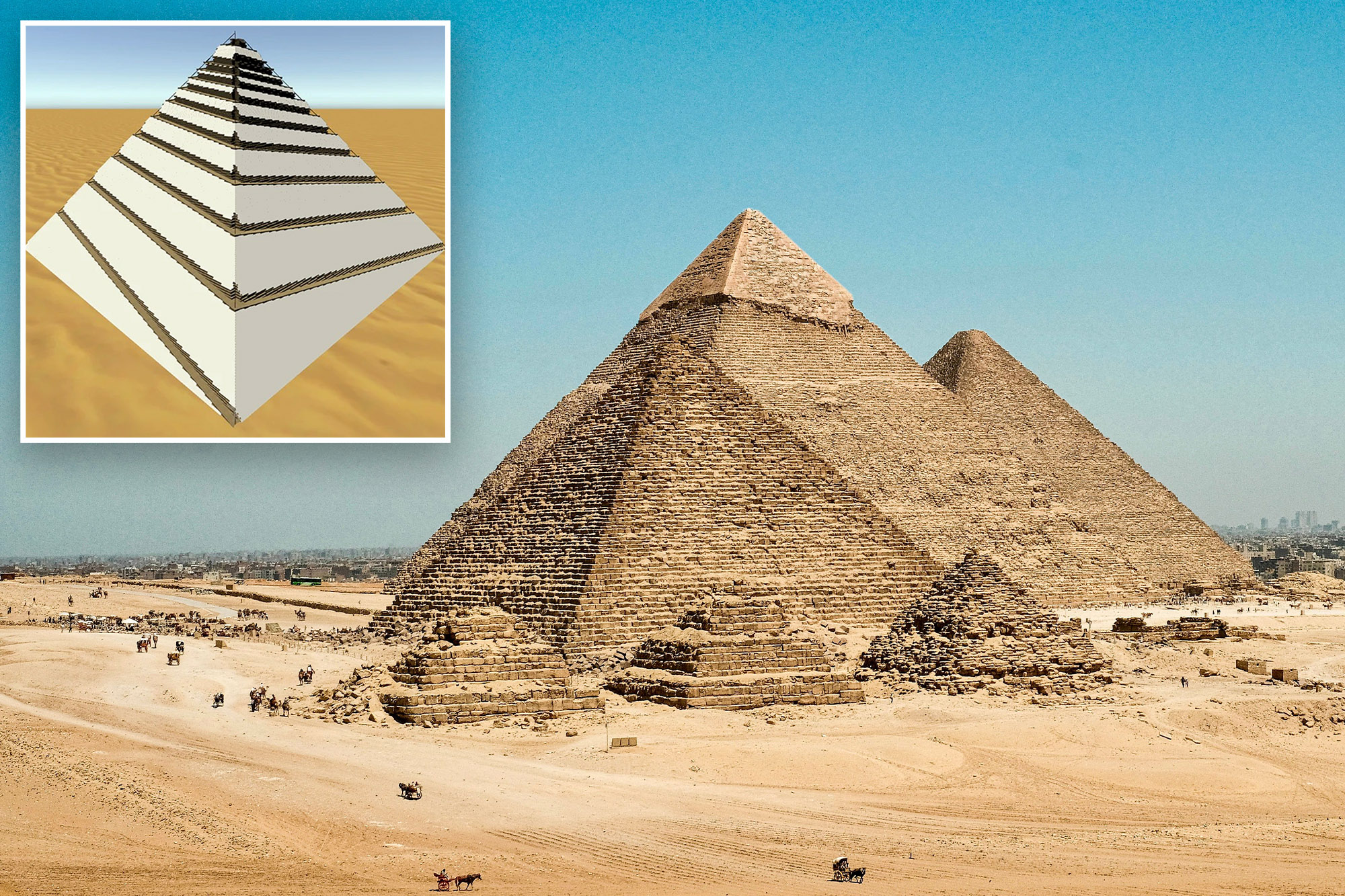
Have they finally solved the ancient Egyptians’ pyramid scheme?
Aliens might not have built the pyramids — but the ancient Egyptians might’ve had a pretty cool hack nonetheless. A cutting-edge 3D model suggests that the Great Pyramid of Giza was constructed using a special concealed ramp that might’ve allowed them to build it in less than two decades, per a groundbreaking study in Nature.
For decades, archaeologists have racked their brains over how ancient workers managed to construct Egypt’s largest pyramid, which measured 755 feet along each side of its base and stood about 481 feet tall.
They were specifically puzzled over how they managed to hoist the 2.3 million bricks, some of which weighed over 60 tons, without the aid of modern machinery and while maintaining the structure’s precise geometry.
If that achievement wasn’t monumental enough, the pyramids were reportedly built in under 30 years.
To shed light on this feat of human engineering, computer scientist Vicente Luis Rosell Roig tested the theory that an “adaptive, multi-ramp Integrated Edge-Ramp (IER) system could achieve the documented construction rate within the Old Kingdom’s material and technological constraints, and derive testable field predictions.”
Per Roig’s model, which simulated how the pyramid was built while remaining stable, materials were transported via a central ramp that was built into the pyramid’s outer structure rather than via a network of external ramps.
The workers left segments of the outer layers open so they could move materials and people along them on an ascending route.
As construction progressed, these gaps would be filled in, thereby removing visible traces of this ramp after the pyramid was finished.
While ramp theories had been floated before, Roig’s pyramid scheme was the first to account for how construction could progress sans creating obstacles or requiring additional building material.
Perhaps most importantly, this model fits the timeframe of the pyramid’s construction.
The ramp method indicated that blocks could have been set every four to six minutes, which, when extrapolated out, meant that the pyramid could have been completed between 14 and 21 years.
When factoring in quarrying, transport and worker breaks, this window was pushed to between 20 and 27 years, which still fell within the accepted estimates.
The proposed ramp theory also accounted for weight limits and unexplained gaps in the structure, which, per Roig’s model, were a deliberate part of the construction process.
They also factored in wear and tear in certain areas, attributing it to construction traffic and places where the structure was filled in.
All told, the model allowed for explaining how they managed to seemingly fast-track the pyramid’s construction without impacting the monument’s finished appearance.