Viktor Orban's crushing defeat in the April 12 election will have far-reaching consequences for Europe's political landscape — and especially for neighboring Czechia and Slovakia, which are run by his political allies.
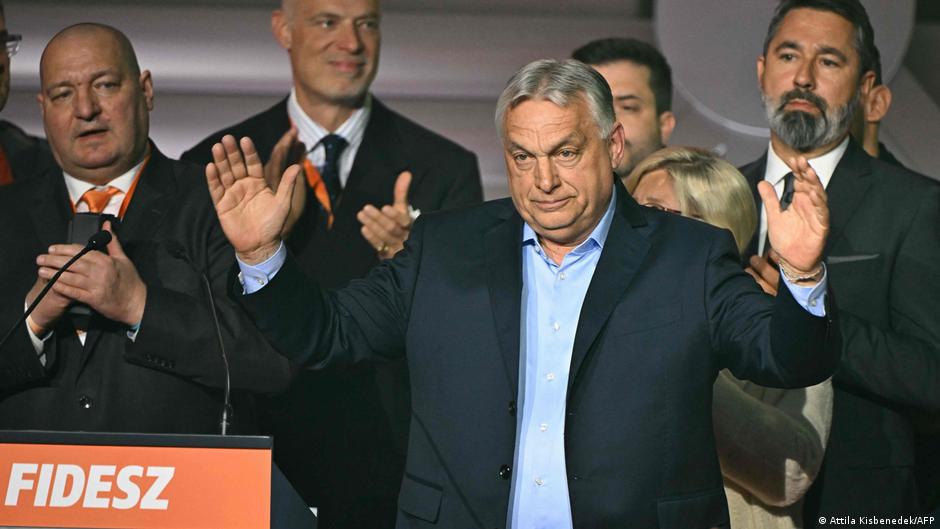
https://p.dw.com/p/5C986After 16 years in power, Viktor Orban conceded defeat in Hungary's parliamentary election on Sunday evening Image: Attila Kisbenedek/AFPAdvertisementAt the heart of Peter Magyar's victory in the Hungarian parliamentary election on April 12 was more than just anger at high-level corruption and economic hardship.
His win was also a repudiation of Viktor Orban's "illiberal democracy," a rejection of his drift away from the European mainstream and a warning not to stray too close to Moscow's orbit.
Two of his closest allies — prime ministers Robert Fico of Slovakia and Andrej Babis of Czechia — moved relatively swiftly to congratulate Magyar. But the congratulations were carefully worded and hardly gushing with praise.
"Facing such a strong opponent as Viktor Orban was never easy, yet he earned the trust of the majority of Hungarians and carries great hopes and expectations," Babis wrote on X. "He must not disappoint."
Change of guard in Hungary as Magyar ousts OrbanTo view this video please enable JavaScript, and consider upgrading to a web browser that supports HTML5 video
His Slovak counterpart, Fico, is known for releasing lengthy video messages and long press statements. This time, however, journalists received a terse email with three bullet points.
"I fully respect the decision of Hungarian voters," Fico said, adding he was ready for "intensive cooperation" with the new government in Budapest.
Fico said that Slovakia's priorities remained unchanged. These include reviving the Visegrad Group (an informal alliance between Czechia, Hungary, Poland and Slovakia), protecting shared energy interests and restoring Russian oil supplies to Slovakia and Hungary via the Druzhba pipeline.
Those supplies have been halted since January, after what Kyiv said were Russian drone and missile attacks on a section of the pipeline in Ukraine.
They might now be restored: Ukrainian President Volodymyr Zelenskyy said recently that repairs could begin in the next few weeks.
The carefully calibrated responses from Bratislava and Prague reflect both the scale of the political shift in Budapest and the uncertainty now facing Central Europe, where Orban had long been the central figure in a loose alliance of nationalist and populist leaders.
Orban, after all, co-founded the euroskeptic Patriots for Europe group alongside Babis in 2024.
For the Czech and Slovak leaders, the outcome of the election is not only symbolic, but potentially significant for their own political positioning.
"The biggest threat to Russia is a free, independent and democratic Ukraine," said Martin Poliacik, a former Slovak MP affiliated with the opposition Progressive Slovakia party.
"By extension, the biggest threat to Fico is a pro-European Hungary, because Slovaks would see that this is possible," Poliacik told DW.
Orban's defeat also deprives Fico of a key partner on the European stage. The Hungarian leader was seen as a interlocutor with both Moscow and Washington.
Some now believe Russia, at least, will turn its full attention to Slovakia.
Poliacik, however, expressed doubts that Fico could step into Orban's shoes as Putin's man in Europe.
"He's tired," he said, adding that Fico also lacked a strong team of capable and combative enforcers, unlike Orban.
The Slovak leader had threatened to block the EU's €90-billion loan for Kyiv if Orban was defeated, but some doubt he is really ready to defy the rest of the EU on his own.
But even with Orban out of power, analysts caution that the shift in Hungary may not lead to long-term stability.
"I think it's really hard to stay in power in Europe right now," said Poliacik. "Every status quo is hard to keep. It's like a swinging pendulum."
Andrej Babis returned to power in late 2025 at the head of a coalition including his ANO movement, the conservative Motorists for Themselves party and the far-right, anti-immigrant SPD.
Critics argue that the government is already seeking to reshape key elements of Czechia's liberal democratic system, including public media and the role of civil society, taking a leaf right out of the Orban playbook.
Supporters — as well as Babis himself — have rejected that characterization.
Analysts, meanwhile, point out that there are structural limits to what Babis can achieve in the Czech setting.
"Babis realized during his first term as prime minister that he can't control the country the way Orban can," said Czech political commentator Jindrich Sidlo.
"Orban governed much longer, had very different electoral results, there's no Senate [Czech upper house of parliament] in Hungary, and he was able to shape the electoral system to his advantage," he told DW.
"That's something Babis might have envied, but I think he now understands it's not realistic in the Czech Republic. Even changing the electoral law requires agreement between the Chamber and the Senate — you can't force it through," he said. "So, Babis is, in that sense, a much weaker version of Orban."
Beyond national politics, too, Orban's defeat could also affect a broader network of alliances built over the past decade.
Andras Lederer of the Hungarian Helsinki Committee argues that Hungary has played a central role in supporting like-minded actors across Europe.
"Orban has helped his allies politically and financially," he said.
That support has included funding for think tanks, advocacy groups and media initiatives aligned with a more sovereigntist vision of Europe, he told DW.
"With Orban out of power, this network will likely diminish significantly or even disappear," Lederer added.
The implications could also extend to regional cooperation formats such as the Visegrad Group.
The group has been largely dormant since Russia's full-scale invasion of Ukraine exposed deep divisions among its members.
Poland and Czechia have been strong supporters of Kyiv. Hungary under Orban and Slovakia under Fico have taken far more hostile positions.
Babis has signaled an interest in reviving Visegrad, and his government has already taken steps to improve relations with Bratislava.
But with no Orban, a new Hungarian leader looking to improve ties with Brussels and Poland seemingly uninterested in the Visegrad format — at least until the next election in Warsaw — the bloc appears more moribund than ever.