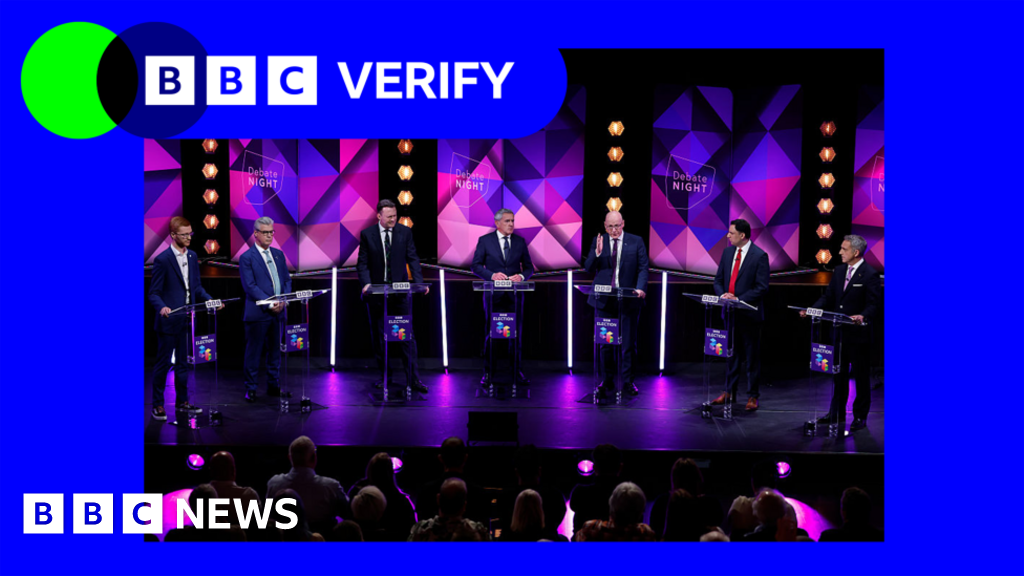
ShareSaveAdd as preferred on GoogleGetty ImagesThe leaders of six political parties took part in a special BBC debate ahead of the Scottish Parliament election.
The 90-minute programme saw the politicians make claims on the cost of living, immigration and the NHS among other issues.
SNP leader John Swinney said: "Labour came in, promised to reduce energy costs by £300, and by the summer energy costs for every household will be £700 higher than Labour promised they would be."
The £300 he is referring to was a prediction for how much bills could be lowered in 2030 if Labour managed, as promised, to generate almost all electricity from low carbon sources by that date - so it was not a promise for current prices.
When Labour came to power, the energy price cap for a typical family in Scotland, England and Wales paying by direct debit and on a dual fuel contract was £1,568 a year.
The current rate running up to the end of June is £1,641, so that's gone up by £73 a year.
Swinney referred to what is going to happen in the summer and we do not currently know what will happen to the price cap in July. Much will depend on what happens in Iran and the Strait of Hormuz.
Analysts at Cornwall Insight are currently predicting that the cap will go up to £1,861 in July, but of course that is highly uncertain.
If that happens then the cap will have gone up £293 since Labour came to office.
Swinney appears to have been referring to a previous Cornwall Insight prediction of an even higher energy price cap.
Scottish Conservative leader Russell Findlay made this claim as he made the case for more drilling for oil and gas in the North Sea.
The figure comes from a forecast made by the Energy Transition Institute (ETI) - a think-tank based at Robert Gordon University in Aberdeen.
It has predicted that 1,000 North Sea oil and gas jobs will be lost every month until 2030.
We spoke to the ETI about this figure and they said they expect 600 to 800 oil and gas jobs a month to go.
The remainder - they told BBC Verify - would be "indirect" job losses, meaning people that benefit from the oil and gas industry indirectly such as taxi drivers and hospitality workers.
In all, 70,000 jobs have been lost over the last decade according to a report, by the Scottish Affairs Committee.
That works out at 7,000 job losses a year or 583 a month.
Highlighting NHS waiting lists, Scottish Labour leader Anas Sarwar said: "How many people in Scotland are waiting more than two years? 5,000. In England, 10 times the size, it's 300."
Public Health Scotland data does not show the number of people waiting more than two years. Instead it shows the number of ongoing waits over two years.
The latest figures show there were 5,291 ongoing waits longer than 104 weeks for a new outpatient, inpatient or day‑case appointment or procedure, as of February.
In Scotland's data a single patient could be on multiple waiting lists.
Comparing waiting lists in Scotland with the rest of the UK is challenging due to differences in how the figures are recorded by the different health services.
Guidance from the Office for National Statistics (ONS) and Public Health Scotland (PHS) explicitly advises against comparing Scotland's hospital waiting times and lists with those in England and Wales.
Data for England measures those waiting to start treatment, while Scottish data is a count of those at different stages between diagnosis and treatment.
NHS England data shows that, at the end of January, there were 200 cases where patients had waited more than two years to start treatment.
Reform Scotland's leader Malcolm Offord claimed "people arriving immediately to Glasgow, the asylum city of the UK, are given priority, they are jumping the queue" for services like housing.
Glasgow could be referred to as the "asylum city" of the UK in that 3,686 asylum seekers were housed there by the Home Office in December 2025 - the largest number in any local authority in the UK.
Asylum seekers who require housing support are given accommodation by the Home Office.
Those who are granted leave to remain are given 42 days to move on from that accommodation but many end up applying to the local council as being homeless.
In Glasgow - which has a long-standing issue with housing - 44% of homelessness applications (1,685) between April and September 2025 involved people who had been granted leave to remain in the UK.
Scottish councils have a statutory duty to find housing for anyone who is "unintentionally homeless", which can take priority over those waiting for permanent accommodation.
So if a flat becomes available, the council may need to use it as a temporary home for a refugee family which has claimed homelessness, in line with its legal duties - as well as the fact this is far cheaper than putting them in a hotel.
However, another family which has been waiting months or years in a temporary home for permanent accommodation may see people moving into that flat and feel they have been overtaken.
Scottish Liberal Democrat leader Alex Cole-Hamilton claimed that "800,000 Scots are currently on an NHS waiting list".
However, Public Health Scotland (PHS) says there is no single database for all patient data so it is not possible to definitively say how many people are on a NHS waiting list in Scotland.
In the PHS waiting list data a single patient could be on multiple waiting lists.
It estimates that 578,804 individuals - around one in 10 of Scotland's population - were on at least one new outpatient, inpatient or day‑case waiting list as of 28 February.
This is a fall on the previous month's figures, when around one in nine were estimated to be on a waiting list.
This also doesn't include all types of waiting lists, such as those for key diagnostic tests.
The number of long waits of over a year for a planned hospital appointment or procedure in Scotland has been falling since July.
But a target to eradicate long waits by the end of March was missed by the Scottish government.
The Scottish Greens' Ross Greer called for more immigration "to meet the needs of this country" and claimed: "If every young person leaving school in Scotland today went to work in social care, there still wouldn't be enough care workers."
The party told BBC Verify that Greer was repeating a reference to a comment said to have been made by Donald Macaskill, boss of the private care home trade body Scottish Care, about the scale of vacancies.
The number of Scottish school leavers in 2024-25 was 55,801 pupils.
An annual vacancies survey of care providers is jointly published by the Scottish Social Services Council (SSSC) and watchdog the Care Inspectorate.
The latest available one is for 2024 and suggests 44% of registered care services reported having staff vacancies, and that in nine of the 32 local authority areas, 50% or more services reported vacancies.
But the survey, which is published more than a year after it is gathered, does not provide numbers of social care vacancies.
The report does state the vacancies are 6.4% of the total workforce on a whole-time equivalent basis.
Census and market data suggest the number of people working in the social care sector in 2024 was between 150,000 and 200,000.
This implies that the number of school leavers would be more than enough to fill those vacancies.