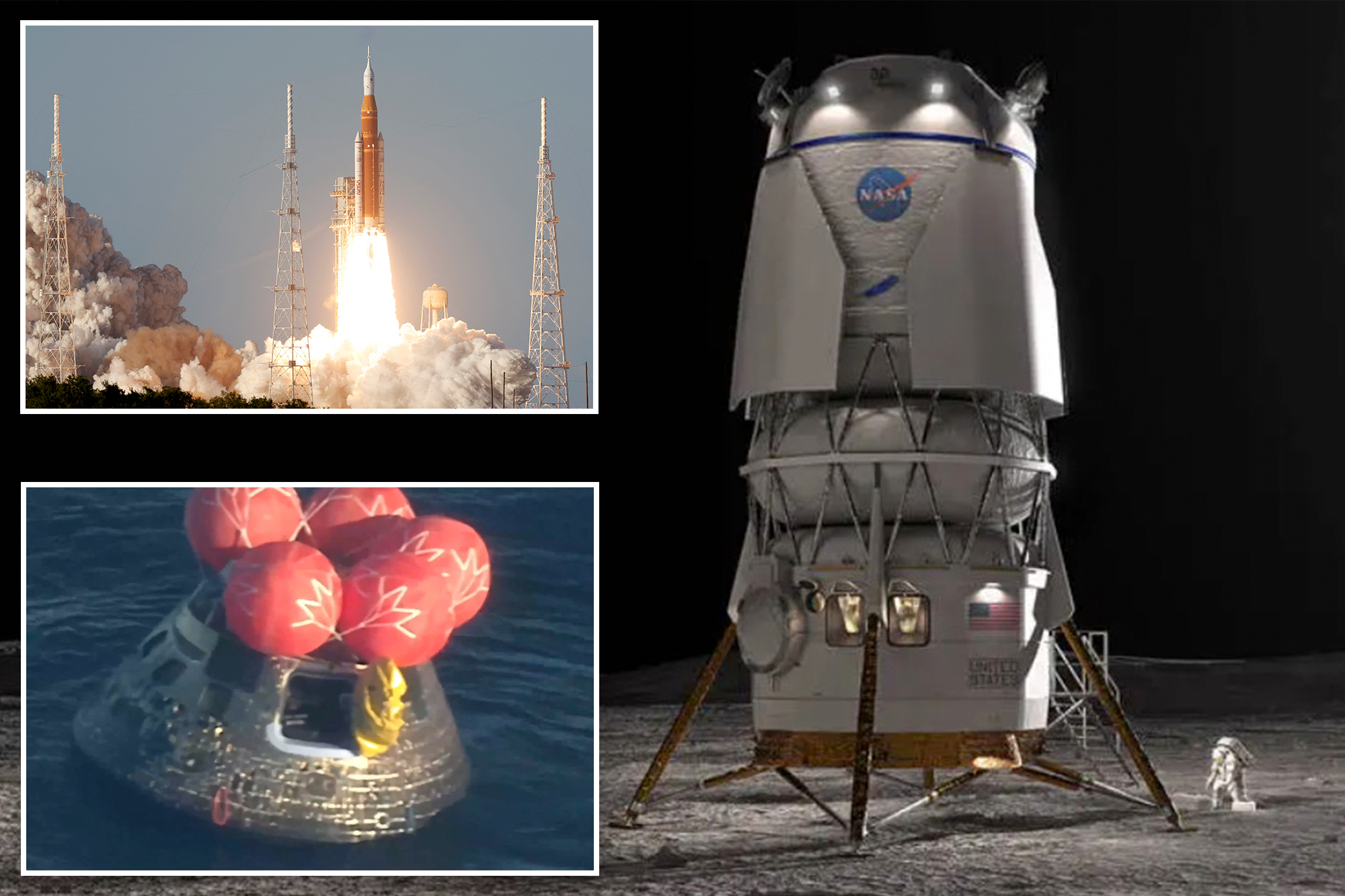
NASA plans to land astronauts on the moon within two years after Artemis II’s successful return to Earth on Friday — with the program’s final test flight, Artemis III, already scheduled for next year.
Artemis III is expected to launch sometime in mid-2027, with the mission remaining in Earth’s orbit and testing out flight and rendezvous procedures with new lunar landers being designed by Jeff Bezos’ Blue Origin and Elon Musk’s SpaceX.
As in the Apollo days, the crew capsule will have to link up with a lunar lander in space while flying to the moon for the landing — a delicate procedure that takes careful planning and practice.
If everything goes well with Artemis III’s tests, Artemis IV is scheduled to have humans walking on the moon again by 2028, with a landing on the lunar south pole.
But despite the great accomplishments of Artemis II’s 10-day flight around the moon and back, Artemis III’s success is far from guaranteed — especially since the lunar landers still having a long way to go before they’re ready for a mission in Earth’s orbit, let alone days on the moon.
The SpaceX lander — a massive re-usable rocket known as the “Starship” — has only had two fully successful flights out of 11 tests, and neither of those reached orbit, according to Space.com.
That lander has also never refueled in space — as it will need to do for a moon mission — and hasn’t flown with the life-support systems required to keep astronauts alive on the moon.
Blue Origin’s lander, “Blue Moon,” hasn’t been to space at all.
It also remains unclear which lander will be a part of the Artemis IV landing. Schedules from 2025 called for SpaceX’s lander to make the first one and Blue Origin’s to make one after that, but the final call will likely be determined by which one performs better during Artemis III.
Despite such uncertainties, NASA administrator Jared Isaacman said at a Saturday press conference with the Artemis II astronauts that Artemis III was moving full steam ahead.
“There are a lot of things, based on the information we have available today, from feedback from our vendors, that we know are achievable,” Isaacman said, adding that NASA had “the first senior-level Artemis III mission design discussion” just a day after Artemis II splashed down.
Artemis II mirrored 1968’s Apollo 8 with its test of the mission’s rocket and life support systems, while Artemis III will follow Apollo 9’s 1969 test of the lunar landing system in Earth’s orbit.
Apollo 9 spent 10 days orbiting Earth and was the first mission to fly a lunar lander and rendezvous with it — just as Artemis III will do.
As Apollo 9’s success opened the door for Apollo 11’s launch just months later, Artemis III is currently scheduled to determine whether Artemis IV will be able to land on the moon in 2028.
Apollo 9 was followed by a full landing dress-rehearsal — Apollo 10 — which sent a lunar lander within miles of moon’s surface, but so far no such mission is scheduled for Artemis.
Artemis III was initially supposed to be the landing mission, but NASA announced in February that it would remain in Earth’s orbit to test the landing systems.
The moon-landing mission’s crew has not yet been revealed, though it has likely already been selected.
Plans have already been announced for a long-term moon base, which would be part of the goal of a manned Mars landing in the mid-2030s.
“This is just the beginning,” Isaacman said Friday after the Artemis II splashdown. “We are going to get back into doing this with frequency, sending missions to the moon, until we land on it in 2028 and start building our base.”
The Artemis II crew was also already cheering on future missions during the triumphant Saturday press conference.
“It is time to go, and be ready,” commander Reid Wiseman said.
“It takes courage, it takes determination, and you all are freakin’ goin’,” he said. “We’re going to be standing there supporting you every single step of the way in every possible way.”