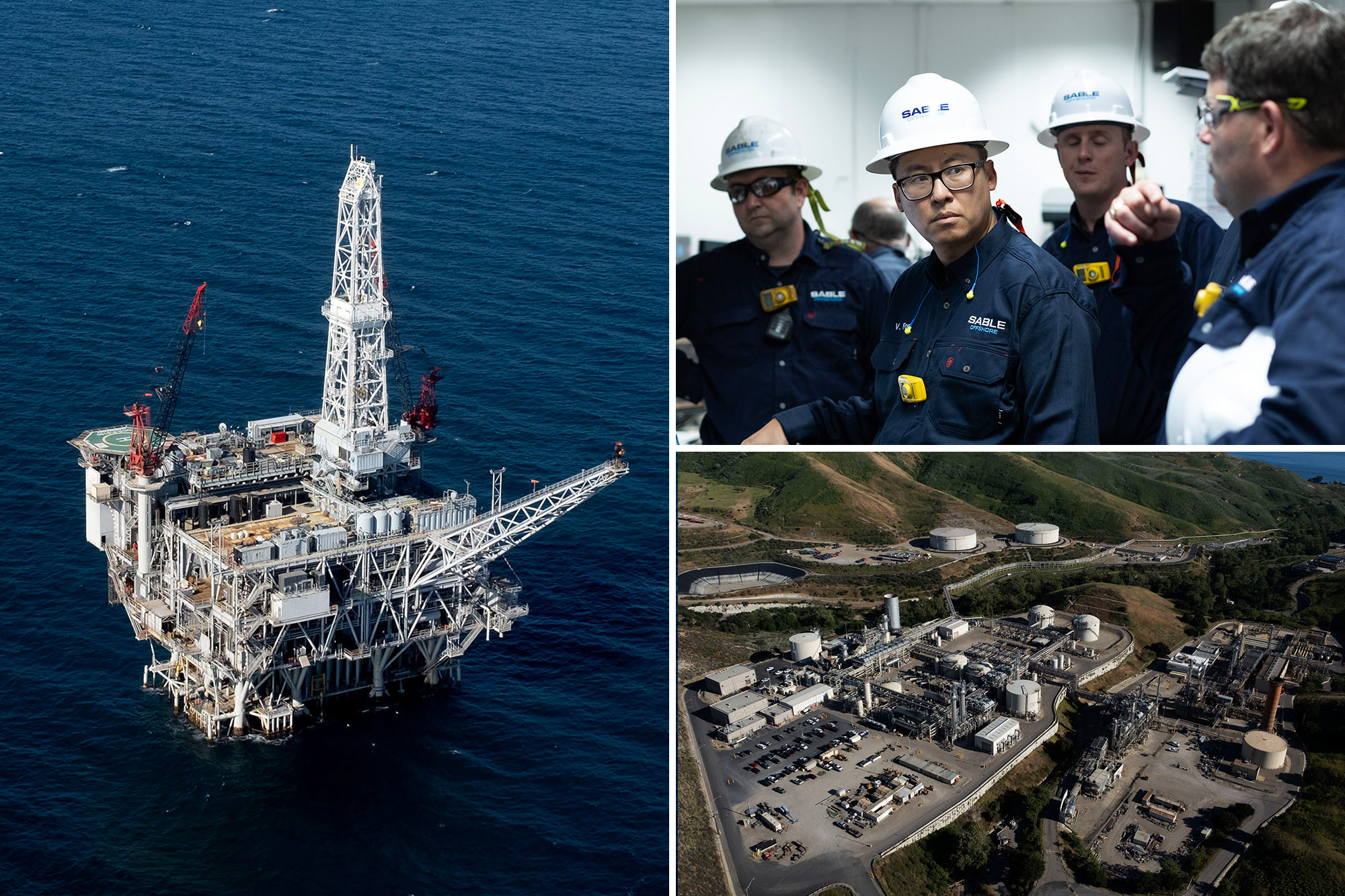
As Californians face soaring prices at the gas pump, the newly re-opened Santa Ynez Refinery is now churning out 60,000 barrels of oil a day.
During an exclusive visit to the newly reopened platforms, where oil is once again flowing through onshore pipelines in Santa Barbara following a Trump executive order, The California Post sat down with the facility’s executive, who offered a pointed but measured response to the Democrat outcry at the decision, which is still facing legal action to shut it down again.
“We have a perfect, safe restart of the pipeline,” J. Caldwell Flores, president and CEO of Sable Offshore Corp., told The Post.
“We recognize we’re providing a necessary service to California and the country as a whole.”
About 100 new jobs have already been created, and an additional 200 are expected once all three platforms are fully operational, according to Sable.
It’s also projected to generate an estimated $5 million in annual tax revenue, which the state certainly needs.
The helicopter tour was a brief ten-minute flight from the Las Flores Canyon onshore base to the Harmony platform.
On board were two pilots, six passengers, and a Post journalist.
The platform typically hosts about 35 crew members at a time on two-week shifts. There are three platforms – Hondo, Harmony, and Heritage – all located in federal waters off the Santa Barbara coast.
U.S. Rep. Vince Fong, whose district includes some of the state’s richest oil reserves, was also part of the tour.
Fong was far more scathing in his critique of Gov. Gavin Newsom’s oil policies, and hailed the refinery as a critical step toward lowering fuel costs.
“It’s American oil, on American soil,” Fong said, as he watched the platforms in action.
Sable’s nearly 60,000 barrels per day may be small compared to U.S. consumption of about 20 million barrels, but it’s significant for California.
The state’s oil production has fallen by about 75% since its peak in the 1980s.
The Santa Ynez pipeline restart “marks a 15% increase in California’s in-state oil production, which will replace almost 1.5 million barrels of foreign crude oil each month,” according to the Department of Energy.
“We need more production. Look at California’s energy crisis right now – it’s because of bad policies,” Fong said, taking aim at Newsom.
“Gavin Newsom has restricted domestic supply of oil and gas. He’s made California more dependent on foreign oil. He’s imposed taxes and fees and mandates that make California gasoline more expensive.”
California has the highest gas tax in the U.S. at 61.2 cents per gallon for the state excise tax.
When including federal taxes, sales taxes, and fees, the burden on California drivers is about 90 cents per gallon.
Flores agreed, adding that the production from the refinery will fill a much-needed gap and ease prices.
“There will be some impact on that,” Flores said. “It’s not perfect to quantify beyond the fact that we will be responsible for $6 million worth of fuel for cars each month. That’s probably the best way to look at it.”
Sable’s infrastructure in Santa Barbara had been closed following the 2015 Refugio Beach oil spill, caused by a ruptured, heavily corroded pipeline that released over 120,000 gallons of crude oil.
The operation was shuttered for over a decade due to environmental damage, legal injunctions, and failure to obtain necessary safety permits before recently attempting to resume operations under federal emergency orders.
In May 2025, oil from six Platform Harmony wells began flowing to Las Flores Canyon for storage pending approval to restart the onshore pipeline.
On March 13, Trump issued an executive order directing use of the Defense Production Act to authorize Sable Offshore to resume operations in the Santa Barbara Channel, citing national security and energy supply concerns.
On March 14, hydrocarbon transport resumed from Las Flores Canyon to Pentland, and oil sales began on March 29.
“California is really stuck on its own, and that’s where we land in critical infrastructure from a national security standpoint, because there are about 50 air bases, naval bases, and army bases on the West Coast that are supplied directly by California domestic production,” Flores said.
“Being dependent on foreign imports that may not show up, as we’ve seen in the last month, is not a good national security posture at all.”
“For every barrel produced, it’s replacing a barrel of oil imported into California from a foreign country,” Fong added.
“Gavin Newsom has destroyed production in Southern California.”
In response, a spokesperson for Newsom offered: “For the amount of money Congressman Fong accepts from the fossil fuel industry, it’s surprising that he doesn’t seem to understand basic economics.
“Since oil trades at a worldwide price, American crude sells to the highest bidder, not at a discount for American consumers.”
Phillips 66 and Valero are winding down operations in California. The Bakersfield Phillips 66 refinery closed in December 2025, and Benicia’s Valero facility is set to shut end of this month.
Critics say Newsom’s strict environmental rules – including a 2023 refinery price-cap law – have accelerated closures and boosted reliance on imported oil.
“Gavin Newsom needs to look in the mirror when we talk about the energy crisis in California,” Fong said. “If he had any common sense, he would have allowed Sable to move forward without the executive order, without the use of the Defense Production Act. But because of his incompetence, President Trump had to intervene and take action.”
The governor has maintained that rising gas prices are due to Trump’s war-related actions in Iran, which blocked the Strait of Hormuz, a key route for the world’s oil supply. California was one of the worst-hit states as a result.
The California Post has reached out to Newsom’s office for comment on in-state oil production decline during his tenure.