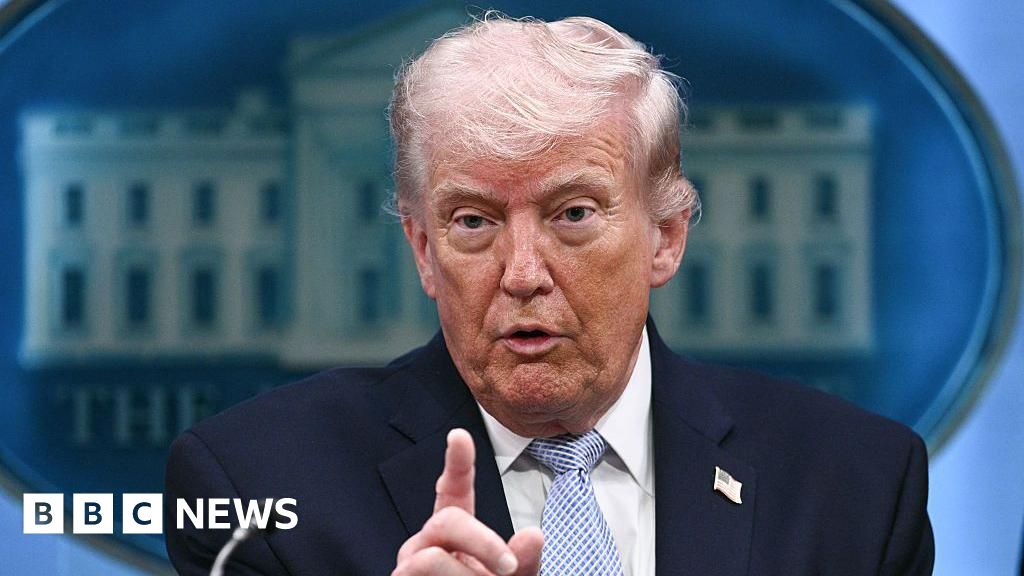
ShareSaveAdd as preferred on GoogleGeorge WrightandRachel Clun,Business reporterAFP via Getty ImagesUS President Donald Trump says that the US is going to start blockading the Strait of Hormuz after talks with Iran failed to reach a deal to end the war.
Iran has in effect closed the strait, a vital shipping route through which roughly 20% of the world's oil and gas passes, as a key element of its war strategy.
Trump said direct talks with Iran in Pakistan failed because "Iran is unwilling to give up its nuclear ambitions".
Iran's foreign ministry spokesman criticised the US's "excessive demands and unlawful requests". Iran's parliamentary speaker Mohammad Bagher Ghalibaf, who led Iran's negotiating team, wrote that "the opposing side ultimately failed to gain the trust of the Iranian delegation in this round of negotiations".
Posting to Truth Social on Sunday, Trump said that the US is going to start "BLOCKADING any and all Ships trying to enter, or leave, the Strait of Hormuz".
"I have also instructed our Navy to seek and interdict every vessel in International Waters that has paid a toll to Iran. No one who pays an illegal toll will have safe passage on the high seas," Trump said.
He added that the US will also begin destroying the mines he said Iran has laid in the strait.
"Any Iranian who fires at us, or at peaceful vessels, will be BLOWN TO HELL!" he continued.
Trump said that "at some point" an agreement on free passage will be reached, but "Iran has not allowed that to happen by merely saying, 'There may be a mine out there somewhere,' that nobody knows about but them".
He added in another post that "Iran promised to open the Strait of Hormuz, and they knowingly failed to do so."
"As they promised, they better begin the process of getting this INTERNATIONAL WATERWAY OPEN AND FAST!" he said.
Trump wrote that "effective immediately", the US Navy would begin the process of blockading the strait.
The US Navy Commander's handbook on naval operations law from 2022 defines a blockade as a "belligerent operation to prevent vessels and/or aircraft of all States, enemy and neutral, from entering or exiting specified ports, airfields, or coastal areas belonging to, occupied by, or under the control of an enemy State".
Later on Sunday, Trump told Fox News the blockade "will take a little while, but will be effective pretty soon" and described it as an "all or none" policy.
Trump said that other countries will be involved in blockading the strait, but did not say which ones. The BBC understands that the UK will not be involved in the blockade.
Trump also told Fox News that Nato has offered to help "clean out" the strait.
"It won't take long to clean it out, so we're gonna clean out the strait," he said, adding that he thinks it will be free to use again "in not too long a distance".
Trump said the US would bring in minesweepers, and that the UK - a member of Nato - will too.
"I understand the UK and a couple of other countries are sending minesweepers," he said.
Prime Minister Keir Starmer has previously said British military mine-hunting systems are already in the region.
A UK Government spokesperson said: "We continue to support freedom of navigation and the opening of the Strait of Hormuz, which is urgently needed to support the global economy and the cost of living back home."
The spokesperson said the Strait of Hormuz "must not be subject to tolling".
"We are urgently working with France and other partners to put together a wide coalition to protect freedom of navigation."
The strait's geography has allowed Iran to use it as leverage throughout this war, selectively preventing vessels from passing through the narrow waterway and spiking oil prices in the process.
Tehran has been charging huge sums of money for some vessels to pass through.
By closing off the strait, Trump could cut off a significant source of revenue for the Iranian government - although this could risk sending oil and gas prices even higher.
He told Fox News that "we're not going to let Iran make money on selling oil to people that they like and not people that they don't like", saying the goal instead was letting "all or nothing" pass through the crucial shipping channel.
Trump's threat to blockade the strait will only affect a small handful of vessels that are still navigating the waterway, shipping expert Lars Jensen says.
"If this is actually done by the Americans, it will halt a very tiny trickle of vessels. In the greater scheme of things, it doesn't really change anything," he says.
Jensen, chief executive of Vespucci Maritime, says Trump's threat of preventing safe passage for any ships paying tolls to Iran would also have little impact, as any company doing so would already face sanctions for paying the regime.
"First of all, there's very few ships that pass. There's even fewer of those that pay, and those that pay will already be subject to American sanctions," he says.
Most shipping companies will continue to wait and see if there is a tentative peace agreement and whether that might hold, Jensen says, and if that occurs, a slow ramping up of shipping may resume.
A two-week ceasefire in the US-Israel war with Iran agreed on 7 April included a condition that "safe passage" through the narrow waterway would be guaranteed.
However, vessels in the area then received messages that they would be "targeted and destroyed" if they attempted to cross the strait without permission, and only a few ships made the journey in the first three days after the ceasefire was announced.
By 17:00 BST on 10 April, only 19 ships had been tracked passing through the strait since the ceasefire, according to BBC Verify analysis of ship-tracking data from MarineTraffic.
Of these, four were tankers carrying either oil, gas or chemicals. The rest are listed as bulk carriers or container ships of various types.
Other ships have made the journey without broadcasting their location.
That compares to an average of 138 ships passing through the strait each day before the conflict started on 28 February.