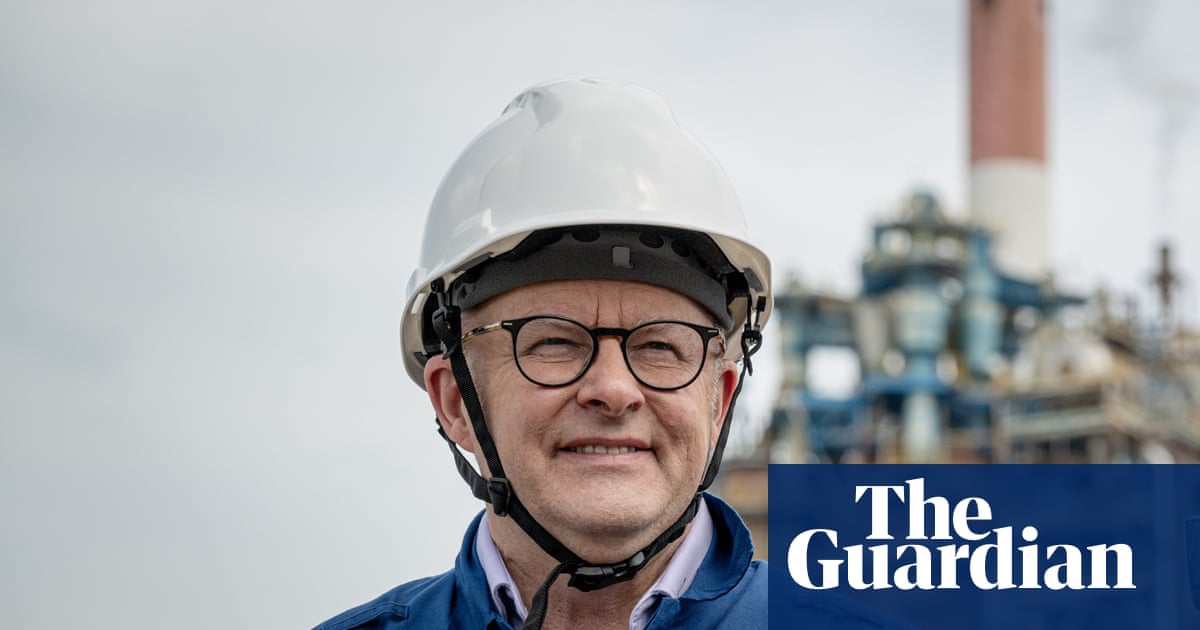
Anthony Albanese made the comments on the way home from an official visit to Singapore. The PM is pictured visiting Singapore’s oil and energy facilities on Jurong Island. Photograph: Tom White/AAPView image in fullscreenAnthony Albanese made the comments on the way home from an official visit to Singapore. The PM is pictured visiting Singapore’s oil and energy facilities on Jurong Island. Photograph: Tom White/AAPAnthony Albanese urges Israel to stop Lebanon attacks that intensified during Middle East ceasefirePM tells Guardian Australia Hezbollah should cease reprisals and confirms Australia’s military surveillance aircraft will remain in region
Get our breaking news email, free app or daily news podcast
Australia’s prime minister, Anthony Albanese, has urged Israel to stop its attacks on Lebanon and raised concern over its intensified military campaign on Beirut and the country’s south after the ceasefire in the Middle East.
Albanese also called on Hezbollah to cease attacks on Israel, reiterating his government’s belief that the Middle East ceasefire must include Lebanon. The prime minister also confirmed Australia’s military surveillance aircraft would remain in the region for at least another month beyond its initial deployment.
“We’ve made our position clear, which is that the conflict there should cease. Hezbollah should stop any attacks on Israel, and Israel should stop its attacks on Lebanon,” Albanese told Guardian Australia in an interview on the way home from an official visit to Singapore.
“Israel stepped up the attacks after the ceasefire, including into very built-up areas.”
Israel on Wednesday carried out its largest attack on Lebanon since its war with Hezbollah began, killing at least 254 people and wounding 837, an assault that prompted Iranian officials to warn Tehran could withdraw from the ceasefire agreed with the US this week.
On Sunday, Australia’s foreign minister, Penny Wong, said it was “disappointing” that US and Iran peace talks had failed, saying it must be a priority to continue the ceasefire and keep discussions open. Wong said any escalation in conflict would have “an even greater human cost and further impact the global economy”.
Returning from Singapore, where he and his counterpart there, Lawrence Wong, signed an agreement to keep supplies of fuel and liquid natural gas flowing between the two countries, Albanese spoke positively about the “middle powers” forging new areas of cooperation amid tumultuous global geopolitical circumstances.
He called the meeting a “win-win” for both countries, with leaders agreeing to a legally binding addendum to their free trade agreement on essential supplies such as energy.
“Countries that are not participants in the current conflict recognise the need to work together … It’s all part of a changing structure in the world and in international relationships, where middle powers and economies and countries are working together in mutual interest,” Albanese said.
Read moreHe said he saw “parallels” with a recent increase in engagement with Canada, including the visit to Australia by its prime minister, Mark Carney, and the finalisation of a free trade agreement with the European Union.
Increasing focus on the “middle powers” concept has come amid global tensions precipitated by tensions between the United States, China, Russia and other major powers; Carney’s visit saw him refer to Australia and Canada as “strategic cousins”, and he warned of the “global architecture now breaking down from consecutive crises”.
Albanese will this week travel to Brunei and Malaysia, which are other key suppliers of Australian fuel, as well as urea for fertiliser.
Lawrence Wong told Albanese on Thursday that Singapore would continue supplying refined fuels to Australia “as long as upstream supplies continue”. Albanese called that guarantee “very positive”, saying Wong was “very confident” fuel supplies wouldn’t be interrupted.
“He was referring to the fact that we do live in an uncertain world, and [in] that context, people will always – if they’re being honest with people – put [in] that caveat,” Albanese said when Guardian Australia asked about Wong’s comment on upstream supply.
“But he was very confident, because Singapore has been able to diversify where it’s getting its inputs: from West Africa, from the Americas; that’s made a difference.
“We live in uncertain times. One of the things that I’ve done – going back to my statement to the nation – was to say we’re at this point now.
“Today, diesel stocks have gone up by two days, fuel has continued to come in, nothing has not arrived that was due to arrive. There’s been a spike in demand that has led to some shortages in some areas, but we have supplies continuing to come.”
Read morePointing to figures released on Saturday, Albanese said 57 fuel tankers were on their way to Australia, and that there were 4.1bn litres of fuel contracted to arrive in the next four weeks, an increase from the government’s last update.
“That continues, but we’re also stating … that the world is a very volatile place,” he said.
Albanese repeated his calls for a ceasefire in the Middle East and his desire to see the strait of Hormuz reopened to shipping. On Thursday, he revealed that an Australia Wedgetail surveillance aircraft – which was deployed to the United Arab Emirates for an initial four weeks – would have its mission extended.
Albanese confirmed on Saturday it would be deployed for an additional four weeks, but reiterated: “They’re not playing a role in the conflict beyond defending our allies.”
When asked why the deployment had been extended, he said it was “just common sense” since the initial four weeks had concluded. “[We’re] just putting in place contingencies.”