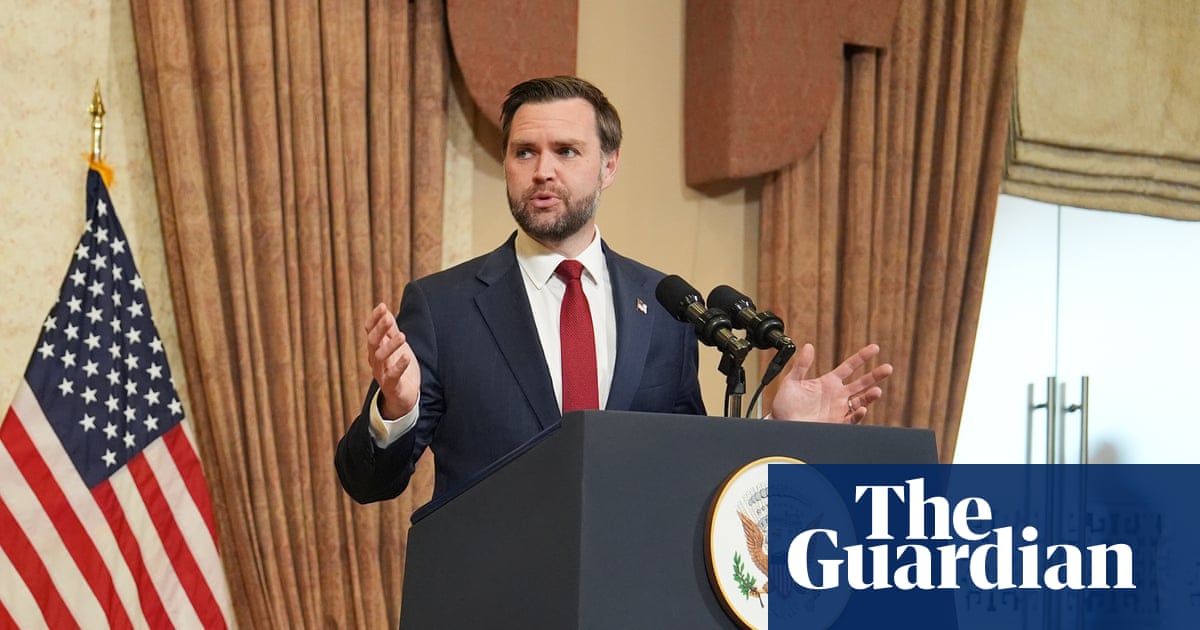
JD Vance briefs media on Sunday after his meeting with Iranian and Pakistani officials. Photograph: Jacquelyn Martin/APView image in fullscreenJD Vance briefs media on Sunday after his meeting with Iranian and Pakistani officials. Photograph: Jacquelyn Martin/APCollapse of US-Iran talks heightens fears of prolonged energy shockOil prices and borrowing costs are expected to rise this week as tankers remain stranded in Persian gulf
The failure of the US and Iran to reach a peace deal after marathon negotiations has put markets on alert for further oil and gas price rises.
With large numbers of oil tankers remaining stuck in the Gulf, the US vice-president, JD Vance, blamed the collapse of the talks on Tehran’s refusal to abandon its nuclear weapons programme, while Iranian sources hit back at “excessive” demands from Washington.
Vance, who left Islamabad on Sunday morning after 21 hours of talks with Iranian officials in the Pakistani capital, said his team had been very clear on its red lines as hopes faded of a quick end to the war that began on 28 February with US and Israeli airstrikes on Tehran.
Governments have grown concerned at the long-term impact of rising inflation following a jump in oil and gas prices. Central banks have indicated that previous expectations of cuts in interest rates would need to be re-examined. Ireland has suffered social unrest as protesters took to the streets of Dublin last week and throughout the weekend about the rising the cost of living.
Mohamed El-Erian, an adviser to the German insurer Allianz and a former president of Queens’ College, University of Cambridge, said uncertainty would continue to dominate assessments of the financial impact from the war.
“While both parties stressed that a quick agreement was too much to hope for given the issues involved, neither readily indicated the next step – something the whole world will be focused on, especially as Israel’s attacks on Lebanon continued throughout the weekend,” he said.
El-Erian added: “Absent a swift resumption of negotiations, the immediate reaction of financial markets when they open for the trading week will be to push oil prices higher and borrowing costs higher. “The extent of the sell-off in the stock market, where investors have been consistently more optimistic than in other asset classes, will depend on whether they see a viable path to further diplomacy. “For the UK, all this translates into another hit to the cost of living and less flexibility for both fiscal and monetary policy responses.”
Over the weekend, Israel continued to strike southern Lebanon, amid condemnation of its attacks on Beirut on Thursday that killed hundreds of civilians and injured many more.
The week had started with Donald Trump’s apocalyptic threat to Iran that “a whole civilisation will die tonight, never to be brought back again” by bombing the country’s power stations and bridges. But he pulled back from the brink on Wednesday after a two-week truce was hastily agreed with Tehran, brokered by Pakistan, including the reopening of the strait of Hormuz.
Read moreOil prices fluctuated wildly, and fell below $100 a barrel on Wednesday amid relief about the truce. They ended the week lower, with Brent crude at $94.26 a barrel, compared with a peak of $119.45 during the war, and about $72 a barrel before the conflict began. West Texas Intermediate crude ended the week at $95.63 a barrel.
Global stock markets rebounded after the temporary ceasefire was announced. By the end of the week, the S&P 500, a measure of top US companies, was close to its level before the US-Israeli attacks on Iran began, and flat on the year.
Saudi Arabia attempted to head off a possible increase in oil prices by announcing that its east-west oil pipeline and other facilities had been restored following attacks by Iran on infrastructure across the Gulf.
Citing an energy ministry statement, the official Saudi Press Agency reported that the attacks had led to a “loss of approximately 700,000 barrels per day of pumping capacity through the east-west pipeline” and work was under way to restore full production capacity at the kingdom’s Khurais oilfield.
Wei Yao, an economist at Societé Générale, said: “Even if the ceasefire frays, the more likely near-term outcome, in our view, is messy non-compliance and low-level retaliation near-term, rather than an immediate return to full-blown escalation. For the global economy, this means lasting disruptions, as oil and LNG [liquefied natural gas] flows would normalise only slowly.”
The war’s impact on the global economy will dominate the International Monetary Fund and World Bank’s spring meetings in Washington, which start on Monday. The IMF’s managing director, Kristalina Georgieva, has indicated that the fund will present three scenarios this week, all of which predict lower economic growth and higher inflation. The IMF is also expected to highlight the impact on vulnerable economies.